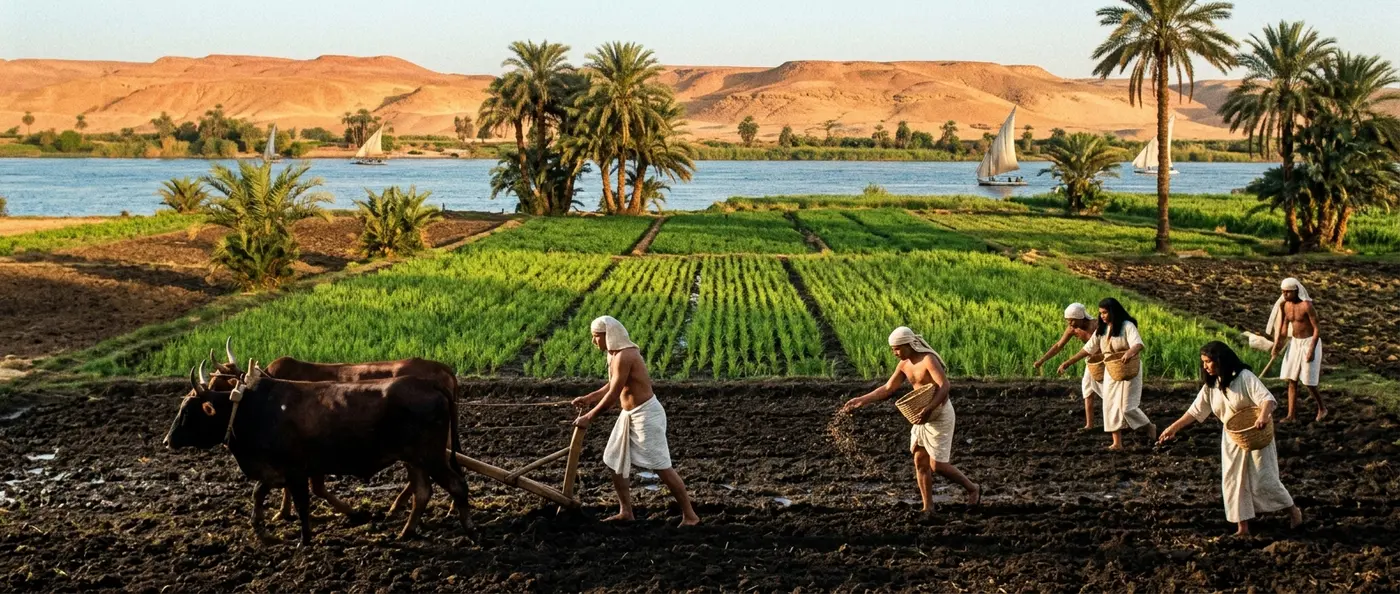
Every year for thousands of years, ancient Egyptians waited anxiously for the same phenomenon: the flooding of the Nile. The survival of an entire civilization depended on this annual overflow. Without the Nile and the fertile mud it left on its banks, Egypt would have been nothing more than a vast desert.
📖 Read more: Cleopatra: The Last Pharaoh of Egypt
🌊 The Nile: Egypt's Lifeline
Ancient Egypt developed in one of the planet's most inhospitable environments. Ninety-six percent of the country's total area was desert. Only 3% of the land was arable, yet this small percentage fed one of history's greatest civilizations.
The secret lay in the Nile. Every summer, from July to October, the river flooded. Its waters covered the valley, and when they receded, they left behind a layer of fertile silt. This natural fertilization renewed the soil each year, allowing continuous cultivation without exhausting the land.
Egyptians were so deeply aware of the Nile's importance that they named their three seasons based on the river's behavior: akhet (the flood), peret (the season when land emerged from the waters), and shomu (the dry period).
🌾 The Evolution of Nile Valley Agriculture
Agriculture in Egypt didn't begin immediately. Archaeological evidence shows intensive agricultural exploitation started when domesticated animals were introduced from Southwest Asia. In the first quarter of the 7th millennium BCE, villages in the Al-Fayyum region already had sheep, goats, and pigs.
Early farmers cultivated emmer wheat, barley, cotton, and flax. Flax was particularly important—it was woven into linen fabric used for clothing and ritual purposes. At Al-Badari in Upper Egypt, dead domesticated animals were wrapped in linen and buried near villages, suggesting possible religious connections to agriculture.
By the time of the predynastic Amratian culture, around 3550 BCE, agriculture had spread to the alluvial plains of the Nile valley. Agricultural development was accompanied by increased wealth and the emergence of more hierarchical social structures.
📖 Read more: How Ancient Egyptians Moved 100-Ton Stone Blocks
⚙️ Irrigation Technology and Organization
The success of Egyptian agriculture was based on controlling the Nile's waters. As early as King Menes' reign, around 2875 BCE, large dams were constructed to control the river and provide water for irrigation.
A thousand years later, floodwaters were diverted through a 12-mile canal to Lake Moeris. After the flood receded, water from the lake was gradually released for irrigation. This system allowed cultivation of land that would otherwise remain dry.
Basin System
Land was divided into basins that filled with water during floods. Water remained there for 40-60 days, saturating the soil.
Shaduf
A lever with a bucket for lifting water from the Nile to higher levels. An invention still used today.
Archimedes' Screw
Though invented later, it became a key irrigation tool in Egypt for continuous water lifting.
🏛️ The Bureaucracy of Agriculture
By the beginning of the 4th Dynasty, around 2525 BCE, agriculture had become an extremely organized enterprise. Unlike Mesopotamia where large cities developed, Egyptian cities functioned mainly as markets serving the countryside.
An entire bureaucracy dealt with agriculture. At its head stood the grand vizier, second only to the pharaoh. Below him was the ministry of agriculture, with a chief of fields and overseer of livestock. There were royal estates and temple lands.
The relationship between landowner and tenant was patriarchal. Though it could be despotic, it was governed by a strong sense of responsibility toward the land. Rent was three and a half modii of grain per acre.
📖 Read more: Tutankhamun: The Boy King Who Died Too Young
💡 Did You Know?
Ancient Egyptians lent seeds to tenants and rented them pairs of oxen for plowing. Land was plowed twice—once to break the soil and once to cover the seed. The harvest yielded 11 times the amount of seed planted!
🌱 Crops and Methods
Six-row barley and emmer wheat were the main crops. Seeds were sown either through a funnel attached to the plow or trampled into the soil by sheep. Harvesting was done with sickles improved by introducing curved blades.
Threshing was done with donkeys or oxen trampling the stalks on the threshing floor. Winnowing was done by throwing the mixture into the air—chaff was carried away by wind while grains fell back into the basket. Grain was then stored in massive silos.
Other important crops included lentils, beans, flax, and onions. Cotton, mentioned in sources, later became Egypt's main export crop. The country became the primary producer of long-staple cotton (over 1.12 inches long), covering one-third of global production of this type.
🌾 Main Crops of Ancient Egypt
🐄 Livestock and Animal Production
Animal production for food was equally important as plant production. Records show Egyptians raised cattle (black, spotted, and white), sheep with coarse wool, goats, pigs, and domesticated ducks and geese.
A wealthy landowner of the 6th Dynasty could own thousands of animals. Besides common domesticated animals, tomb depictions show they kept in captivity or under some control other animals like gazelles, deer, hyenas, and wild Barbary sheep.
Some early villages relied heavily on gazelles as a food source. Some scholars have suggested there may have been incipient gazelle domestication during the predynastic period, though this hypothesis is disputed.
📖 Read more: Pharaoh Stole Another Pharaoh's Tomb
📊 The Economic Significance of Agriculture
Unlike other developing countries of the era, Egyptian agriculture was oriented primarily toward commercial rather than subsistence production. Field crops represented about three-quarters of total agricultural production value, while the remainder came from livestock products, fruits, vegetables, and specialty crops.
Egypt had two growing seasons—one for winter and one for summer crops. This allowed intensive land use and maximized production. Strict crop rotation, combined with government controls on land allocation, planted varieties, and fertilizer distribution, contributed to high yields.
🔮 The Legacy of Egyptian Agriculture
Ancient Egyptian agriculture left an indelible mark on human history. The irrigation techniques developed by Egyptians influenced agricultural systems throughout the Mediterranean. The basin flood system was used for thousands of years and was only abandoned with the construction of the Aswan Dam in 1970.
The organization of agricultural production, with extensive bureaucracy and central control, became a model for later empires. The ability to feed 8 people per acre of arable land was remarkable for the time and allowed the development of a civilization that lasted over 3,000 years.
Today, as we face challenges like climate change and food security, lessons from ancient Egyptian agriculture remain relevant. Adaptation to environment, efficient water resource management, and organized production are principles that continue to have value.