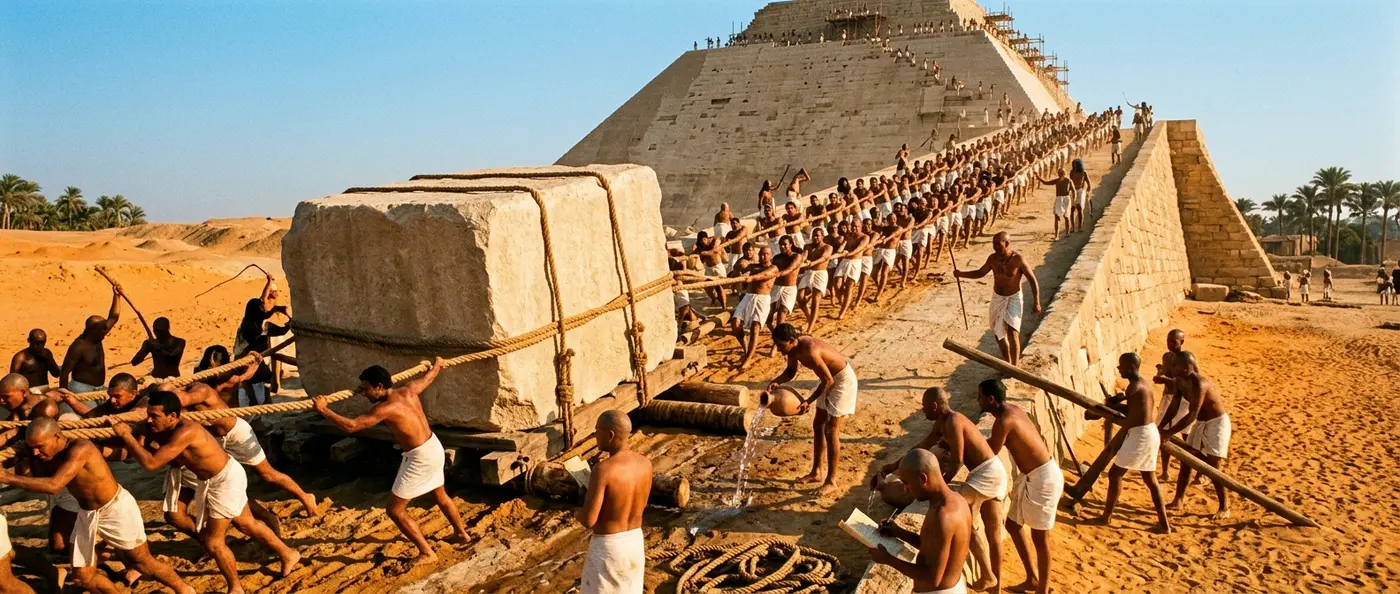
When we think of the pyramids of Giza, our minds immediately turn to the massive stone blocks that compose them. Stones weighing from 2.5 to 100 tons, transported from quarries hundreds of kilometers away. How did the ancient Egyptians manage to move such colossal weights without cranes and trucks? Recent discoveries in Egypt's oldest known port have revealed the precise methods behind this ancient engineering feat.
🏗️ The Scale of the Challenge
The construction of pyramids and great temples in ancient Egypt required transporting millions of tons of stone. The blocks used in the Great Pyramid of Giza came from various locations: limestone from local Giza quarries, white limestone for casing from Tura on the east bank of the Nile, and granite from Aswan, approximately 800 kilometers to the south.
The weights of these stones varied dramatically. Most pyramid blocks weighed between 2.5 and 15 tons, but the granite beams in the King's Chamber reached 50-80 tons. Even more impressive, certain colossi and obelisks exceeded 100 tons. To put this in perspective, a 100-ton block weighs about as much as 70 cars combined.
Moving such weights without modern machinery seems nearly impossible. Yet the ancient Egyptians not only managed it, but did so with such precision that the joints between stones are so tight that not even a knife blade can fit between them. How did they achieve this?
📜 The Papyri That Changed Everything
In 2013, archaeologists working at Wadi al-Jarf uncovered papyrus scrolls that contained something unprecedented: the actual work diaries of pyramid builders. At Wadi al-Jarf, the world's oldest known port on the Red Sea, they found papyri dating to the reign of Khufu, the pharaoh who built the Great Pyramid. These papyri contained work diaries of teams involved in the construction.
One of the most significant diaries belonged to a foreman named Merer, who led a team of 40 workers. His diary describes in detail how his team transported limestone from the Tura quarries to Giza. According to the records, they used wooden boats to transport stones along the Nile and through specially constructed canals that reached almost to the pyramid's base.
The papyri also reveal that the work was extraordinarily organized. There were specialized teams for each stage of the process: from quarrying and loading stones, to transport and placement. Each team had a specific name and hierarchy, and the workers weren't slaves as many once believed, but skilled craftsmen who were paid with food and other goods.
⚓ The Power of the Nile
The Nile wasn't just a river for the ancient Egyptians — it was their civilization's lifeline and the main highway for transporting heavy loads. The river's annual floods, occurring from June to August, created ideal conditions for navigation and moving large cargo.
The Egyptians built special barges from Lebanese cedar or local sycamore wood, capable of carrying enormous weights. For the largest blocks, they constructed specially designed ships with multiple hulls for better weight distribution. One such vessel, depicted in a relief at Queen Hatshepsut's temple, transported two obelisks with a combined weight of approximately 600 tons from Aswan to Thebes.
The Egyptians went further than simply using the Nile. They constructed artificial canals that extended the transport network deep into the desert. Recent geological surveys have identified traces of such canals leading from the Nile toward the Giza plateau, confirming references in ancient papyri.
Specialized Barges
Ships with multiple hulls and reinforced structure for transporting blocks up to 100 tons. Built from Lebanese cedar for maximum durability.
Artificial Canals
Network of canals connecting the Nile to construction sites. Enabled material transport during flood seasons.
Harbor Facilities
Specially designed docks and ramps for loading and unloading. Lifting systems with counterweights and levers.
🛷 The Sledding Technique
Once blocks reached dry land, they had to be transported to their positions. Here the Egyptians used a clever technique depicted in many wall paintings: sliding on wooden sledges. Stones were placed on large wooden sledges and dragged by teams of workers.
The key to this method's success was reducing friction. Recent experiments by researchers at the University of Amsterdam proved that the Egyptians poured water on the sand in front of the sledges. Wet sand reduces friction by 50%, allowing a team of workers to move much heavier loads than they could on dry sand.
A famous wall painting from the tomb of Djehutihotep at El-Bersha shows exactly this process: 172 men pulling a colossal statue on a sledge, while a worker pours water in front of it. Calculations show that with this method, each man could pull approximately 0.5 tons on level ground.
💡 The Secret of Wet Sand
Adding the right amount of water to sand creates capillary bridges between grains, turning it into an almost solid surface. Too little water has no effect, too much turns it to mud. The Egyptians had perfected the ratio through centuries of experience.
🏔️ Lifting to the Heights
Transporting blocks horizontally was only half the problem. How did they raise stones weighing dozens of tons to heights reaching 146 meters in the case of the Great Pyramid? Theories are numerous, but archaeological evidence points to the use of ramps.
Traces of ramps have been found at various pyramid construction sites. At the pyramid of Sahure at Abusir, archaeologists discovered the foundations of a ramp that started from the quarry and reached the pyramid. At Giza, although the ramps have been destroyed by time, there are indications of their positions.
The ramps were probably of various types depending on the construction stage. Straight ramps for lower levels, spiral ramps wrapping around the pyramid for middle sections, and possibly internal ramps for upper portions. A recent theory, supported by thermal scans of the Great Pyramid, proposes the existence of an internal spiral ramp that allowed material transport without the need for massive external constructions.
⚖️ Comparison of Lifting Methods
🔧 Tools and Techniques
The Egyptians developed specific tools and techniques for handling massive blocks. They used copper and later bronze tools for cutting soft limestone, while for hard granite they used dolerite, an extremely hard rock.
For precise block placement, they used levers made from hard wood and stone or copper wedges. The process was slow and laborious, but allowed remarkable precision. The joints between stones in the Great Pyramid are so perfect that in many places it's impossible to pass even a sheet of paper between them.
Consider the granite beams of the King's Chamber. These beams, weighing up to 80 tons each, had to be raised to a height of 60 meters and positioned with absolute precision. This likely required a combination of ramps, counterweights, and complex lever systems.
👥 Work Organization
The Egyptians' success in moving massive blocks wasn't due only to technology, but also to exceptional work organization. The Wadi al-Jarf papyri reveal a sophisticated management system with clear hierarchy and division of labor.
Workers were organized into teams of 40-50 people, led by a foreman. Multiple teams formed larger units under the supervision of senior officials. There were specialized teams for each phase of work: quarrymen for extraction, sailors for transport, craftsmen for placement.
The workers weren't slaves, as the world once believed. They were free Egyptians working in three-month shifts, often as part of their tax obligations to the state. They received regular rations of bread, beer, and other foods, and had medical care. Skeletal remains from the workers' cemetery at Giza show that despite the hard work, they received good care and treatment for injuries.
🌟 Legacy and Lessons
Four and a half thousand years later, the scale of what the Egyptians accomplished still staggers engineers. Without machines, without steel, without explosives, they managed to create monuments that have withstood time for millennia.
No lost technology or alien assistance was needed. The Egyptians succeeded through engineering, planning, organization, and the coordinated effort of thousands of workers. They used their natural resources — the Nile, sand, wood — in the most efficient way possible.
Today, as we face our own challenges of sustainability and efficiency, we have much to learn from the ancient Egyptians. Their ability to achieve the seemingly impossible with simple means and human labor reminds us that innovation doesn't always mean complexity. Sometimes, the most elegant solutions are also the simplest.