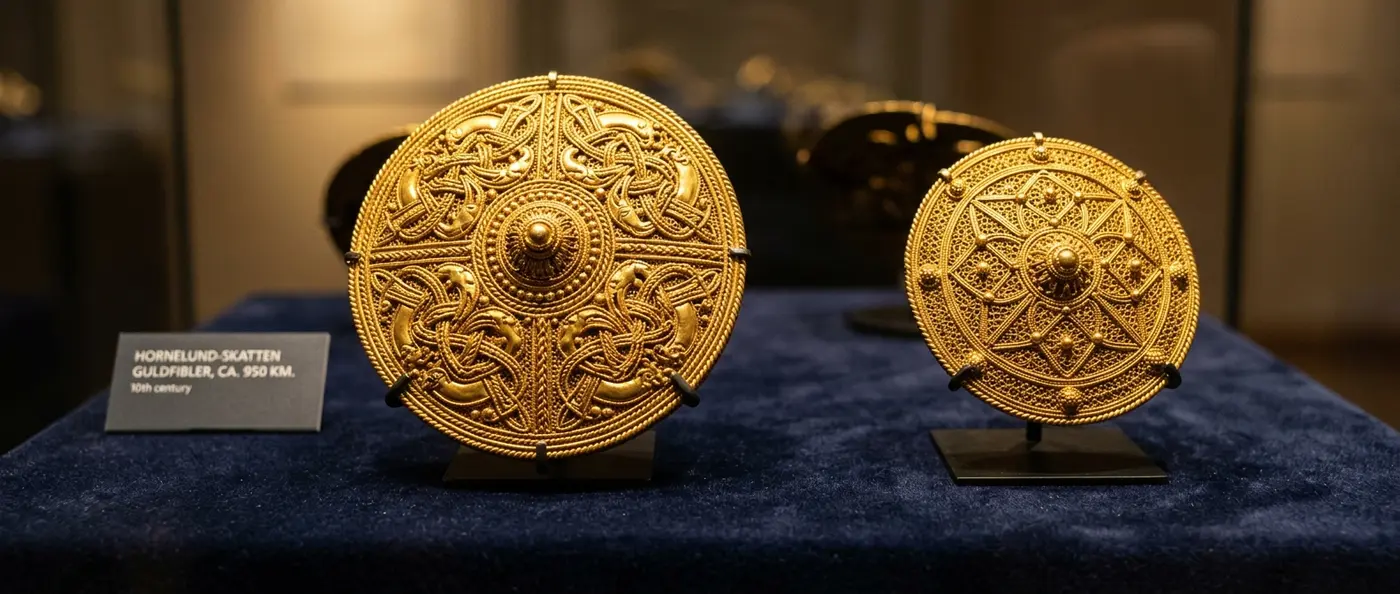
A Danish farmhand was plowing his master's field in 1892 when his plow struck something hard. What he unearthed would prove to be one of the most enigmatic treasures of the Viking Age — two gold brooches of extraordinary craftsmanship that still guard their secrets 130 years later.
📖 Read more: Viking Woman's Wagon Burial Stuns Danish Archaeologists
🏺 The Hornelund Discovery
In 1892, near the town of Varde in southwestern Jutland, a servant working his landlord's soil struck two gold brooches with his plow. Alongside the two gold brooches, he found a gold bracelet, forming a small hoard dated to the early 11th century AD.
The landowner immediately handed the treasure to Denmark's National Museum, receiving 295 Danish crowns in compensation — roughly $4,000 in today's money. Unfortunately, the site wasn't archaeologically investigated at the time, and recent excavations have yielded no new information about the hoard's context.
The mystery endures: Did these ornaments come from a burial? Were they part of a household's treasure? Or did someone bury them hastily during a time of danger? Archaeologists hope future research will illuminate the origins of this exceptional find.
💎 Artistry That Bridges Worlds
The Hornelund brooches represent masterpieces of Viking goldsmithing. Each brooch measures roughly 8.5 centimeters in diameter and weighs between 60 and 75 grams. Their construction involves intricate decorative wire work bent into elaborate patterns, requiring techniques that few metalworkers could master.
According to Lene Frandsen, curator at the Varde Museum who studied the brooches in 1994, the designs on the two pieces reflect different cultural influences. The first brooch features four animal heads facing forward in typical Scandinavian style. This suggests it was crafted by a local Danish or Viking goldsmith.
The second brooch presents an entirely different aesthetic. It's decorated with leaves and vines — motifs likely connected to Christianity. In early Christian art, grape vines symbolized Christ as the "true vine of life" and the concept of resurrection.
🔱 Jutland as a Goldsmithing Center
During the Viking Age, Jutland had evolved into an advanced goldsmithing center. The region's craftsmen were renowned for their ability to create complex jewelry that combined local traditions with influences from distant lands.
Archaeologist Władyslaw Duczko, in a 1987 study, characterized the Hornelund brooches as "completely unique in the Danish jewelry collection." Their uniqueness lies not only in their exceptional construction quality but also in their combination of different artistic traditions.
Intriguingly, similar brooches have been discovered in Sweden, suggesting that certain Jutland jewelry was manufactured for export. Additionally, the swirling motifs decorating the brooches resemble designs found on accessories from Slavic countries like Estonia, dated to the late 10th century.
Construction Technique
Intricate decorative gold wire bent into elaborate patterns, demonstrating advanced metallurgical expertise.
Artistic Influences
Combination of Scandinavian animal motifs with Christian vine symbols, reflecting the era's cultural transition.
International Trade
Similar jewelry in Sweden and influences from Estonia indicate extensive trade networks and cultural exchanges.
⚓ An Era of Transformation
The Hornelund brooches date to the early 11th century, a crucial period in Scandinavian history. This was when Christianity began establishing itself in Scandinavian countries, gradually replacing the old Norse religion.
The coexistence of pagan and Christian symbols on the brooches reflects this transitional period. The animal heads on the first brooch belong to a Scandinavian artistic tradition dating back centuries. The plant motifs on the second brooch introduce new elements connected to Christian iconography.
📖 Read more: Vikings Traded with the Islamic World: Silver Reveals All
This blending wasn't unusual for the time. Many Vikings who embraced Christianity continued using traditional symbols and designs, creating a unique synthesis that characterized transitional period art.
💡 Did You Know?
Denmark's National Museum, where the brooches are displayed today, reports they are the only known examples of this type of jewelry in Denmark. Their uniqueness makes them invaluable for understanding Viking art and culture.
🗿 The Enduring Mystery
Despite extensive study of the brooches, many questions remain unanswered. The most significant concerns the reason and circumstances of their burial. Why would someone bury such precious objects in a Hornelund field?
Archaeologists have proposed various theories. They might have been grave goods in the burial of some prominent community member. The presence of such valuable objects would indicate high social status. Alternatively, they could be treasure hidden during a period of unrest or war, intended to be retrieved later.
The absence of archaeological investigation during the 1892 discovery deprived researchers of valuable information about the find's context. Modern excavations in the area have yielded no new evidence, leaving the mystery unsolved.
🔬 Modern Research and Prospects
The Hornelund brooches continue to attract researchers' interest. New metal analysis technologies can reveal information about the gold's origin and construction techniques. Comparison with similar finds from other Scandinavian and Baltic regions helps understand the era's trade and cultural networks.
Archaeologists hope future excavations in the Hornelund area, using modern methods, might reveal new evidence. Technologies like ground-penetrating radar and magnetometry allow subsurface exploration without excavation, locating potential archaeological structures or other buried objects.
Study of the brooches also contributes to broader understanding of the transition from the Viking Age to the medieval world. Their artistry reflects the profound changes occurring in Scandinavian society as old traditions encountered new ideas and beliefs.
⚔️ Comparison with Other Viking Finds
👑 The Brooches' Legacy
The Hornelund gold brooches today constitute a Danish national treasure. Their permanent exhibition at Copenhagen's National Museum attracts thousands of visitors annually, who admire the exceptional artistry of modern Danes' ancestors.
The brooches function as 11th-century business cards, advertising their owner's wealth and religious leanings. They testify to the technical excellence of Viking Age goldsmiths, Scandinavia's extensive trade contacts, and the gradual transition from paganism to Christianity.
The mystery surrounding them adds to their allure. Every visitor who sees them wonders about their story: Who wore them? Why were they buried? What other secrets does Danish soil conceal?
The Hornelund brooches remind us that history isn't simply a series of events and dates. It's full of mysteries waiting to be revealed, stories waiting to be told. And every archaeological discovery, however small it might seem, can open a new window into the past.