🏛️ The Discovery That Rewrote Ancient History
The Hittite story begins with doubt. Until the early 1900s, these people existed only as shadowy references in biblical texts and Egyptian inscriptions that spoke of a powerful northern enemy. Most historians dismissed these mentions as mythological or grossly exaggerated.
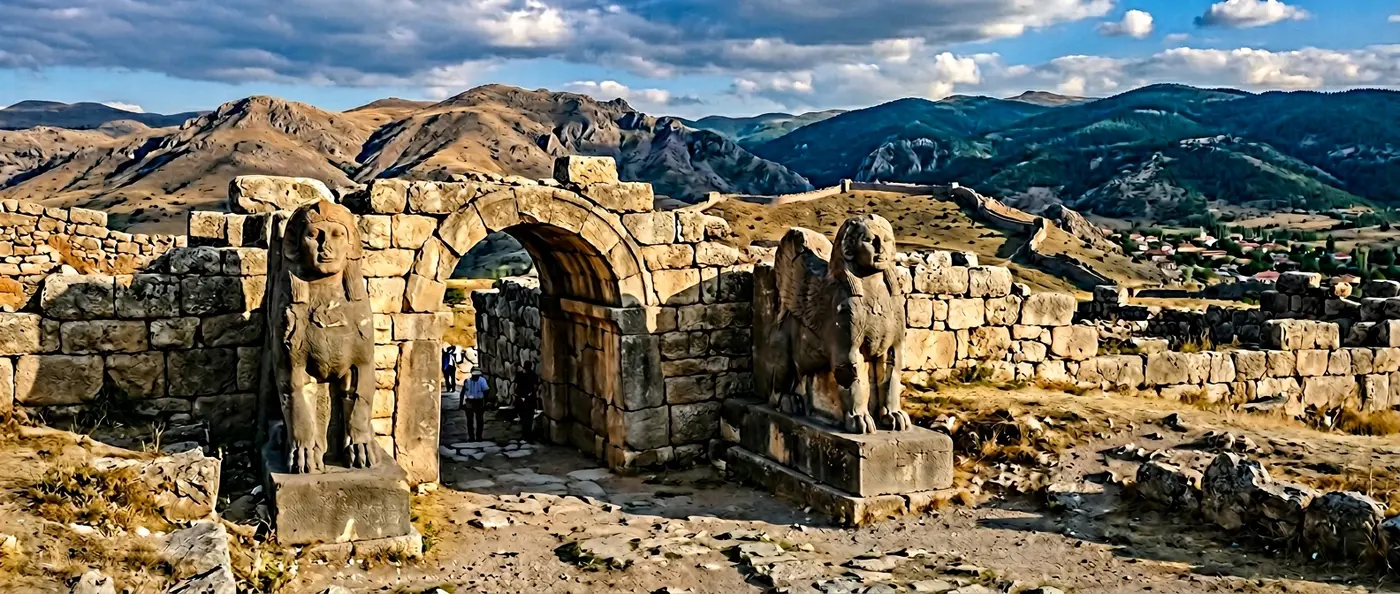
German archaeologist Hugo Winckler changed everything when he began excavating at Boğazköy in central Turkey. There, at a site locals called "Hattusa," he uncovered ruins of a massive city with imposing walls, temples, and palaces. But the real treasure lay in the palace archives: over 30,000 clay tablets written in cuneiform script.
Deciphering these tablets revealed a completely unknown language — Nesitic (now called Hittite) — which proved to belong to the Indo-European language family. The find upended everything linguists thought they knew about Indo-European origins. Suddenly, linguists had the oldest written Indo-European language in their hands, predating even Sanskrit.
🗺️ From Kussara to Hattusa
According to texts found at Boğazköy, Hittite history begins in the city of Kussara — whose exact location remains unknown today. Two semi-legendary kings, Pithana and his son Anitta, conquered Nesa (modern Kültepe) around 1800 BCE and made it their capital.
Here's the paradox: Anitta destroyed Hattusa and cursed it, forbidding its reconstruction. Yet centuries later, his descendants chose exactly this city as their new imperial capital. Hattusa's strategic position on a plateau controlling Anatolia's major trade routes proved too valuable to ignore, curse or no curse.
The transition from Old to New Hittite Kingdom was marked by internal conflicts and palace conspiracies. The Edict of Telipinu, one of the last Old Kingdom rulers (around 1500 BCE), gives us a vivid picture of the political chaos. Telipinu established succession laws to stop the murders of royal family members that had plagued the dynasty.
⚔️ Clash of Titans: Hittites vs Egyptians
The most famous moment in Hittite history is undoubtedly the Battle of Kadesh (1274 BCE), where Hittite king Muwatalli II faced Egypt's Ramesses II. This clash near the Orontes River in modern Syria was one of history's largest chariot battles.
Both sides claimed victory. Ramesses filled Egyptian temples with reliefs showing his triumph, while Hittite records speak of Egyptian retreat. The reality? The battle ended without a clear winner, and both empires realized neither could decisively defeat the other.
Sixteen years later, Hattusili III and Ramesses II signed history's first known peace treaty. The treaty text survives in both languages, and a copy adorns the UN building entrance in New York as a symbol of diplomacy. The agreement established mutual defense, extradition of fugitives, and trade relations that lasted for generations.
Military Innovation
Iron gave the Hittites their edge. Their chariots, lighter and faster than rivals', carried three warriors instead of two. Their siege techniques could crack any Bronze Age fortress.
Legal System
Hittite law codes broke new ground. They preferred monetary fines over physical punishment and recognized rights for women and slaves. Their legal code influenced later Mesopotamian law systems.
Diplomacy
Hittites mastered international relations. They maintained extensive correspondence with other kingdoms and used strategic marriages to cement alliances. Their diplomatic archives are unmatched in the ancient world.
🔱 Gods, Rituals, and Daily Life
Hittite religion was a mosaic of influences. They worshipped thousands of deities — so many they called their land "the country of a thousand gods." Each conquered city brought its own gods into the Hittite pantheon, creating an incredibly complex religious system.
The king wasn't just a political leader but also high priest. Texts describe elaborate rituals he had to perform: from annual spring festivals to daily temple offerings. If the king neglected his religious duties, they believed the gods would abandon the kingdom.
Daily life in the Hittite Empire was surprisingly organized. Farmers cultivated wheat and barley in fertile valleys while herders grazed sheep and cattle in the highlands. Craftsmen organized into guilds produced high-quality ceramics, metalwork, and textiles that were traded across the ancient world.
💡 Did You Know?
Hittites were among the first to use iron on a large scale. For centuries they kept iron-working technology secret, giving them a crucial military advantage. When they sent gifts to foreign kings, iron objects were considered more precious than gold.
📜 The Language That Unlocked the Past
Deciphering Hittite was one of 20th-century linguistics' greatest achievements. Czech linguist Bedřich Hrozný proved in 1915 that Hittite belonged to the Indo-European language family by recognizing words like "watar" (water) and "ezzateni" (you eat).
The implications hit immediately. Hittite proved to be the oldest known Indo-European language with written texts, offering invaluable insights into this language family's evolution. The Hittite archives also contained texts in other regional languages: Luwian, Palaic, Hattic, Akkadian, and Hurrian.
Besides cuneiform script for official documents, Hittites developed a hieroglyphic writing system. These "Hittite hieroglyphs" were used mainly for monumental inscriptions and seals. Their decipherment wasn't completed until the 1970s, revealing another layer of Hittite civilization.
🌅 The End of an Era
Around 1200 BCE, the Hittite Empire collapsed suddenly. Hattusa was abandoned and burned. The cause still eludes archaeologists today. Theories include invasions by the "Sea Peoples," internal conflicts, climate change causing famines, or a combination of all three.
The collapse wasn't immediate everywhere. In southeastern Anatolia and northern Syria, small Neo-Hittite kingdoms survived for several centuries. Cities like Carchemish, Malatya, and Tabal maintained elements of Hittite civilization, language, and art until conquered by the Assyrians in the 8th century BCE.
After the collapse, new peoples settled in Anatolia. The Phrygians, who according to Greek tradition came from Macedonia and Thrace, created a new kingdom centered at Gordion. In the east, the Urartians built a powerful civilization around Lake Van. But the memory of the Hittites was almost completely lost.
📊 Hittites vs Other Contemporary Civilizations
🔬 Modern Discoveries and Ongoing Research
Archaeological research at Hittite sites continues today. Each year, new excavations reveal unknown aspects of this civilization. Recent discoveries include new sections of Hattusa's walls, unpublished texts, and impressive artworks that reshape our understanding of Hittite culture.
Technology has opened new research avenues. Digital analysis of thousands of tablets enables faster translation and understanding of texts. Satellite imagery and remote sensing techniques help locate new archaeological sites. DNA analysis of human remains provides information about population origins and migrations.
The biggest puzzles still have no answers. The exact location of Kussara, the Hittites' original homeland, hasn't been found. Thousands of tablets still await translation. And the biggest question — why did this powerful empire collapse so suddenly — remains without a definitive answer.
The Hittites may have been forgotten for three millennia, but their legacy is invaluable. They showed us that Anatolia wasn't just a bridge between East and West, but the center of one of antiquity's most important civilizations. Their story reminds us that even the mightiest empires can vanish, leaving behind only stones and words to tell their tale.