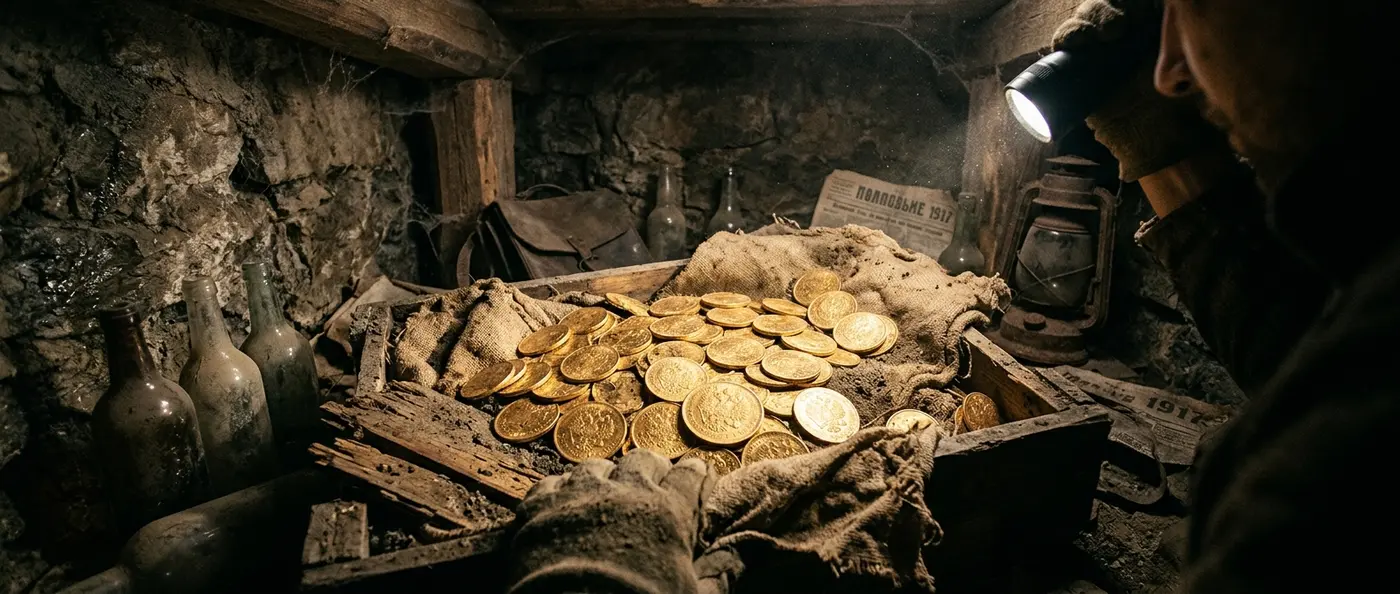
A broken clay pot. 409 gold coins. One desperate family's last gamble before everything collapsed. In 2025, archaeologists working beneath a historic house in northwestern Russia uncovered what someone had buried in panic as the 1917 Russian Revolution tore apart the old world forever. The treasure they found tells the story of the Romanov empire's final hours — and the people who never made it back to reclaim their hidden fortune.
🪙 The Discovery in Torzhok
Torzhok sits 260 miles southeast of St. Petersburg, a town that witnessed history's violent pivot point. Researchers from the Russian Academy of Sciences' Institute of Archaeology and the All-Russian Historical and Ethnographic Museum were excavating foundations before new construction when they spotted a pit carved into the basement floor.
Inside the pit: a shattered clay vessel called a "candyushka" in Russian. The pot held 409 gold coins minted between 1848 and 1911. The breakdown reads like a desperate inventory: 387 ten-ruble pieces, 10 five-ruble coins, 10 fifteen-ruble pieces, and two 7.5-ruble coins.
The owner's identity makes this discovery haunting. While two coins came from earlier tsars (Nicholas I and Alexander III), the rest bear the face of Tsar Nicholas II — the last Russian emperor before the revolution swept him into history's dustbin. Someone watched their world crumble and made a calculated bet that they'd survive to dig up their life savings.
They never came back.
💰 What Half a Million Dollars Looked Like in 1917
The math tells the story of desperation. Experts calculated the hoard's face value at 4,085 rubles. In 1916, the exchange rate was 6.7 rubles per US dollar — making this worth $610 in American money. Adjusted for inflation, that's over $18,000 today.
The gold content changes everything. Each 10-ruble coin contains 90% gold. The melt value of a single coin hits nearly $1,300 today. Do the math on 387 of them, plus the smaller denominations, and you're looking at over half a million dollars in raw gold.
This wasn't pocket change. This was generational wealth, buried in terror.
🏛️ The Historical Context
The burial date narrows the timeline. Experts believe someone buried this treasure during or after the 1917 revolution began, planning to return when the chaos ended. Archival records show 24 families lived in this area during the late 19th and early 20th centuries.
Which family buried their life savings? Nobody knows. Historical and modern house numbers don't match up, leaving the identity lost to time. What we know is this: someone, in a moment of pure desperation, chose to bury their wealth rather than flee with it.
They bet on survival. History had other plans.
🔍 Why They Never Returned
The Russian Revolution and subsequent civil war killed millions and displaced entire populations. Upper and middle-class families faced execution, exile, or forced emigration. The treasure's owner likely became another casualty of history's bloodiest political upheaval.
⚔️ Crisis Hoards Across History
Torzhok isn't unique. When empires collapse, people bury treasure. Recently in Luxembourg, archaeologists discovered 141 Roman gold coins dating between 364 and 408 AD, hidden near a small Roman fortress foundation.
These coins, called solidi, featured portraits of eight emperors. But three coins showed an unexpected ruler: Eugenius, an illegitimate Western Roman Emperor who reigned just two years (392 to 394 AD). His coins are exceptionally rare because of his brief time in power.
Same pattern. Different century. Same human response to collapse.
The Last Tsar
Nicholas II and the Romanov family were executed in 1918. For decades, rumors circulated that his daughter, Grand Duchess Anastasia, had escaped execution, but researchers now believe she died with her family.
Strategic Location
Torzhok sat strategically between Moscow and St. Petersburg. During the revolution, the area saw intense fighting between Red and White forces, explaining why someone would hastily hide their wealth.
🗿 Thracian Treasures in Bulgaria
Bulgaria has a long history of gold metallurgy. In 2012, archaeologists discovered a 2,400-year-old Thracian treasure in an ancient tomb in Sveshtari, Bulgaria. The hoard included golden horse heads and other jewelry.
The Thracians were ruled by a warrior aristocracy with access to abundant gold deposits in the Danube delta, which contained one of the largest ancient supplies of the metal. They enjoyed vibrant trade with their neighbors, including the Scythians to the north and Greeks to the south.
In 1972, a worker discovered a 6,000-year-old necropolis near the Bulgarian city of Varna that was filled with graves containing the oldest known gold treasure ever found.
💎 The Dacians of Transylvania
In Romania, looters discovered about two dozen gold snake-shaped bracelets about ten years ago at the Sarmizegetusa Regia archaeological site in the Transylvania region. The bracelets, dating roughly between 100 BC and 70 BC, weigh about 2.2 pounds each.
Craftsmen shaped each spiral bracelet from an entire gold ingot, showing "no economy of gold," according to researcher Bogdan Constantinescu. Their chemical fingerprint matches Transylvanian gold, and the gold for the bracelets likely came from two rivers near Sarmizegetusa Regia.
🏺 Ancient Treasure Comparison
🔬 Archaeological Significance
The Torzhok coins capture tsarist Russia's final days. Unlike many ancient hoards discovered by accident, this one was found in a controlled archaeological context, allowing researchers to study not just the coins themselves but the environment where they were hidden.
The treasure will now be transferred to the All-Russian Historical and Ethnographic Museum for further study. Researchers hope analysis of the coins and archaeological context will shed more light on the lives of people who lived through this turbulent period of Russian history.
Similarly, the Luxembourg discovery was kept secret for nearly four years due to its historical significance. Excavations ran from 2020 to 2024 under dangerous conditions, as multiple World War II munitions and explosives were buried in the area.
📜 History's Lesson
Across centuries, people facing collapse follow the same pattern: bury wealth, hope to return. Whether it's Dacians facing Roman conquest or Russian citizens experiencing the collapse of a centuries-old regime, the human response remains the same.
Every hidden hoard represents a human tragedy. Someone buried their wealth hoping to return, but circumstances prevented them. These coins and jewelry remained buried for centuries, patiently waiting to reveal their stories to future generations.
The Torzhok treasure speaks to something universal about human nature. When everything falls apart, we bury what matters most and hope we'll live to dig it up again. Sometimes we don't.