📖 Read more: Ribchester Helmet: Roman Cavalry Face Mask
🏛️ The Discovery That Stunned Rome
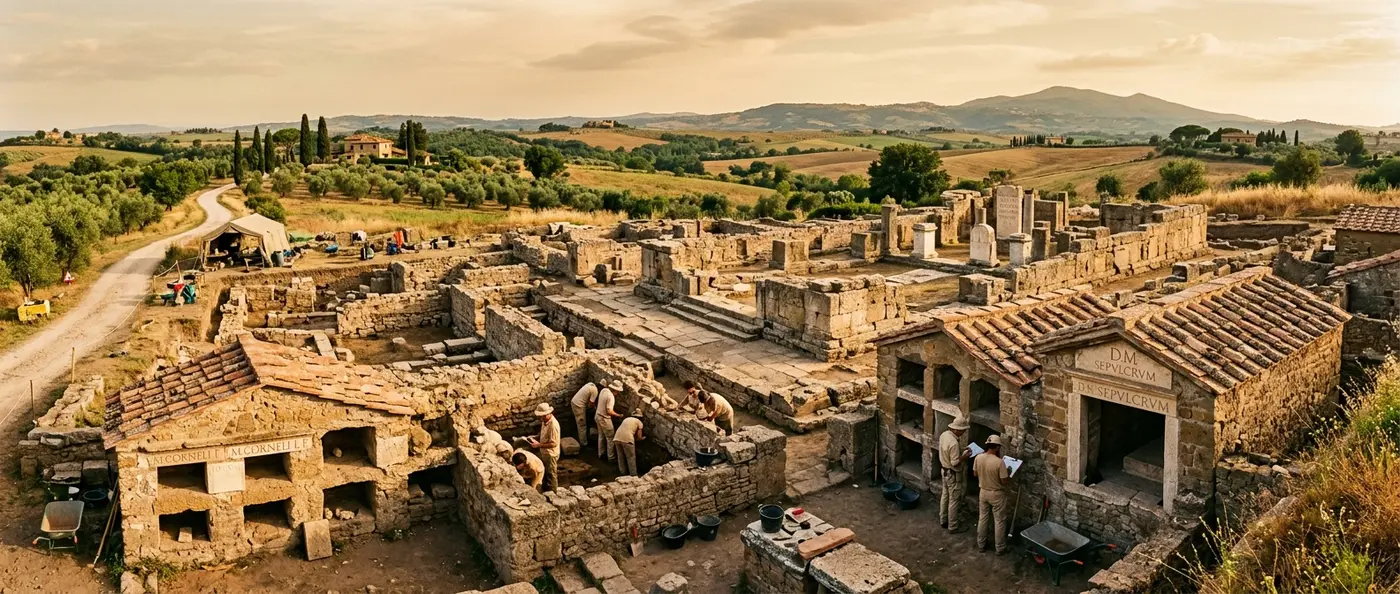
The shrine sits on a hill the locals call "Colle del Eroe" — Hero's Hill. For generations, nobody knew why. Then archaeologists started digging and found a 4th-century BC religious complex that changes how we see Roman religion before the Republic's golden age. The site includes a small temple, sacrificial altars, and a network of underground passages that probably hosted mystery rites.
But the showstopper was the tomb beneath the central altar. Inside that travertine coffin lay the bones of a man who stood roughly 6'3" — a giant by ancient standards. Bronze weapons surrounded him. A gold oak-leaf crown sat where his head once rested. Inscriptions called him "Magnus Hercules Protector" — the Great Hercules Protector.
Who was this guy? The question has archaeologists debating across three universities. The skeleton dates to 380 BC, just as Rome was flexing its muscles across the Italian peninsula. DNA analysis shows Mediterranean ancestry with Central European markers. The burial goods scream high status. But the inscriptions hint at something more extraordinary.
⚔️ Hercules: Rome's Adopted Hero
Romans didn't just borrow Hercules from the Greeks — they made him their own. They called him Hercules and wove him deep into their founding myths. According to Roman legend, Hercules passed through Rome during his tenth labor, driving Geryon's cattle back to Greece. On the Palatine Hill, where emperors would later build their palaces, he killed the giant Cacus who'd stolen some of his herd.
Grateful for Roman hospitality, Hercules taught the locals proper worship and founded the first altar to himself — the Ara Maxima. This wasn't just mythology to Romans. It was history. Hercules represented everything they valued: strength, victory, the triumph of civilization over chaos.
The Hero's Hill shrine takes this worship to another level. While the Ara Maxima in Rome was public, this complex feels private, exclusive. The underground passages suggest initiation rites. The quality of offerings implies wealthy patrons. Someone built this place for serious religious business.
🗿 Architecture of Power
The shrine's central temple measures just 12 by 8 meters, but the joints between stones are so tight you can't slip a knife between them. Local travertine walls rise 3 meters high. Collapsed roof sections show they used porous tufa stone — lighter but still impressive. The builders knew their craft.
Those underground passages are the real mystery. They stretch over 50 meters, connecting the temple to smaller chambers. Wall frescoes depict Hercules' labors in an early Roman style that predates the famous Pompeii paintings by centuries. The artwork predates Pompeii's famous frescoes by three centuries.
Three circular altars, each 2 meters across, show burn marks from centuries of sacrifice. Archaeologists found animal bones and ash layers dating across 400 years of continuous use. This wasn't a weekend worship spot — it was a major religious center.
Central Temple
Rectangular 12x8m temple with pronaos and cella. Travertine walls 3m high, with traces of polychrome plaster inside.
Sacrifice Altars
Three circular 2m diameter altars with burn traces. Animal bones and ash from sacrifices spanning 400 years of worship.
Underground Passages
50m network of subterranean corridors with Hercules labor frescoes. Likely used for mystery cult initiations.
💀 The Mystery Man
That tomb beneath the altar holds the biggest puzzle. The skeleton belonged to a man in his 40s who died around 380 BC. At 6'3", he towered over his contemporaries. Isotope analysis of his teeth shows he spent his childhood north of Rome, probably in Etruria. He was an outsider who somehow earned divine honors.
His grave goods tell a warrior's story. The bronze sword bears an archaic Latin inscription: "HERCULI VICTORI" — To Hercules the Victor. The gold crown weighs 340 grams and features oak leaves — sacred to Jupiter, Hercules' father. These weren't random burial gifts. They marked someone special.
But here's where it gets weird. One inscription reads: "HIC IACET QVI DEVM IMITATVS EST" — Here lies he who imitated the god. That phrase is unique in Roman epigraphy. What did it mean to "imitate" Hercules in 4th-century Rome? Did this man perform the hero's labors? Win impossible victories? Or something else entirely?
🔍 The Inscription Enigma
The tomb inscription "HIC IACET QVI DEVM IMITATVS EST" (Here lies he who imitated the god) appears nowhere else in Roman literature. This unique phrase creates more questions than answers. What did it mean to "imitate" Hercules in 4th-century BC Rome? The mystery deepens with every translation attempt.
📖 Read more: Roman Tombs at Ostia: 2026 Necropolis Discovery
🏺 Centuries of Worship
The shrine operated for 600 years, accumulating a treasure trove of votive offerings. Archaeologists catalogued 127 bronze and clay figurines, 89 coins from different periods, and dozens of inscribed prayers and dedications. The collection reads like a who's who of early Roman society.
Most figurines show Hercules in action — wielding his club, wrestling the Nemean Lion, holding the Apples of the Hesperides. But other gods appear too: Minerva, Mercury, even Bacchus. This suggests the shrine served broader religious needs beyond Hercules worship alone.
The inscriptions reveal why people came here. Many ask for strength and courage before battles. Others thank the god for healing diseases or athletic victories. One touching inscription from a mother thanks Hercules for saving her son "from the wolf's teeth" — probably a literal encounter in the dangerous countryside.
Clay tablets list names of prominent Roman families: the Fabii, Claudii, Valerii. All the major early Roman clans are represented. The shrine wasn't just a religious center — it was a networking hub where Rome's elite made deals and formed alliances.
📜 Rome's Pivotal Century
The shrine's 4th-century BC founding places it at a crucial moment. Rome had just recovered from the devastating Gallic sack of 390 BC and was beginning its expansion across Latium. Building a major shrine to Hercules — god of strength and victory — wasn't coincidental. It was a statement of intent.
The site's location, 30 kilometers from Rome, suggests strategic importance. This wasn't random countryside — it sat on a major route connecting Rome to its growing territories. Travelers would stop here to pray for safe passage and successful ventures. The shrine became both spiritual center and checkpoint.
Archaeological evidence supports this theory. Road markers found nearby date to the same period. Pottery shards show Mediterranean-wide trade connections. This wasn't an isolated rural shrine — it was part of Rome's expanding infrastructure, both physical and spiritual.
🏛️ Roman Hercules Shrines Timeline
🔬 Technology Meets Ancient Mystery
The dig team used every tool in modern archaeology's arsenal. Ground-penetrating radar mapped the underground passages before digging began. Drone photogrammetry created detailed 3D site models. Spectroscopy revealed invisible pigment traces in the frescoes.
Organic residue analysis from the altars revealed sacrifice patterns. Cattle, pigs, and sheep dominated, but exotic animals appeared too — deer and wild boar. One ash layer contained frankincense and myrrh residues — expensive aromatics imported from the East. Someone was spending serious money on these rituals.
Strontium isotope analysis of the skeleton's teeth confirmed he grew up north of Rome, probably in Etruscan territory. This supports theories that he was a foreign warrior adopted by Romans and honored as a hero. His story mirrors Hercules himself — an outsider who earned divine status through extraordinary deeds.
🌅 Death and Transformation
The shrine operated continuously until the 2nd century AD. The latest coins date to Hadrian's reign. After that, visitors simply stopped coming. No signs of violent destruction — just gradual abandonment as religious fashions changed.
During the Middle Ages, locals recycled the temple stones to build a small church dedicated to "Saint Hercules" — a bizarre Christian rebranding of the ancient hero. That church collapsed in the 15th century, but the "Hero's Hill" name survived in local memory.
Today, archaeologists plan partial restoration and creation of an archaeological park. The goal is making this unique monument accessible to the public while preserving its mysteries. The tomb of the mysterious "Hercules" will remain in place — a silent witness to an age when humans believed they could become equal to gods.
The discovery raises fundamental questions about early Roman religion and society. How did a foreign warrior earn burial beneath a god's altar? What rituals took place in those underground chambers? And why did Romans of the Republic's early days feel compelled to build such an elaborate shrine to divine strength?
The Hero's Hill shrine proves that Rome's rise wasn't just military and political — it was deeply spiritual. In honoring Hercules, Romans honored their own aspirations to transcend human limitations through courage, strength, and divine favor. The giant in the tomb may have achieved that transcendence. His story, carved in stone and bone, waits for us to decode it.