📖 Read more: 1,300-Year-Old Menorah Medallion Found Near Temple Mount
🌰 The Shells That Spoke
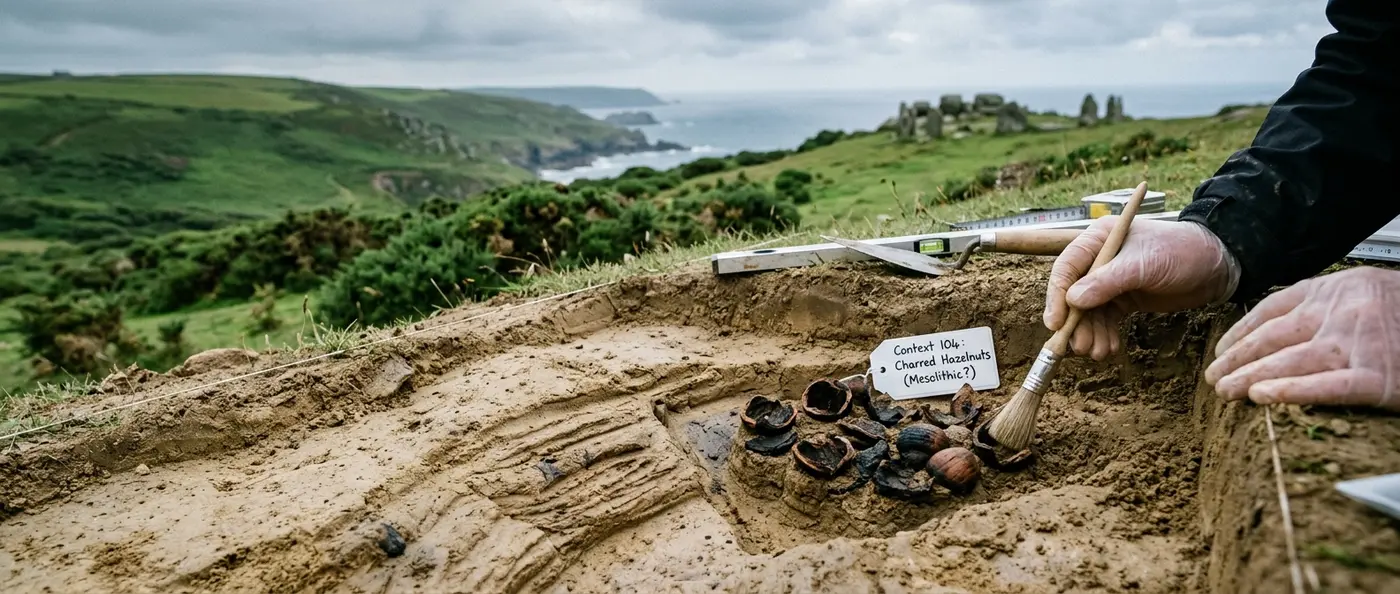
Cotswold Archaeology's team wasn't expecting to make headlines when they started digging at Tregunnel Hill. But among their finds, carbonized hazelnut shells turned out to be the most valuable witnesses to the past. Radiocarbon dating placed them between 3985 BC and 3793 BC, firmly anchoring human activity in the Early Neolithic period.
The finding upends decades of archaeological thinking about Cornwall's place in Britain's Neolithic transition. The new evidence shows the region was part of a broader, earlier wave of Neolithic settlement than previously assumed.
🏺 The Pits and Their Secrets
The excavation uncovered layers of human occupation stretching back 10,000 years, from the Mesolithic to post-medieval periods. The most striking find was several prehistoric pits containing deliberately placed deposits.
One particularly large pit revealed a structured sequence of materials: ash rich in charcoal, broken pottery including a Carinated Bowl (characteristic of the period), flint tools, animal bones, and beach pebbles. All sealed beneath a layer of soil, preserving them intact for millennia.
A smaller nearby pit, likely functioning as a hearth based on internal burn traces, yielded a similar dating range: 3950 BC to 3760 BC. The consistency in dates strengthens the reliability of the findings.
🌾 The Neolithic Revolution Hits Britain
The Neolithic period brought hunter-gatherers down from the hills and into permanent settlements, their stone tools traded for plows and pottery. This change brought the domestication of plants and animals like wheat, barley, pigs, and cattle, along with new technologies like pottery.
The Tregunnel Hill finds provide crucial new information about when and how these practices first reached Cornwall and southwestern Britain. The presence of the Carinated Bowl, a type of Neolithic pottery closely associated with early farming communities in Britain, reinforces this interpretation.
Agricultural Revolution
The introduction of wheat and barley cultivation radically changed lifestyles. People could now produce and store food, creating surplus that enabled permanent settlement development.
Permanent Settlement
While no building traces were found (rare for a period leaving minimal archaeological traces), the carefully placed pit deposits suggest permanent human presence.
New Technologies
Pottery arts, like the Carinated Bowl found, enabled better food storage and cooking, significantly improving quality of life.
🔥 Ritual and Daily Life
The carefully placed pit deposits offer strong evidence of ritual activity. The presence of food remains and cereals suggests household waste was also deposited in the pits, indicating a blend of ritual and daily life.
This mixing of sacred and mundane is characteristic of Neolithic communities. The pits weren't simply disposal sites, but places where the community performed ceremonies possibly related to earth fertility, harvest gratitude, or ancestor communication.
The structured nature of the deposits — with specific material sequences and final soil sealing — suggests careful planning and ritual significance. Beach pebbles found in the pits may have symbolized connection to the sea, perhaps recalling the origin of these new practices from continental Europe.
💡 Why Hazelnuts?
Hazelnuts were an important food source for Neolithic populations. Rich in nutrients and easy to store, they formed a basic dietary supplement. Their carbonization preserved the organic material, enabling precise dating thousands of years later.
🗺️ Redrawing the Prehistoric Map
The Tregunnel Hill discovery reaches far beyond Cornwall's borders. Southwest Britain was long considered peripheral in discussions of Britain's Neolithic transition, but these new dates suggest it was part of a broader, earlier wave of Neolithic settlement.
This has significant implications for our broader understanding of how the Neolithic revolution spread to the British Isles from continental Europe. It appears the adoption of agriculture and settled life was faster and more extensive than previously believed.
📖 Read more: 11,000-Year-Old Paphos Buildings Rewrite History
🔬 The Science Behind the Discovery
The carbon-14 radiocarbon dating used on the hazelnut shells is an extremely precise method that measures the decay of radioactive carbon isotopes in organic material. The carbonization of the shells preserved them perfectly, creating ideal conditions for accurate dating.
Cotswold Archaeology's archaeologists applied the most modern excavation and analysis techniques. Each pit layer was recorded in detail, and all finds were documented with precision. This methodical approach enabled reconstruction of the exact sequence of events that led to these deposits.
⚖️ Old vs New Timeline
🏛️ The Broader Context of British Prehistory
The Tregunnel Hill discovery must be understood within the broader context of British prehistory. The Neolithic period in Britain began around 4000 BC, when the first farmers arrived from continental Europe, bringing domesticated animals, crop seeds, and new technologies.
Until now, the prevailing view was that these innovations spread gradually from southeastern England westward and northward. Cornwall, due to its geographical position at the tip of the southwestern peninsula, was thought to have adopted these practices later.
The new evidence overturns this picture. It shows the Neolithic revolution reached Cornwall almost simultaneously with other parts of Britain, perhaps suggesting maritime communication and exchange routes that bypassed the interior.
🌊 The Significance of Maritime Connection
Cornwall's geographical position, with its extensive coastline and natural harbors, made it ideal for maritime contacts. The beach pebbles found in the ritual pits may symbolize this connection to the sea.
The first Neolithic colonists likely reached Cornwall directly from Brittany or other Atlantic European regions, using advanced nautical skills for the period. This would explain the early dating and presence of typical Neolithic elements like the Carinated Bowl.
«Hazelnut shells, often overlooked as humble food remains, proved here to be exceptional time capsules, preserving within their carbonized remains the precise moment when a new way of life took root in one of Britain's most ancient landscapes»
🔍 Future Research and Questions
The Tregunnel Hill discovery opens new research avenues. Archaeologists plan further excavations in the area to locate possible dwelling traces or other structures. While Neolithic period buildings leave minimal traces, new techniques like geophysical surveying may reveal hidden structures.
Analysis of animal bones and plant remains from the pits will provide information about diet and agricultural practices of these early communities. Pottery study may reveal trade relationships and cultural contacts with other regions.
A particularly interesting question is the relationship between Neolithic colonists and pre-existing Mesolithic populations. Evidence from Tregunnel Hill shows human activity extending back to the Mesolithic period. How did these two groups interact? Was there peaceful coexistence and cultural exchange, or conflict and displacement?
🏺 The Legacy of Tregunnel Hill
As archaeologists continue analyzing finds from Tregunnel Hill, it's clear this discovery will have long-term impact on our understanding of British prehistory. The humble hazelnut shells have rewritten an entire chapter of Cornwall's history.
Other sites across Cornwall now demand fresh excavation. How many more Neolithic settlements lie undiscovered beneath the peninsula's moors and fields?
Tregunnel Hill teaches us that history isn't static. Each new discovery can overturn decades of assumptions and force us to reexamine what we thought we knew. In Cornwall's case, a handful of carbonized shells changed 6,000 years of history.