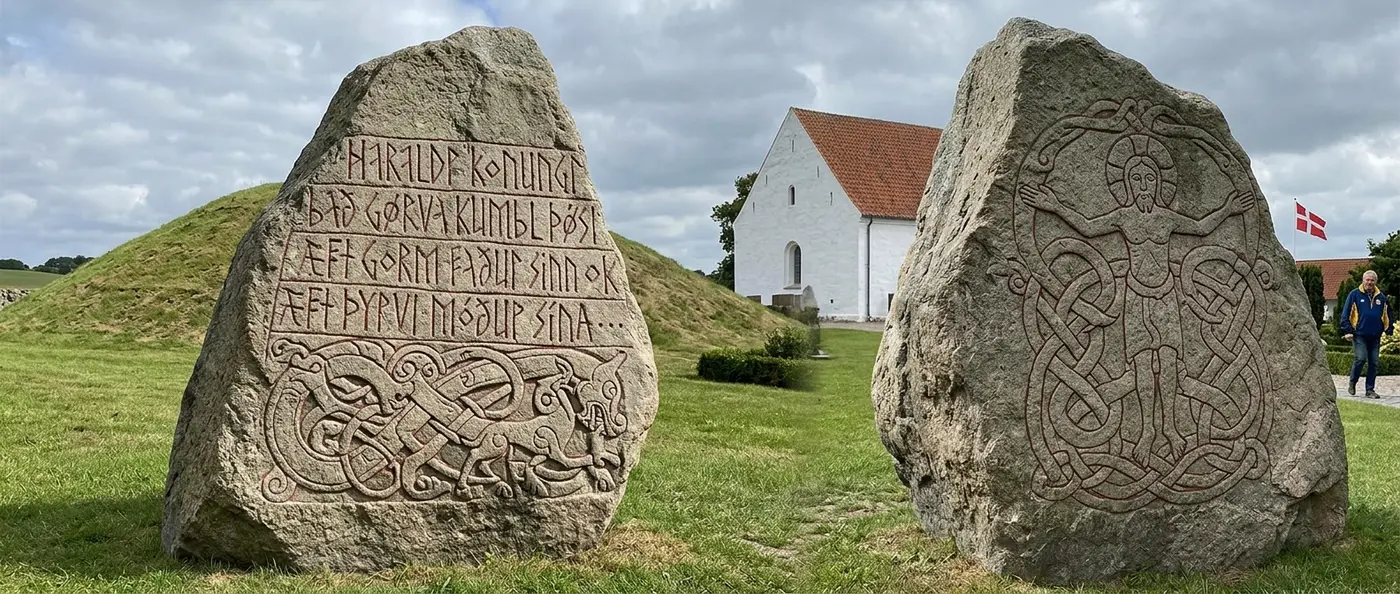
Your phone says his name billions of times a day. Every wireless headphone connection, every file transfer, every smart device pairing whispers the legacy of a 10th-century Viking king who died nearly a thousand years before the first computer was built. Harald Bluetooth ruled Denmark and Norway when longships ruled the seas, uniting scattered Scandinavian tribes into a single kingdom — exactly like the wireless technology that bears his name unites our scattered devices today.
👑 The King Who Forged Scandinavia
Harald Gormsson earned his throne around 958 AD and kept it until 986, ruling during one of the most pivotal periods in Northern European history. Son of Gorm the Old, Harald inherited a fractured kingdom bleeding from internal divisions and external threats. His masterstroke was welding Denmark's warring tribes together with chunks of Norway and Sweden into a unified powerhouse that dominated the Baltic.
The "Bluetooth" nickname probably came from a dead or discolored tooth — though historians still argue about the exact origin. What's certain is that Harald wielded massive political influence across the region, forging alliances and extending his reach throughout the Baltic Sea. His reign wasn't just about conquest. It was about connection.
Harald built monuments that still stand today as testaments to his power. He also made the bold decision to introduce Christianity to Denmark, a move that carried profound political and cultural consequences for the entire region. This wasn't just religious conversion — it was strategic positioning that strengthened ties with Christian European powers and helped establish Denmark as a major medieval force.
🏰 The Viking Elite Uncovered
Fresh archaeological discoveries in Denmark are rewriting what we know about Harald's social hierarchy. At Lisbjerg, near Aarhus, archaeologists from Moesgaard Museum unearthed 30 Viking Age graves that likely belonged to an elite family serving King Bluetooth directly. These late 900s AD burials contained stunning grave goods — coins, beads, ceramics — that scream wealth and status.
This discovery breaks the mold. Viking Age graves rarely contain such rich offerings. According to archaeologist Liv Stidsing Reher-Langberg, most burials from this period hold few or no objects at all. The presence of such luxury items signals these dead belonged to the upper echelons of society — the people who made Harald's unified kingdom actually work.
The most spectacular grave belonged to a woman buried in an elaborate coffin with a sophisticated locking mechanism, high-quality nails, and premium fittings. X-ray technology revealed jewelry, a needle, and an elegant pair of scissors inside the coffin. These finds give us a rare window into how the elite who served Harald Bluetooth actually lived and died.
⚔️ Power Players in Harald's Kingdom
The archaeologists connected these graves to a local chieftain whose farmstead was discovered nearby. This nobleman would have sat just below King Bluetooth in the social hierarchy — part of the aristocracy that made the kingdom function. As Reher-Langberg explains, "The chieftain at Lisbjerg had enormous power — economic, political, religious and social."
The variety in grave size and luxury suggests a mix of social classes among the buried. The cemetery likely includes the chieftain's family members but also servants or even slaves. This social stratification reflects the complex hierarchical structure of Viking society, where power and wealth concentrated in very few hands.
The discovery caught everyone off guard. Despite finding traces from the pre-Roman Iron Age in the area and locating the chieftain's farmstead, archaeologists hadn't expected Viking Age burials. "It was a huge surprise," Reher-Langberg said. "We simply had no expectation of finding graves."
💡 Did You Know?
The Bluetooth technology symbol combines the runic initials of Harald Bluetooth (H and B) into a single design, honoring the Viking king who united Scandinavia.
🗿 Portrait of a Viking King
One of the most captivating discoveries from Harald's era is a rare game piece depicting a Viking king. The figurine, carved from walrus ivory and standing just 3 centimeters tall, dates to the late 10th century — exactly Harald Bluetooth's reign period.
The piece was discovered in the Viken region of southern Norway, just west of Oslo, which was part of Harald's kingdom at the time. While archaeologist Peter Pentz from Denmark's National Museum is careful not to claim it depicts Harald himself, he notes that "the figure represents a king from the late tenth century" and was found "within his realm."
The figurine's most striking feature is its elaborate hairstyle — a center part with a side wave that left the ears visible and short hair at the back. It also sports a large mustache, sideburns, and a long braided beard. According to Pentz, "It's extremely detailed and so expressive, showing a sly — or even malicious — facial expression."
The Game of Hnefatafl
The piece belonged to Hnefatafl, known as "Viking chess," which was popular in Northern Europe before being replaced by classical chess after the 12th century.
Rare Human Depiction
Viking Age art typically depicted fantasy animals like dragons. This figurine is one of the few known human representations from the period.
🏛️ Bluetooth's Lasting Legacy
Harald Bluetooth's influence extends far beyond his reign. He built impressive monuments, including the famous Jelling stones, considered Denmark's "birth certificate." The inscriptions on these stones record his achievements in unifying Denmark and converting the Danes to Christianity.
The transition from paganism to Christianity under Harald was a strategic move that strengthened ties with Christian European powers and helped establish Denmark as a significant force in medieval Europe. This religious conversion had profound impacts on Scandinavian culture, art, and political organization.
Today, Harald Bluetooth's name lives on through the wireless communication technology that bears his name. When Intel engineer Jim Kardach was searching for a name for the new technology that would unite different devices in 1997, he drew inspiration from the Viking king who had united Scandinavia. The Bluetooth logo combines the ancient Scandinavian runes for the letters H and B — Harald Bluetooth's initials.
🔬 New Discoveries, New Questions
Recent archaeological discoveries in Denmark continue to enrich our understanding of Harald Bluetooth's era. The objects from the Lisbjerg graves have been sent for analysis and conservation to Moesgaard Museum's Natural Science and Conservation department. Human remains, wood, and soil from the excavation will also be analyzed, hopefully revealing more information about the life and death of these Viking elite.
The king figurine, which had been forgotten in a museum storage room for over 200 years after being catalogued in 1798, reminds us that even the most well-studied collections can hide surprises. As Pentz noted, "When I encountered him in one of our storage rooms a few years ago, I was truly amazed — he was just sitting there, staring directly at me, and I had never seen such a Viking before."
These discoveries give us a more complete picture of Viking society during Harald Bluetooth's reign. From the luxury graves of the aristocracy to detailed depictions on game pieces, each find adds another piece to the puzzle of understanding this fascinating period in European history.
📊 Harald Bluetooth's Era
🌍 From Vikings to Modern Wireless
Harald Bluetooth's story reminds us how the past continues to influence the present in unexpected ways. A medieval king who united tribes a thousand years ago lent his name to technology that unites devices in the 21st century. Every time we connect our headphones or transfer files via Bluetooth, we unconsciously honor the memory of a Viking leader whose legacy extends far beyond the borders of his medieval kingdom.
Ongoing archaeological research in Scandinavia promises to reveal even more about this fascinating period. As new technologies like X-ray analysis and DNA testing are applied to ancient finds, we can expect fresh revelations about the lives, culture, and achievements of the Vikings and their leaders.
Harald Bluetooth remains an iconic figure in Northern European history — a leader who managed to transform a fragmented collection of tribes into a unified, powerful kingdom. His ability to unite people and build bridges between different cultures makes him a particularly fitting namesake for a technology that does exactly the same thing in the modern age.