📖 Read more: Ancient Korea's Three Kingdoms: 700 Years of Power & Glory
🐘 The Bone That Rewrites History
A team of archaeologists from the University of Córdoba made a discovery that could change our understanding of the Second Punic War. In a fortified village near Córdoba in southern Spain, they found a bone the size of a baseball that initially puzzled scientists.
The bone was later identified as the right carpal bone of an elephant — essentially the "ankle" of the animal's right front leg. Radiocarbon dating places it around 2,250 years ago, precisely during the Second Punic War period (218-201 BC). According to Rafael Martínez Sánchez, head of the research, this could be the first direct archaeological evidence of Carthaginian war elephants used in the Iberian Peninsula.
💡 Why This Discovery Matters
Until now, archaeologists relied solely on ancient written sources and indirect evidence for the presence of Hannibal's elephants. This bone provides the first physical proof that Carthaginian war elephants operated on Spanish soil.
⚔️ Traces of War in the Pyrenees
Alongside the Córdoba discovery, new evidence from the Pyrenees reveals the violent path of Hannibal's army toward Rome. At Tossal de Baltarga, an Iron Age settlement in the Pyrenees about 115 kilometers north of Barcelona, archaeologists discovered signs of a catastrophic fire dating to the last quarter of the 3rd century BC.
The fire completely destroyed a two-story farmhouse along with the animals inside — four sheep, a goat, and a horse. The humans appear to have escaped, as no human remains were found. However, a gold earring discovered hidden in a ceramic vessel on the second floor suggests the inhabitants were expecting an attack.
🗺️ Hannibal's Epic March
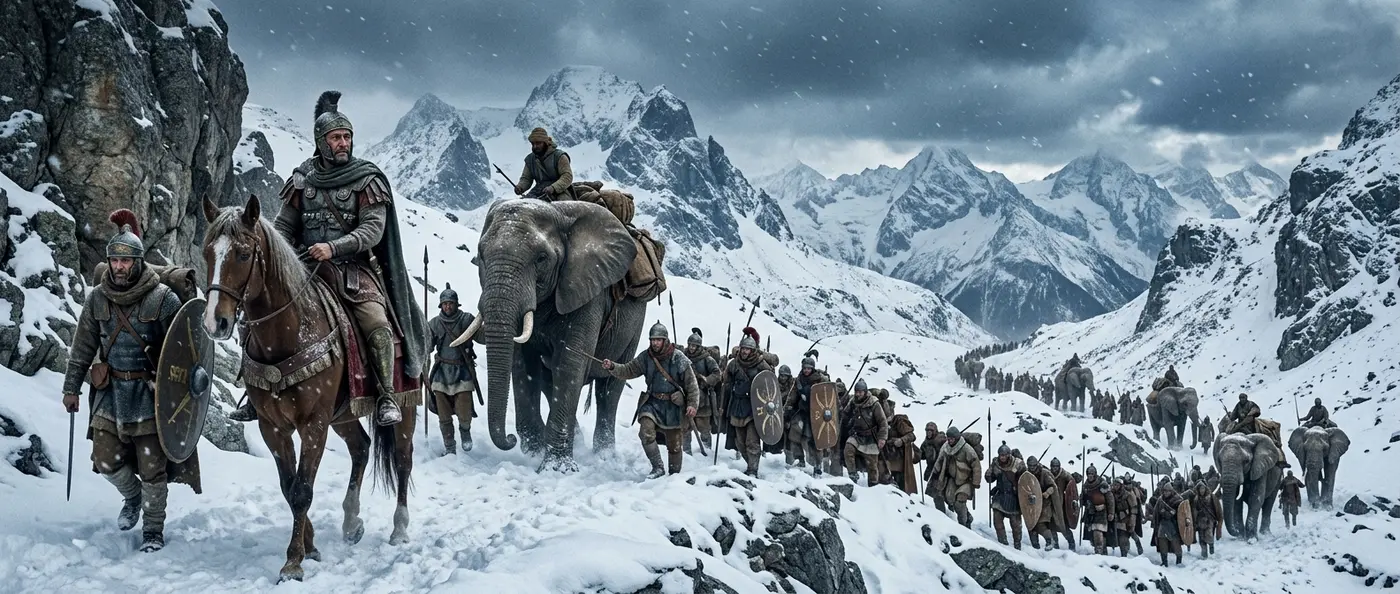
Hannibal Barca began his campaign against Rome in 218 BC from New Carthage (modern Cartagena) in Spain. His strategy was simple but bold: instead of attacking Rome by sea where the Romans were strong, he would approach by land, crossing the Alps.
The ancient Greek historian Polybius, who lived around 200-118 BC, recorded that Hannibal fought several battles during his passage through the Pyrenees. The archaeological findings at Tossal de Baltarga now confirm these accounts. "It was not a peaceful crossing," emphasizes Olesti Vila.
🏺 Evidence of Conflict
Besides the burned farmhouse, archaeologists found other signs of military conflict in the area. Twelve spherical stones discovered at the site are believed to have been ammunition for Carthaginian catapults. Additionally, the fact that animals were found locked on the ground floor of the house instead of grazing freely in the meadows suggests residents were expecting an attack.
In another building of the settlement, they found the burned remains of a dog that was likely tied up when the fire broke out. All these elements point to an organized attack that destroyed the entire settlement, not simply an accidental fire.
Devastating Fire
The fire destroyed the entire two-story building with wooden roof and floors. Unlike typical domestic fires of the era that were limited to one room, this one destroyed the entire settlement.
Hidden Treasure
A gold earring was found deliberately hidden in a ceramic vessel on the second floor. Residents apparently tried to protect their valuables before the attack.
Military Ammunition
Twelve spherical stones suitable for catapults were found in the area. These projectiles were typical siege weapons used by Carthaginian armies.
🔬 Scientific Analysis
The elephant bone found in Córdoba underwent extensive analysis. Researchers cannot yet determine whether it belonged to an Asian elephant (Elephas maximus indicus) — the species used by King Pyrrhus of Epirus against the Romans — or to a now-extinct species of African elephant preferred by the Carthaginians.
The bone was found in a soil layer dating before 150 BC, when the Romans took control of the area. It appears to have been protected by a collapsed wall, though researchers don't rule out the possibility it was preserved as a memento, since it's small enough to be carried.
War elephants were the tanks of their time. The Carthaginians used them extensively in the first two Punic Wars against Rome. These massive animals, trained for battle, could break enemy lines and spread panic among opposing soldiers who often had never seen elephants before.
⚔️ Military Force Comparison
The Alpine crossing proved catastrophic for the elephants. Most died from cold, exhaustion, and the harsh conditions of the mountain passage. Nevertheless, Hannibal managed to reach Italy and defeat the Romans in many battles for years.
📜 Hannibal's Legacy
Hannibal was recalled to Carthage in 203 BC to defend his homeland from Roman attacks. Eventually the Carthaginians lost the Second Punic War, as they had lost the First more than 20 years earlier. About 50 years later, Rome provoked a Third Punic War, which the weakened Carthage also lost, leading to its final destruction.
Despite the ultimate defeat, Hannibal's campaign remains one of the most impressive military achievements in history. The crossing of the Alps with elephants continues to capture our imagination more than two millennia later.
🗿 The Mystery That Remains
Despite new discoveries, many questions remain unanswered. What exact route did Hannibal follow through the Alps? How many elephants exactly survived? Ongoing archaeological research may soon provide more answers.
🏛️ New Discoveries on the Horizon
Archaeologists continue excavations both in Córdoba and at Tossal de Baltarga. Each new finding adds a piece to the puzzle of this epic story. The discovery of the elephant bone is particularly significant because it offers the first physical evidence of the legendary war elephants' presence in the Iberian Peninsula.
Researchers emphasize that the elephant that died near Córdoba could not have been one of the "legendary specimens" that crossed the Alps with Hannibal. However, the bone constitutes a relic of the ancient Punic Wars for control of the Mediterranean and represents the "passage of the gigantic 'tanks of antiquity' through the peninsula."
The bone itself may hold more secrets. Advanced DNA analysis could determine whether it came from an Asian or African elephant — a detail that would reveal which species the Carthaginians preferred for Spanish campaigns.