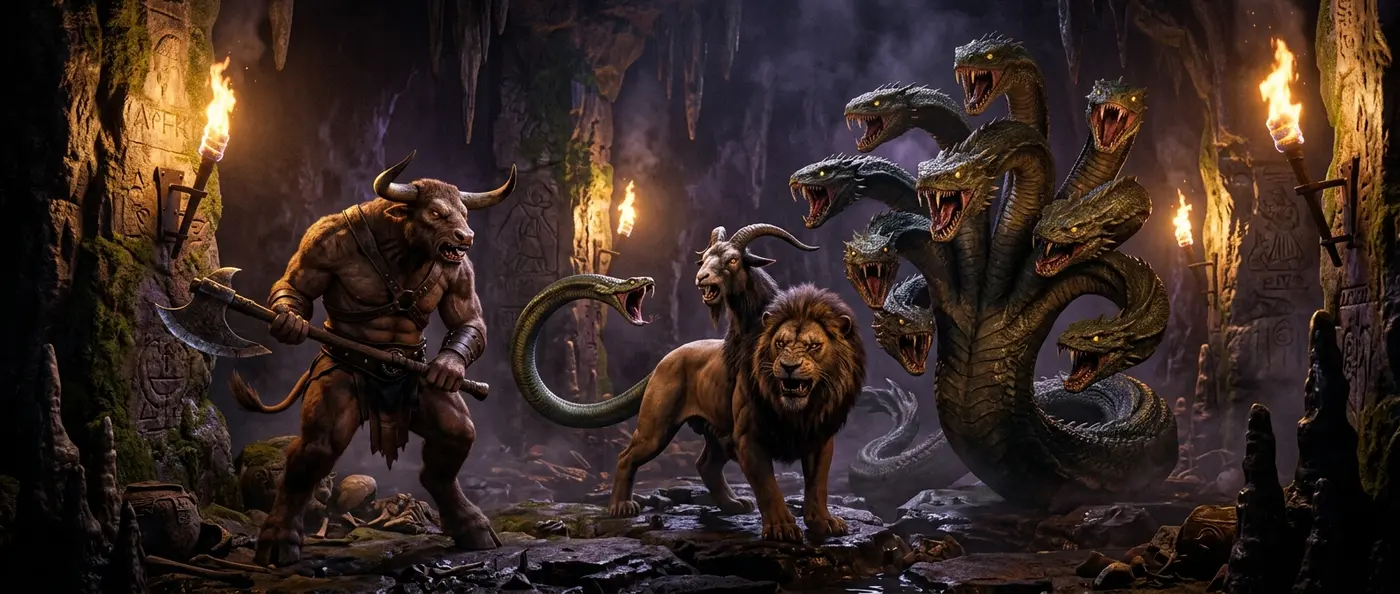
Everyone knows the Centaurs and Medusa. But Greek mythology hides an entire bestiary of bizarre creatures that most people never hear about. These hybrid beings and monstrous forms show how ancient Greeks explained the unexplainable — violent storms, sudden deaths, and the terrors that waited beyond their known world.
📖 Read more: Eleusinian Mysteries: Ancient Greece's Sacred Death Ritual
🐐 Satyrs: Dionysus's Wild Spirits
In Eretria, Euboea, archaeologists uncovered a 4th century BC mosaic floor depicting two naked Satyrs. The mosaic shows a younger Satyr playing the flute while an older, bearded one dances to the music.
Satyrs were hybrid creatures with human torsos but tails, horns, and pointed ears. Closely tied to Dionysus, god of fertility and wine, they participated in ritual festivals and drinking parties. The Eretria mosaic measures 1.13 meters wide and was crafted with multicolored pebbles.
🦅 Harpies: The Winged Storm Monsters
Harpies appeared as female forms with wings and talons of birds of prey. Their name means "those who snatch" and they embodied destructive winds. In the Odyssey, they serve as Zeus's enforcers, punishing mortals who offend the gods.
The most famous Harpy story involves King Phineus of Thrace. The Harpies snatched his food every time he tried to eat, leaving him to starve for eternity. Only the Argonauts managed to drive them away.
🐍 Echidna: The Mother of Monsters
Echidna ranked among the most terrifying creatures in Greek mythology. Her upper body was a beautiful woman, her lower half a massive serpent. She lived in a cave deep underground. Married to Typhon, together they spawned some of mythology's most fearsome monsters.
Lernaean Hydra
Multi-headed serpent that grew two new heads for every one you cut off
Chimera
Beast with lion's head, goat's body, and serpent's tail that breathed fire
Cerberus
Three-headed dog that guarded the entrance to Hades
📖 Read more: 10 Hidden Secrets of the Athenian Acropolis You Never Knew
🌊 Telchines: The Sea Sorcerer-Smiths
Telchines were mysterious sea creatures skilled in magic and metalworking. They had dog or seal heads with clawed hands. Originally dwelling on Rhodes, they were considered the island's first inhabitants.
Master craftsmen, they forged Poseidon's trident and Cronus's scythe. But the Telchines had a darker side — they were jealous and malicious. They used magic to destroy crops by sprinkling water from the river Styx.
🦎 The Dragon of Colchis: The Sleepless Guardian
In Colchis, on the shores of the Black Sea, a massive dragon guarded the Golden Fleece. The beast never slept and coiled around the tree where the precious fleece hung. Only Medea's magic could lull it to sleep so Jason could steal the treasure.
The dragon had scales that gleamed like gold and teeth large as spears. Its length reached one hundred feet and its breath poisoned anyone who approached.
💡 Did You Know?
Ancient Greeks believed that dragon teeth, when sown in earth, would sprout armed warriors called Spartoi. Jason had to face such warriors in Colchis.
🐴 Hippocampi: Poseidon's Horses
Hippocampi were sea creatures with horse front halves and fish rear halves. They pulled Poseidon's chariot through ocean depths and symbolized his power over waves. Artists often depicted them with seaweed manes and tails that swirled like currents.
📖 Read more: Ancient Athenian Democracy: How It Was Born
Sailors considered them lucky creatures. Their appearance meant calm seas and safe passage. During Roman times, Hippocampi became popular decorative themes in baths and fountains.
🦅 Griffins: The Gold Guardians
Griffins had lion bodies with eagle heads and wings. They lived in the mountains of Scythia, guarding vast gold treasures. The Arimaspians, one-eyed people of the north, constantly tried to steal their gold, leading to endless battles.
⚔️ Griffin Characteristics
🐍 Python: The Giant Serpent of Delphi
Python was a massive serpent born from mud after Deucalion's flood. It terrorized the Delphi region until Apollo killed it with arrows when he was just four days old, establishing his oracle there.
Python's size was so enormous its body covered the entire slope of Mount Parnassus. From its spilled blood, poisonous plants sprouted. The Pythia, the oracle's priestess, took her name from this monster.
🦌 The Ceryneian Hind: Artemis's Sacred Beast
The Ceryneian Hind was a magical creature with golden horns and bronze hooves. Though female, it had antlers like a male deer. Sacred to Artemis, it lived on Mount Ceryneian in Arcadia. It could run faster than an arrow.
Heracles needed a full year to capture it alive, since he couldn't kill or wound it. He chased it to the land of the Hyperboreans and finally caught it when it stopped to drink water.
📖 Read more: Ancient Greek Coins: How Money Was Born
🐙 Scylla: The Strait Monster
Scylla was once a beautiful nymph transformed into a monster by the sorceress Circe. She had twelve legs and six heads with three rows of teeth each. Dog heads barked around her waist. She lived in a cave in the Strait of Messina, opposite Charybdis.
Every ship that passed lost six sailors — one for each of Scylla's heads. Odysseus chose to sail near her rather than risk his entire ship in Charybdis's whirlpool. He lost six of his best men but saved the ship.
Scylla's Victims
Hundreds of sailors who tried to pass through the strait
Location
Strait of Messina, between Italy and Sicily
🔮 Modern Influence
Ancient Greece's mythical creatures continue to captivate. From Hollywood movies to video games, these beings appear again and again. What's fascinating is how many resemble real animals or animal combinations found in nature.
Archaeologists and historians believe many myths might stem from misinterpreted fossils or encounters with unknown animals. For example, elephant skulls without tusks could be mistaken for Cyclops skulls due to the large central cavity for the trunk.