📖 Read more: Pythagoras: How Numbers Rewrote Philosophy
📐 The Birth of Geometry in Ancient Greece
Ancient Greek geometry wasn't just a branch of mathematics — it was their attempt to decode the universe's blueprint. Greek mathematicians transformed the practical knowledge of Egyptians and Babylonians into a rigorous science with logical proofs and universal principles.
Thales of Miletus, who lived around 624-546 BCE, is considered the first to introduce the idea of mathematical proof. According to Syrian historian Iamblichus (250-330 CE), Thales and his student Anaximander were the ones who introduced young Pythagoras to mathematics. This meeting would launch a mathematical revolution.
The Greeks weren't satisfied with just knowing that geometric rules worked — they demanded to know why. The Greeks weren't content to just measure and calculate — they wanted to understand the "why" behind every mathematical truth.
🔺 The Pythagorean Theorem: An Ancient Discovery
The famous theorem bearing Pythagoras' name — that in every right triangle, the square of the hypotenuse equals the sum of squares of the two perpendicular sides (a² + b² = c²) — is actually much older than Pythagoras himself.
Four Babylonian tablets dating from 1900-1600 BCE clearly show that Babylonians knew the theorem. They had calculated the square root of 2 (the length of the hypotenuse of a right triangle with perpendicular sides equal to 1) with astonishing accuracy and had catalogs of special integers, known as Pythagorean triples, that satisfy the theorem (like 3, 4, 5).
The theorem is also referenced in India's Baudhayana Sulba-sutra, written between 800 and 400 BCE. Nevertheless, the theorem became associated with Pythagoras' name and constitutes proposition 47 of Book I of Euclid's Elements.
🌍 Pythagoras' Travels and the Spread of Knowledge
Pythagoras wasn't just a mathematician who stayed locked in his library. Around 535 BCE, he traveled to Egypt to deepen his studies. His fate took an unexpected turn when in 525 BCE he was captured during Cambyses II of Persia's invasion and transported to Babylon.
His captivity became an unexpected education in Babylonian mathematics. There are indications he may have visited India before returning to the Mediterranean. These travels exposed him to different mathematical traditions and enriched his thinking.
When he finally settled in Croton, southern Italy, he founded a school that operated more like a monastery. All members took strict vows of secrecy, and for centuries every new mathematical result was attributed to his name. This is one reason we don't know with certainty whether Pythagoras himself actually proved the theorem that bears his name.
Egypt (535 BCE)
Pythagoras studied Egyptian geometry and astronomy, learning the practical land measurement methods Egyptians used after Nile floods.
Babylon (525 BCE)
During his captivity, he encountered the Babylonians' advanced base-60 numbering system and their knowledge of his theorem.
India (possible visit)
Some historians argue he visited India, where he encountered Indian mathematical traditions and philosophy.
📚 Euclid and the Elements: The Foundation of Geometry
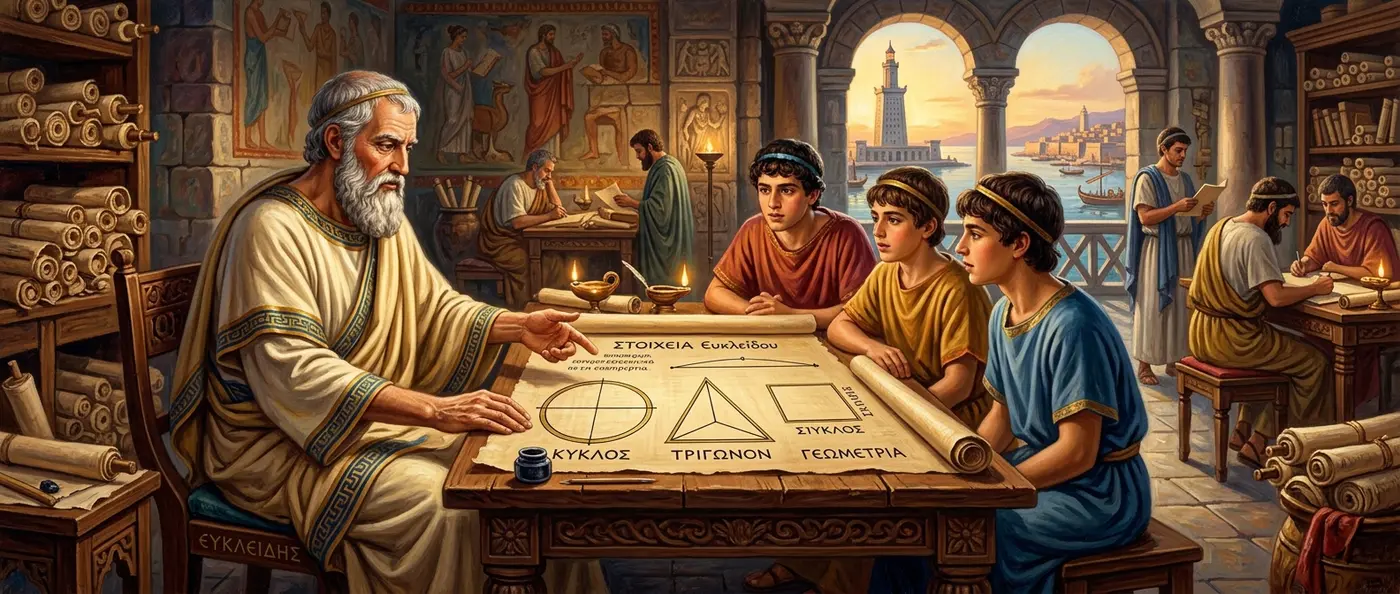
If Pythagoras laid the foundations, Euclid built the structure. His Elements, written around 300 BCE in Alexandria, constitute perhaps the most influential mathematical text of all time. For over 2000 years, it was the second most widely distributed book after the Bible.
Euclid defined a line as "distance between two points" that can extend infinitely in any direction. This seemingly simple definition broke new ground. It clearly separated the concept of a line from a straight segment and a ray.
Book I of the Elements culminates with Euclid's famous "windmill proof" of the Pythagorean theorem. Later, in Book VI, he presents an even more elegant proof using the proposition that areas of similar triangles are proportional to the squares of their corresponding sides.
💡 Why Did Euclid Devise the "Windmill Proof"?
Euclid wanted to place the Pythagorean theorem as the climax of Book I, but faced a problem: he hadn't yet proven (as he would in Book V) that line lengths can be manipulated in ratios as if they were commensurable numbers. So he devised a more complex but strictly logical proof that didn't require this knowledge.
🎨 The Legacy of Greek Geometry
The influence of Greek geometry extends far beyond mathematics. Euclid showed that any symmetric regular shapes drawn on the sides of a right triangle satisfy the Pythagorean relationship — the shape on the hypotenuse has an area equal to the sum of the areas of shapes on the perpendicular sides.
This insight captivated mathematicians across cultures. Pappus of Alexandria (320 CE), Arab mathematician Thabit ibn Qurra (836-901 CE), Leonardo da Vinci (1452-1519) — all created their own proofs of the Pythagorean theorem. Today there are over 300 different proofs.
In China, the work "Nine Chapters on Mathematical Procedures" from the 1st century CE contains problems for finding sides of right triangles. Liu Hui in the 3rd century CE proposed a proof requiring cutting and rearranging squares on the triangle's sides — a method reminiscent of the tangram puzzle.
🔢 From Theory to Practice: Applied Geometry
Ancient mathematics grew from imperial necessity. Algebra and geometry techniques were likely invented around 3000 BCE in Sumeria, as the developing civilization needed ways to calculate taxes, record commercial transactions, and create calendars.
Babylonians used a base-60 numbering system, which we still use today for time measurement — 60 seconds in a minute, 60 minutes in an hour. This choice wasn't random: 60 is divisible by many numbers, making calculations easier.
The transition from oral tradition to written knowledge recording, which began around 3500 BCE in Kish, was so dramatic that it's sometimes compared to the transition from paper to digital recording in the 20th century. The clay tablets students used as "scratch paper" for their calculations give us a unique glimpse into the educational process of the era.
📊 Mathematical Systems Comparison
🏛️ The Timeless Value of Geometric Thinking
Greek geometry wasn't just a set of rules and theorems. It was a new way of thinking that required rigorous logic, clear definitions, and unshakeable proofs. This approach influenced not only mathematics but also philosophy, physics, even legal thinking.
Today, when students learn the Pythagorean theorem or study Euclid's Elements, they're not just being taught mathematics. They're learning a way of thinking developed 2,500 years ago that remains fundamental to understanding the world around us. From building design to computer development, the legacy of ancient Greek geometry is everywhere around us.
The history of geometry also teaches us something important about the nature of knowledge: great ideas don't belong to one civilization or era. The Pythagorean theorem was discovered independently in various cultures, from Babylon to China. The true contribution of the Greeks was transforming this practical knowledge into a systematic science with universal application.