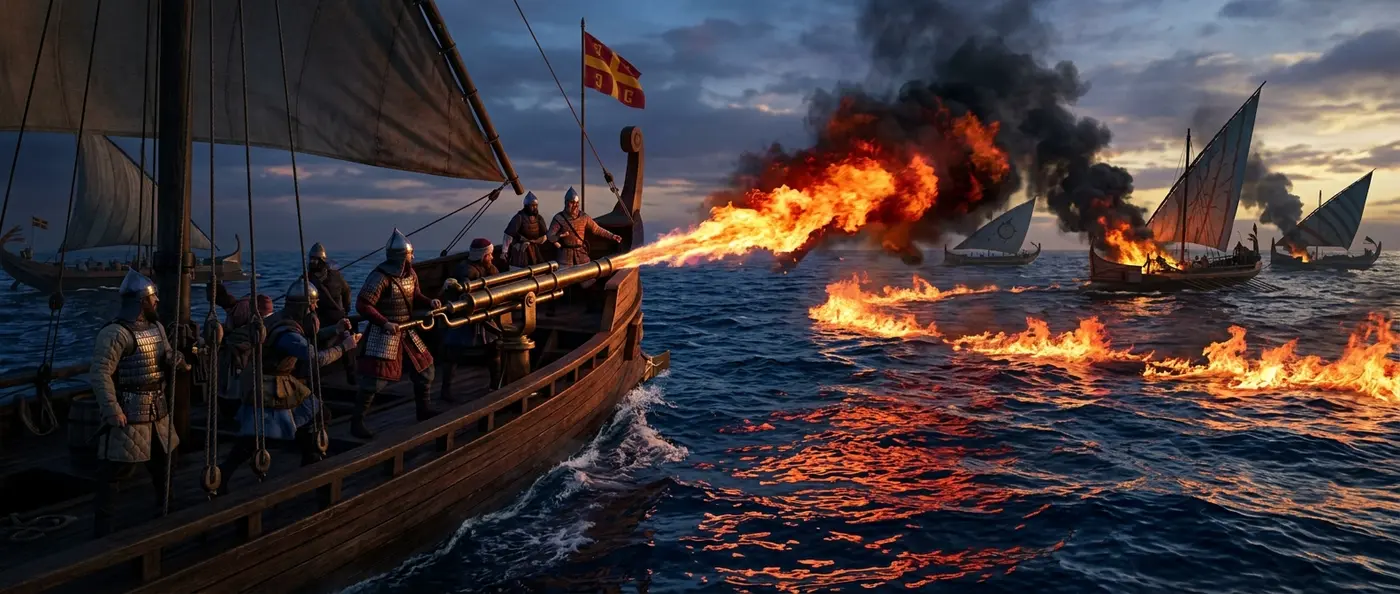
Water makes fire die. That's physics 101. But for seven centuries, Byzantine warships shot liquid flames that burned hotter when doused with seawater — an impossible nightmare that saved Constantinople from four separate sieges and extended the Eastern Roman Empire's life by centuries. Greek Fire was the ancient world's napalm, a classified weapon so secret that its formula died with the empire. No enemy ever cracked the code.
🔥 The Inventor: Callinicus and the Birth of Terror
The man who changed naval warfare forever was a refugee. Callinicus fled Muslim-conquered Syria around 668 AD, carrying his chemical knowledge to Constantinople just as Arab fleets were closing in on the Byzantine capital. Callinicus arrived at the perfect moment. Emperor Constantine IV faced an existential threat: three massive Arab armadas had already conquered Sicily, Crete, and most Christian territories across the Mediterranean. Traditional weapons weren't working.
Callinicus wasn't starting from scratch. Ancient armies had used pitch, naphtha, sulfur, and pine resin for centuries. But his mixture was different — lethally different. The base was likely petroleum distilled from Crimean or Black Sea deposits, a process requiring sophisticated technology for the 7th century. Modern researchers suspect the formula included quicklime (which reacts violently with water, generating heat), sulfur to boost combustion temperature, pine resin as a thickening agent, and possibly saltpeter — an early form of gunpowder. The preparation process was extraordinarily dangerous. One wrong measurement could trigger catastrophic explosions. The distillation alone required precision that wouldn't be matched for centuries.
Greek Fire's deadliness came from more than chemistry — the delivery system was equally advanced. Bronze tubes mounted on warships could spray flames 30 to 50 feet with rotating nozzles that allowed operators to aim in any direction, even during rough seas. The ships carrying this weapon were dromons — fast attack vessels powered by both sails and oars, perfect for hit-and-run tactics. When Bulgarians once captured an entire Greek Fire apparatus with significant quantities of the liquid, they never managed to make it work. The operational knowledge was as classified as the formula itself.
700+
Years as state secret
4
Sieges of Constantinople repelled
⚔️ The Delivery System: Engineering Centuries Ahead
Greek Fire wasn't just a flammable liquid — it was a complete weapons platform that combined chemistry, metallurgy, and hydraulic engineering in ways that wouldn't be surpassed until the age of gunpowder. The bronze components included a launch tube, high-pressure siphon pump, and rotating nozzle that let operators direct flames up, down, left, or right during the chaos of naval combat. Dromons carrying this system could reach impressive speeds, making their attacks nearly impossible to evade.
One incident reveals the system's complexity: when Bulgarians captured a complete launch system along with substantial quantities of the liquid, they never got it working. The operational expertise was as secret as the mixture itself — only trained specialists knew how to regulate pressure, temperature, and flow rates. In 2006, researcher John Haldon built a full-scale replica using reconstructed components and Crimean petroleum, achieving 30-50 foot flame projection that incinerated everything in seconds. The Madrid Skylitzes manuscript from the 12th century, showing a ship of Michael II launching Greek Fire during Thomas the Slav's siege (821–822 AD), confirms the written sources.
Greek Fire's most terrifying feature: it burned hotter on water, defying every law enemies understood. The petroleum base, combined with quicklime that reacts exothermically with water, created a self-feeding combustion system. Instead of extinguishing the flames, quicklime generated more heat when more water was thrown on it. Enemy crews trying to douse fires with buckets of seawater actually intensified them, plunging their ships into even greater hell. No known extinguishing method worked — not soaked animal hides, not safe distance, not even attacking during storms. According to Byzantine historian Theophanes, "it caused such terror among enemies that they trembled."
🏛️ The Battles That Saved an Empire
By the late 7th century, the Arab world was devouring vast stretches of Christian Mediterranean territory. Sicily, Tarsus, and large parts of North Africa had fallen — even mighty Rhodes with its famous Colossus. The Arab fleet seemed invincible, dominating every naval engagement. Then, in 678 AD, three Arab fleets reached Constantinople's waters, occupied an island opposite the capital, and began a four-year siege. The situation was desperate — Byzantines needed a miracle, and Greek Fire was exactly that.
Byzantine ships emerged spraying flames, caught the Arabs completely off guard with a weapon they'd never encountered, and the enemy fleet was utterly destroyed. Fiery waves ran across the water, setting sails, timber, and men ablaze. In a second critical moment, 717–718 AD, Emperor Leo III the Isaurian used Greek Fire to break an Arab blockade that had lasted an entire year — a siege during which the capital faced famine and plague. The naval supremacy provided by Greek Fire decided the battle.
Decades later, in 941 AD, Romanos I destroyed a Russian fleet threatening the capital. Liutprand of Cremona, an eyewitness, recorded: "The Russians, seeing the flames, threw themselves hastily from their ships, preferring to drown in the water rather than be burned alive." In 972 AD, John I Tzimiskes used Greek Fire in land battle — for the first time outside naval warfare — invading Preslav, the Bulgarian capital occupied by Russians, and liberating the Bulgarian king. In 988–989 AD, Basil II combined Greek Fire with the Varangian Guard — the fearsome Viking force — to crush the rebellion of usurper Bardas Phokas.
Naval Supremacy
Dromon ships launched 30-50 foot flames through bronze tubes. Siphon technology and rotating nozzles enabled precision targeting of moving targets at sea.
Fire Grenades
Clay vessels filled with Greek Fire were launched by catapult. Fabric balls soaked in the mixture fell on enemy positions, causing chaos and terror.
Defensive Use
Portable pumps were positioned on fortifications and walls, turning every siege into a nightmare. Even unmanned fire ships were used against enemy fleets.
🏺 The Ultimate State Secret
Emperor Romanos II (959–963 AD) declared that three things must never fall into foreign hands: the imperial regalia, the princesses, and Greek Fire. Historically, the first two were occasionally given to foreign rulers — but never the last. The formula was known only to a handful of people and passed from emperor to successor as a secret of highest security.
This ruthless control kept the secret exclusively in Byzantine hands for over seven centuries — extraordinary in an age of espionage, betrayal, and constant wars. Even when enemies captured equipment and raw materials, the absence of technical knowledge made them useless. The secrecy was so absolute that today, nearly a thousand years after its last use, the exact composition remains unknown to science.
678 AD First use — Arab siege of Constantinople
717-718 AD Leo III breaks year-long Arab blockade
821-822 AD Michael II repels Slavic fleet
941 AD Romanos I destroys Russian fleet
972 AD First land use — Liberation of Preslav
988-989 AD Basil II crushes Bardas Phokas rebellion
🔬 Modern Research and Legacy
After centuries of study, Greek Fire's exact composition remains unknown. The most widespread theory is based on a mixture of naphtha (light petroleum), quicklime (which reacts with water producing heat), sulfur, and resin. Naphtha provides combustibility, quicklime explains why water didn't extinguish the flames, and sulfur increases combustion temperature. Some researchers argue that adding saltpeter (a gunpowder precursor) would explain the ability to launch under pressure.
Greek Fire's legacy extends far beyond the borders of the Byzantine Empire. Historians recognize that without this weapon, Constantinople would have fallen centuries earlier — dramatically changing the course of European history. Historian J.J. Norwich noted characteristically: "Greek Fire's importance to Byzantine survival cannot be overstated." Crusaders encountered similar mixtures as "Greek fire" or "wild fire," but these variants never approached the effectiveness of the original.
After the Fourth Crusade (1202–1204 AD), the use of Greek Fire disappears completely from historical records. The sack of Constantinople by Latin Crusaders likely severed the line of secret transmission — craftsmen were killed or scattered, workshops destroyed, and the imperial bureaucracy that guarded the formula collapsed. The knowledge was lost along with the power of the state that protected it. The appearance of gunpowder in Europe during the 14th century finally filled the gap, but for over 500 years no weapon approached the terror spread by Callinicus's flame — the ancient world's napalm, which gave the Byzantine Empire centuries of life that would otherwise have been denied.
Greek Fire Byzantine Empire ancient weapons Constantinople medieval warfare lost technology Callinicus naval battles