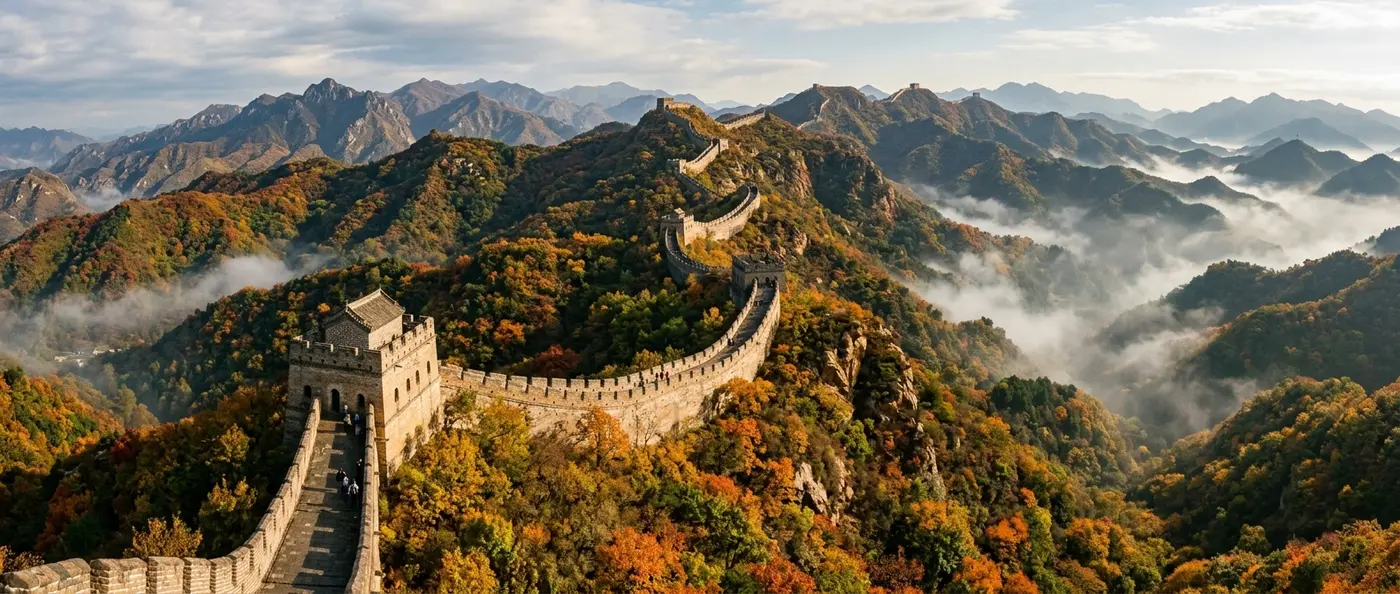
You can't see the Great Wall from space with the naked eye. That myth died when astronauts confirmed it's too narrow to spot. But archaeological digs in China's Shandong Province uncovered something that challenges our timeline: fortified walls built 300 years before what we thought was the beginning of the Great Wall.
📖 Read more: Ancient China's War City: Bones, Sacrifice, and Lost Secrets
🏰 The Discovery That Rewrites History
In early 2025, archaeologists working in eastern China's Shandong Province made a discovery that pushes back the timeline of Chinese fortifications by three centuries. Deep in a narrow mountain pass, they found a 2,800-year-old fortified wall that predates China's first emperor by centuries.
The wall, originally built around 800 BCE, stretched about 10 meters wide. The real surprise came later: during the Warring States period (475-221 BCE), it expanded to 30 meters wide. Archaeologists radiocarbon-dated animal bones and plant remains from the same layer, confirming its age.
Alongside the wall, the team discovered house foundations, roads, and trenches. These finds suggest this wasn't just an isolated fort but an entire defensive system with permanent garrisons.
🗿 The Great Wall of Qi: The Forgotten Ancestor
Professor Gideon Shelach-Lavi from Hebrew University of Jerusalem clarifies that this newly discovered wall isn't part of the famous Great Wall of China. Back then, China was fractured into multiple states that frequently warred with each other, each building their own defensive walls.
The state of Qi, based in northern China, constructed its own "Great Wall" around 441 BCE. This wall, known as the "Long Wall of Qi," stretched east to west across Shandong Province, from Pingyin County to the Pacific Ocean - a distance exceeding 322 kilometers.
Professor Yuri Pines points out that the narrow mountain pass where they found the wall could have been used to invade the state of Qi. The existence of a permanent garrison that tried to fortify the pass is particularly interesting, though this wasn't a "Long Wall" comparable to later efforts.
⚔️ From Warring States to Unification
Construction of the Great Wall as we know it today began under China's first emperor, Qin Shi Huang, who ruled from 221 to 210 BCE. What the first emperor did was unique: he took existing walls from various states - including the Great Wall of Qi - and connected them to create a unified defensive system.
The wall was later modified and renovated during the Ming Dynasty (1368-1644), according to UNESCO. It was built to protect China from nomadic groups living north of the country. The wall controlled key trade routes and military passages between north and south.
Defensive Function
The wall wasn't just a barrier - it included watchtowers, fortresses, and smoke signal communication systems for rapid message transmission.
Trade Control
Wall gates served as checkpoints for Silk Road commerce, collecting taxes and controlling the flow of goods.
Social Organization
Building and maintaining the wall required massive labor organization, with millions of workers participating in the project.
🌍 Myths and Realities
Let's demolish some of the most persistent Great Wall myths. First, it's not visible from space with the naked eye - astronauts confirmed it's too narrow to distinguish. Second, it's not one continuous wall but a series of walls, fortifications, and natural barriers.
Another myth concerns the death toll during construction. While many workers died, stories of millions buried in the foundations are exaggerated. Modern historians estimate hundreds of thousands died during centuries of construction, but exact numbers remain unknown.
💡 Did You Know?
The total length of all Great Wall sections, including branches and secondary walls, is estimated at over 21,000 kilometers - enough to cross the Pacific Ocean!
🌳 The New Great Green Wall
China hasn't stopped building "great walls." Since 1978, the country has planted over 66 billion trees along its borders with Mongolia, Kazakhstan, and Kyrgyzstan. The "Great Green Wall," officially known as the Three-North Shelter Forest Program, is designed to slow soil erosion and halt the expansion of the Gobi and Taklamakan deserts.
Chinese authorities plan to plant another 34 billion trees over the next 25 years. If successful, the Great Green Wall will increase Earth's forest cover by 10% from the late 1970s. By 2050, the "wall" will stretch 4,500 kilometers.
Critics exist, however. Some studies suggest reduced sandstorms are mainly due to climate factors rather than tree planting. The survival rate of planted trees is low, particularly because many areas are planted with only one or two tree species - mainly poplars and willows - making them vulnerable to disease.
🚄 The Modern Wall of Railways
Today, China is building a different kind of "wall" - a high-speed rail network spanning over 45,800 kilometers. For comparison, the European network is about 12,000 kilometers. China just unveiled the world's fastest bullet train, reaching speeds up to 450 kilometers per hour.
This modern "wall" connects the country's vast territory in ways ancient builders could never imagine. From Beijing to Shanghai via Xi'an - a 1,880-kilometer journey - can be completed in just 10 hours. The rail network even includes the Qinghai-Tibet line, an engineering marvel built on permanently frozen ground that crosses some of the world's highest passes.
📊 Ancient vs Modern Wall
🔬 New Discoveries, New Questions
Recent discoveries in Shandong Province remind us that Chinese history continues to hold surprises. Each new excavation reveals the complexity of ancient Chinese civilizations and their sophisticated engineering.
The fact that fortifications of this scale were built 2,800 years ago shows that the need for defense and territorial control was central to ancient Chinese thinking much earlier than we believed. These discoveries also highlight the importance of regional history - it wasn't just great empires that left their mark, but smaller states with their own ambitions and concerns.
With systematic surveys of China's mountain passes just beginning, more pre-imperial walls likely remain buried. The famous Great Wall may be just the final version of a defensive tradition that started centuries earlier than anyone realized.