📖 Read more: 2,000-Year-Old Pharaoh Ship Found Off Alexandria
🗿 The Sphinx That Refuses to Spill Its Secrets
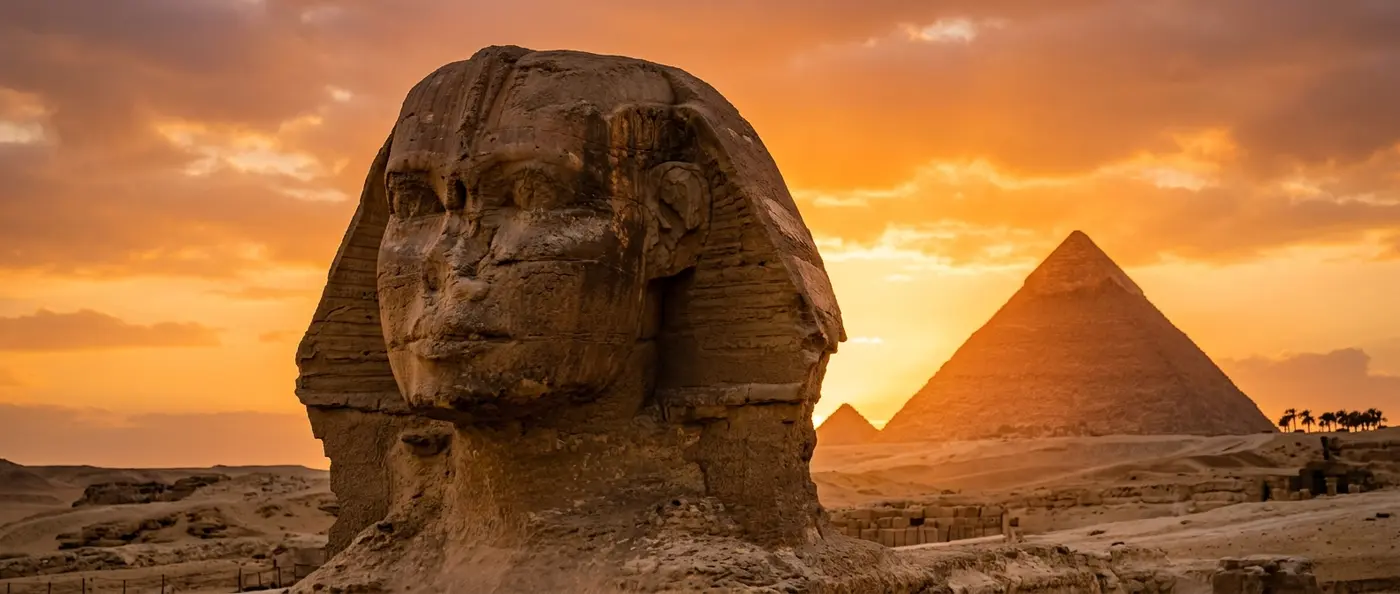
The Great Sphinx of Giza defies explanation. At 240 feet long and 66 feet tall, this human-headed, lion-bodied giant has generated more questions than modern archaeology has answered. Despite decades of research, fundamental questions about its construction, purpose, and true age remain unsolved.
No ancient inscriptions explicitly mention who built the Sphinx or when. Most Egyptologists credit Pharaoh Khafre (circa 2558-2532 BCE), basing this on circumstantial evidence and its proximity to his pyramid. But this dating isn't universally accepted.
The silence is strange for a monument this size. Ancient Egyptians were meticulous record-keepers, especially for monumental projects. Why is the Sphinx an exception? Could it be far older than we think?
💡 Did You Know?
The Sphinx was buried up to its neck in sand for most of its history. Thutmose IV (1401-1391 BCE) first excavated it — roughly 1,000 years after its supposed construction!
🔬 New Discoveries That Raise More Questions
Recent archaeological surveys at Giza have unearthed new evidence that complicates the mystery further. According to a study published in Archaeological Prospection in May 2024, a Japanese-Egyptian team discovered a mysterious L-shaped structure in Giza's western cemetery using electrical resistivity and ground-penetrating radar.
The structure sits about 6.5 feet underground and stretches at least 33 feet long. Someone filled it with sand after building it — a deliberate burial. Professor Motoyuki Sato from Japan's Tohoku University, who leads the research, is certain it's human-made because "the shape is too sharp to be a natural phenomenon."
⚔️ The Erosion That Sparks Controversy
One of the most contentious issues surrounding the Sphinx involves erosion patterns on its body. Some researchers argue these patterns indicate exposure to heavy rainfall over extended periods — which would place its construction thousands of years before the official dating, during an era when Egypt's climate was far wetter.
This theory, while disputed by mainstream Egyptology, raises fascinating questions. If the Sphinx is truly much older, who built it? Was there an earlier, unknown civilization in the region?
🏺 Hidden Chambers and Ancient Legends
Ancient Egyptians and later Arab historians spoke of secret chambers and passages beneath the Sphinx. Herodotus, who visited Egypt in the 5th century BCE, mentioned underground chambers, though it's unclear if he was referring to the Sphinx or the pyramids.
Modern geophysical surveys have indeed detected anomalies beneath the monument. In 1991, a team led by Dr. Robert Schoch used seismic tomography and found what appears to be rectangular chambers beneath the Sphinx's front paws. However, Egyptian authorities haven't permitted further investigation of these anomalies.
Why this reluctance? Fear that new discoveries might overturn established historical narratives? Or do authorities want to protect the monument from potential damage?
🔱 The Constellation Connection
Some researchers link the Sphinx to the constellation Leo. Some researchers argue the Sphinx gazes precisely toward the horizon point where Leo rose during the spring equinox around 10,500 BCE. This would suggest a much older origin for the monument.
This theory has problems. No archaeological evidence supports such an advanced civilization in Egypt at that time. But lack of proof doesn't disprove the idea.
The Enigmatic Gaze
The Sphinx stares directly east, toward the sunrise during equinoxes. This orientation can't be coincidental and suggests profound astronomical knowledge.
The Mismatched Face
The Sphinx's face is disproportionately small compared to its body. Some researchers believe it originally depicted a lion and was later recarved into a human head.
Water's Mark
Vertical erosion patterns on the Sphinx's body resemble rainfall damage more than sand and wind erosion, sparking heated debates about its age.
📖 Read more: Ancient Indian Graffiti Found in Egyptian Royal Tombs
📜 Lost Ancient Testimonies
The Library of Alexandria, before its destruction, contained countless texts about ancient Egypt. Likely among them were documents explaining the Sphinx mystery. Unfortunately, this knowledge was lost forever.
Medieval Arab historians recorded traditions speaking of the Sphinx as guardian of ancient treasures and forbidden knowledge. Al-Maqrizi, in the 15th century, wrote about a secret entrance to the Sphinx leading to underground chambers filled with ancient texts and artifacts.
The sphinx concept isn't limited to Egypt. Similar mythical creatures appear in many ancient civilizations, from Greece to Mesopotamia and India. Did all these cultures share a common source?
In Greek mythology, the sphinx was a monster that posed riddles to travelers. Perhaps this myth reflects a deeper truth — that the Sphinx of Giza is itself a riddle waiting to be solved.
🏛️ Sphinxes Around the World
🔬 Modern Tech, Ancient Mysteries
Recent technological advances offer new ways to investigate the Sphinx's mysteries without damaging the monument. The Scan Pyramids project uses cosmic rays (muons) to "see" inside pyramids. Similar techniques could be applied to the Sphinx.
Each discovery creates new puzzles. The L-shaped structure in the western cemetery, for instance, doesn't match any known type of Egyptian architecture. What purpose did it serve? Why was it deliberately buried?
💀 The Cemetery That Hides Secrets
Giza's western cemetery, where the mysterious structure was found, served as the burial ground for royal family members and high-ranking officials. Most tombs have above-ground structures known as mastabas. But there's an area in the cemetery's center where no above-ground construction has been found.
Why this void? Does it hide something more significant than simple tombs? The Japanese-Egyptian team that discovered the L-shaped structure believes it might be something entirely different from anything found in the area so far.
🔍 Revelation Technology
Electrical resistivity tomography (ERT) and ground-penetrating radar (GPR) used in the discovery can "see" up to 65 feet underground without excavation. These techniques reveal a hidden world beneath the sand.
🌅 The Eternal Enigma
After millennia of study, the Great Sphinx of Giza remains one of humanity's greatest mysteries. Each new discovery, instead of solving the riddle, seems to make it more complex. Recent discoveries of underground structures and hidden entrances suggest we've barely scratched the surface of Giza's secrets.
Perhaps the Sphinx's real message isn't something to decode, but a reminder of the humility we should have toward the past. Its ancient builders, whoever they were, managed to create a monument that continues to challenge and inspire us.
As technology evolves and new research methods become available, some of the Sphinx's mysteries will likely be revealed. Until then, this ancient colossus will continue standing silent in the desert, guarding its secrets and challenging our imagination.
What lies beneath the Sphinx? Who really built it and why? These questions may never be fully answered. And perhaps that's part of its magic — an eternal riddle reminding us that despite all our progress, mysteries still await discovery.