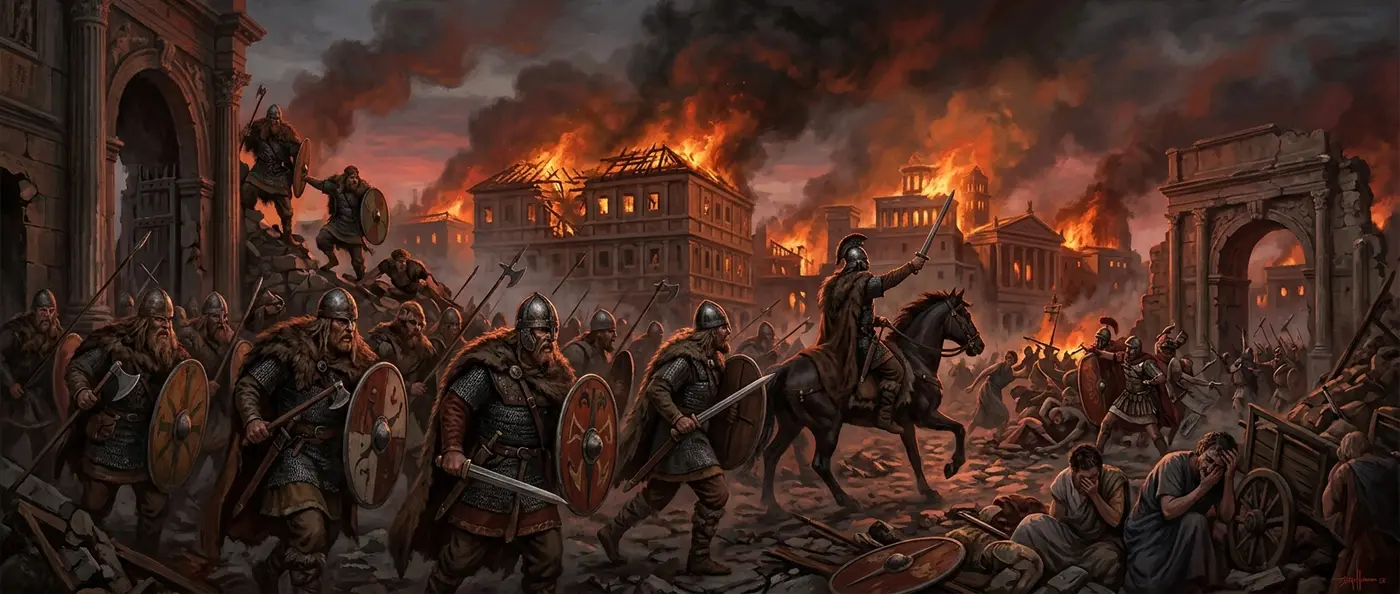
August 24, 410 AD. For the first time in 800 years, foreign boots marched through Rome's streets. Alaric's Visigoths had breached the gates of the Eternal City, marking the beginning of the end for the greatest empire the western world had ever known. Forty-five years later, in 455 AD, the Vandals would finish what the Goths started, systematically stripping Rome bare for two full weeks.
🗡️ Who Were Rome's "Barbarians"
To Romans, "barbarian" didn't just mean savage or uncivilized. It was their catch-all term for anyone living beyond the empire's borders who didn't speak Latin or Greek. The Goths and Vandals were Germanic tribes who had spent centuries on the empire's periphery, sometimes as allies, sometimes as enemies, but always as outsiders looking in.
The Goths split into two major branches: the Visigoths (Western Goths) and the Ostrogoths (Eastern Goths). They'd originally settled north of the Danube River in modern-day Romania. The Vandals started their journey from what's now Poland, gradually migrating west and south over generations.
These weren't mindless hordes of warriors. They had kings, laws, craftsmen, and churches. Many had already converted to Christianity, though in the Arian form that Romans considered heretical. The image of the "savage barbarian" destroying civilization is more myth than reality.
⚔️ The Great Migration of Peoples
The Germanic tribes' movement into Roman territory wasn't a sudden invasion. It was part of a massive demographic shift historians call the "Great Migration of Peoples," lasting from the 4th to 6th centuries AD. The initial push came from the Huns, nomadic warriors from the Central Asian steppes whose westward expansion forced Germanic tribes to seek new homelands.
In 376 AD, thousands of Visigoths requested asylum in the Roman Empire, fleeing Hun aggression. Emperor Valens allowed them to cross the Danube and settle in the Balkans. But mistreatment by Roman officials sparked rebellion. At the Battle of Adrianople in 378 AD, the Visigoths destroyed a Roman army and killed the emperor himself.
For decades afterward, the Visigoths wandered the Balkans, sometimes fighting, sometimes serving as mercenaries in Roman armies. Under Alaric, a charismatic warrior who'd served in Roman ranks, they began moving toward Italy in the early 5th century.
🏛️ The First Sack: Alaric and the Visigoths (410 AD)
Alaric wasn't some bloodthirsty conqueror bent on destruction. For years he'd tried negotiating with Rome, seeking land for his people and official recognition within the imperial hierarchy. The Romans, under weak Emperor Honorius who'd moved his capital to Ravenna, repeatedly refused.
After three sieges of Rome, the third proved fatal. On August 24, 410 AD, the city's gates opened — whether through treachery or starvation — and the Visigoths poured in. For three days they looted the city, but Alaric, a Christian (albeit Arian), ordered churches spared and protected those who sought sanctuary within them.
The shock reverberated across the empire. Rome, the eternal city that hadn't fallen to foreign hands since the Gauls in 390 BC, had been violated. Saint Jerome wrote: "My voice sticks in my throat, and sobs interrupt my words as I write. The city that conquered the whole world has itself been conquered."
Alaric the Visigoth
Born around 370 AD, he initially served as an officer in Roman armies. Became king of the Visigoths in 395 AD and led his people on a decade-long journey through the Balkans and Italy, searching for a homeland where they could settle permanently.
Military Organization
The Visigoths had adopted many Roman military tactics. They used heavy cavalry, Roman-style armor, and organized infantry formations, combining these with traditional Germanic fighting prowess to create formidable armies.
Arian Christianity
Most Goths had converted to Christianity through Bishop Ulfilas in the 4th century, but followed Arianism, which rejected Christ's divinity. This theological difference made Romans view them as heretics, blocking any path to peaceful settlement.
🚢 The Vandals: From Spain to Africa
While the Visigoths eventually settled in southern France and Spain, creating a kingdom that would last centuries, another Germanic tribe followed a different path. The Vandals, along with the Alans and Suebi, had crossed the frozen Rhine in 406 AD, invading Gaul.
After years of wandering and conflict, the Vandals ended up in Spain. There they faced pressure from Visigoths expanding from Gaul. Under this pressure, their king Genseric made a bold decision: in 429 AD he led his entire people — roughly 80,000 souls — across the Strait of Gibraltar into North Africa.
Roman Africa was the empire's breadbasket, a wealthy province that fed Rome with grain. The Vandals conquered the region rapidly, and in 439 AD captured Carthage, the Western Empire's second-largest city. From there, Genseric built a powerful fleet and transformed the Vandals into the dominant naval force in the western Mediterranean.
🌊 Did You Know?
The Vandals were the only Germanic tribe to create a powerful navy. Their fleet terrorized the Mediterranean for decades, conducting piratical raids from Sicily to Greece. Their naval power was so formidable that in 468 AD they destroyed a massive Byzantine fleet sent against them.
💀 The Second Sack: Genseric and the Vandals (455 AD)
By 455 AD, Rome was in chaos. Emperor Valentinian III had been assassinated and his successor Petronius Maximus was trying to force marriage on the dead emperor's widow, Eudoxia. According to some sources, Eudoxia invited Genseric to Rome, perhaps hoping for protection or revenge.
The Vandal fleet arrived at the port of Ostia in June 455. Petronius Maximus tried to flee but was killed by the mob. When the Vandals entered the city on June 2, there was no meaningful resistance. Pope Leo I went out to meet Genseric, as he had done with Attila years earlier, and secured a promise that there would be no massacres.
For two weeks, the Vandals systematically looted Rome. Unlike the Visigoths, who'd limited themselves to three days, the Vandals had time and organization. They loaded their ships with enormous treasures: gold and silver objects, statues, even the bronze roof tiles from the Temple of Jupiter Capitolinus. They also took thousands of captives, including Empress Eudoxia and her two daughters.
🏰 The Legacy of the "Barbarians"
The word "vandalism" in modern languages comes from the Vandals and their reputation as destroyers of civilization. But reality is more complex. Both Goths and Vandals weren't simply destroyers. They were peoples seeking their place in a rapidly changing world.
In the kingdoms they created, they preserved many elements of Roman civilization. The Visigoths in Spain adopted Roman law and the Latin language. The Visigothic Kingdom lasted until the Arab conquest in 711 AD and left a significant legacy in Spanish culture. Their laws, known as the Liber Iudiciorum, influenced medieval Spanish law for centuries.
The Vandals in Africa created a flourishing kingdom that lasted a century. Carthage under their rule remained a center of trade and culture. They maintained Roman administrative structures and the monetary system. Only in 534 AD did the Byzantine general Belisarius manage to reconquer Africa for the empire.
⚖️ Comparing the Two Sacks
📜 The End of an Era
The sacks of Rome by Goths and Vandals didn't cause the fall of the Western Roman Empire, but they were symptoms of its decline. The empire was already bleeding: empty treasuries, defeated armies, murdered emperors, and provinces in revolt.
In 476 AD, when the Germanic warlord Odoacer deposed the last western emperor, the young Romulus Augustulus, there was little surprise. The Western Empire had already fragmented into barbarian kingdoms. The "barbarians" hadn't destroyed Rome — they'd transformed it.
The story of the Goths and Vandals teaches us that imperial collapse is rarely the result of external conquest alone. It's a complex process where internal weakness meets external pressure. Alaric had served in Roman armies. Genseric adopted Roman administrative systems. These conquerors didn't seek Rome's destruction — they claimed its inheritance.