🏛️ Monuments That Defied Time
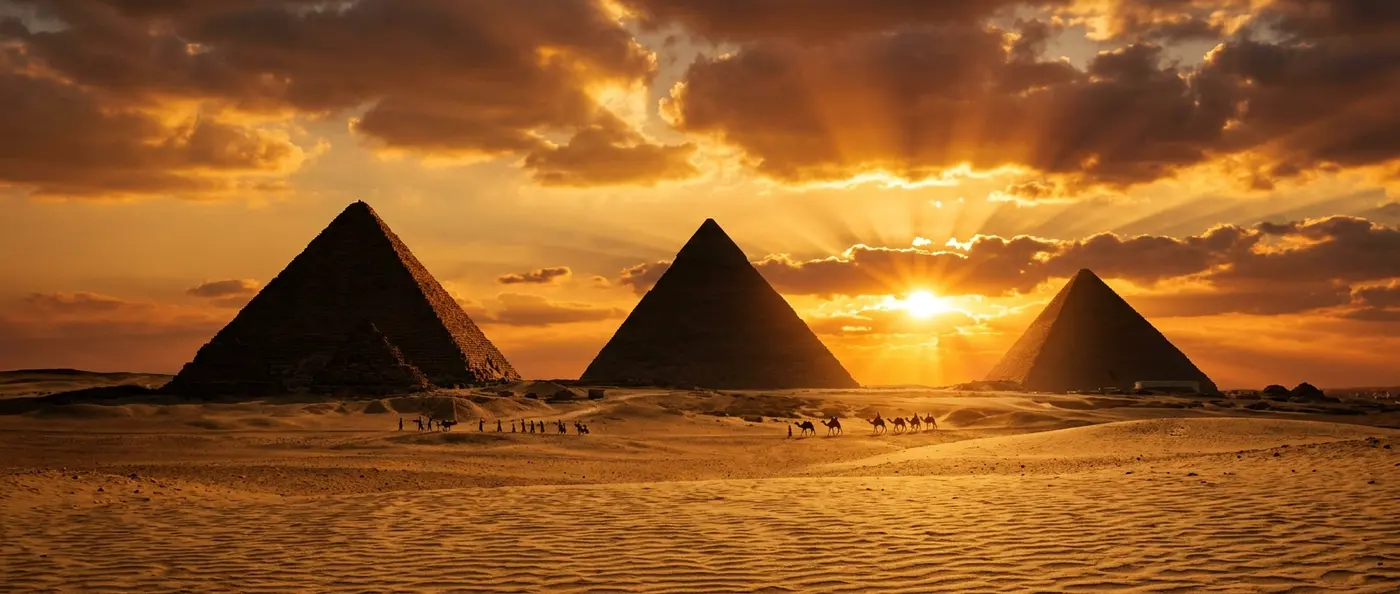
Three pyramids rise from the rocky plateau on the Nile's western bank, overlooking ancient Memphis. Built during the 4th Dynasty (approximately 2575-2465 BCE), they're the only survivors among the Seven Wonders of the Ancient World. UNESCO added them to its World Heritage list in 1979, alongside the ancient ruins of the broader Memphis region.
The Great Pyramid of Khufu (Cheops) dominates the complex as its oldest and largest member. Originally standing 147 meters tall, erosion and the removal of smooth limestone casing stones that once covered its exterior have reduced it to 137 meters. Each base side measures 230 meters, with all four sides aligned to the cardinal directions to within a fraction of a degree.
The middle pyramid belongs to Khafre (Chephren), the fourth king of the 4th Dynasty. With an original height of 143 meters and sides of 216 meters, it still preserves part of its original limestone casing at the summit. The smallest pyramid, belonging to Menkaure (Mykerinos), stands just 66 meters tall with 109-meter sides, but its construction matches the technical excellence of its larger neighbors.
⚒️ The Construction Enigma
How did ancient Egyptians transport and position 2.3 million stone blocks, each weighing an average of 2.5 tons? Scientists converge on the theory that they used a system of inclined ramps made from brick, earth, and sand. These ramps grew in height and length as the pyramid rose, allowing workers to drag the blocks using sledges, rollers, and levers.
Ancient Greek historian Herodotus claimed the Great Pyramid took 20 years to complete and employed 100,000 workers. Modern archaeologists estimate that a permanent workforce of 20,000, plus support staff (bakers, doctors, priests), would have sufficed. These workers likely labored on the project mainly during Nile flood seasons, when agricultural work became impossible.
The interior walls of the pyramids and the few surviving exterior slabs show joints so perfect that not even a knife blade fits between them. This precision surpasses any other stonework in ancient Egypt—a feat that would challenge modern construction crews.
🗿 Interior Architecture
Despite their massive bulk, the pyramids contain minimal interior space. The Great Pyramid's entrance sits on the north face, 18 meters above ground. A descending passage penetrates the pyramid's interior and ends in an unfinished underground chamber. From there, an ascending passage leads to the so-called "Queen's Chamber" and the Grand Gallery.
The Grand Gallery is an impressive 46-meter corridor with a corbelled ceiling. At its end, a narrow passage leads to the "King's Chamber," entirely lined with granite. Two narrow shafts start from this chamber, cutting diagonally through the pyramid to reach the exterior — their purpose remains debated among researchers.
Hidden Passages
A hidden corridor was discovered in 2023 using 3D scanners. Non-invasive technologies continue revealing new pyramid secrets.
Protective Slabs
Five compartments with massive granite slabs sit above the King's Chamber, protecting the ceiling from the overlying mass's weight.
Mysterious Shafts
The two narrow shafts from the King's Chamber may have served religious purposes or functioned as a ventilation system.
📜 Archaeological Discoveries
Official excavations at the Great Pyramid began in the 19th century. In the 1830s, a British Egyptologist discovered worker graffiti confirming the pyramid belonged to Khufu. Later, two boats were found buried near the Great Pyramid, presumably for the pharaoh's afterlife journey.
Unfortunately, Khufu's remains have never been found. The pyramids were looted both internally and externally from antiquity through the Middle Ages. The grave goods originally placed in the burial chambers have vanished, along with the smooth limestone slabs that covered the pyramids and made them shine in the sun.
The most recent discovery from May 2024 involves an L-shaped structure about 2 meters below the surface in the western cemetery. According to Professor Motoyuki Sato from Japan's Tohoku University, who leads the research, the structure measures at least 10 meters long and appears to have been filled with sand after construction. Excavations to determine its nature are ongoing.
💡 Did you know?
Contrary to popular belief, the Giza pyramids contain no hieroglyphs, treasures, or mummies inside. Pyramid decoration with texts and images began centuries after their construction.
🏺 Cemetery of the Elite
The western cemetery at Giza, where the recent discovery occurred, contains tombs of royal family members and high-ranking officials. Many of these tombs have above-ground structures known as "mastabas" — rectangular buildings of stone or brick with flat roofs.
However, there's an area in the cemetery's center where no above-ground structures have been found. That's exactly where Sato's team focused their research, using electrical resistivity tomography (ERT) and ground-penetrating radar (GPR). These techniques allow detection of underground structures without excavation.
Harvard's Professor Peter Der Manuelian commented that this area has avoided exploration due to the absence of visible structures. While L-shaped offering chapels exist at Giza, they're typically above ground. The new discovery's nature remains a mystery until excavations are complete.
🔬 Modern Technology Serving Archaeology
Since the early 21st century, archaeologists increasingly use non-invasive technologies to study the pyramids. 3D scanners, thermal cameras, cosmic rays, and other advanced methods reveal hidden structures without risking the monuments' integrity.
The research leading to the L-shaped structure's discovery ran from 2021 to 2023 by a joint team from Higashi Nippon International University, Tohoku University, and Egypt's National Institute of Astronomy and Geophysics. This collaboration shows how the international scientific community continues its intense interest in ancient Egypt's secrets.
📊 The Three Pyramids by Numbers
🌍 World Heritage and Tourism
The Giza pyramids rank among the world's most popular tourist destinations. In 2024, Egypt welcomed 15.7 million tourists, aiming to reach 30 million by 2028. The Giza area has undergone extensive renovation since 2009, with a new visitor center and electric buses transporting visitors to the archaeological site.
The Grand Egyptian Museum opened fully in November 2025 near the pyramids. With 872,000 square feet of exhibition space, it's the world's largest museum dedicated to a single civilization. For the first time since 1922, it displays Tutankhamun's entire collection of 5,000 golden treasures in one space.
Despite centuries of study and research, the Giza pyramids continue hiding secrets. Each new discovery, like the L-shaped structure, reminds us that these ancient wonders still have much to teach us about the intelligence, organization, and technical capabilities of the ancient Egyptians.