📖 Read more: Mesopotamian Gods: Enlil, Marduk, and Ishtar
📜 The Discovery That Shook the World
The story behind the Epic of Gilgamesh's discovery rivals the epic itself for drama. George Smith, son of a working-class London family, left school at 14 to apprentice at a publishing house. His job demanded attention to detail — a skill that would prove invaluable later.
His workshop sat near the British Museum, and Smith began spending lunch breaks studying clay tablets recently hauled back from Nineveh. Thousands of fragments from Ashurbanipal's library — the 7th-century BC Assyrian king's collection — waited for someone to crack their code. Smith taught himself Akkadian and cuneiform script, impressing experts with his knack for matching broken pieces.
In November 1872, one particular tablet (known today as K.3375) caught his eye. As he brushed away centuries of dust and read the characters, he realized it described a flood. The tablet told how a ship came to rest on Mount Nizir, how a dove was sent out and returned finding no dry land. This was Tablet XI of the Epic of Gilgamesh — and its similarity to the biblical Noah's flood was undeniable.
🏛️ Humanity's First Literary Work
The Epic of Gilgamesh isn't just an ancient story. It's considered the first major literary work in human history, with roots reaching back at least to the 3rd millennium BC. The tale of the demigod king of Uruk and his quest for immortality has profoundly influenced world literature.
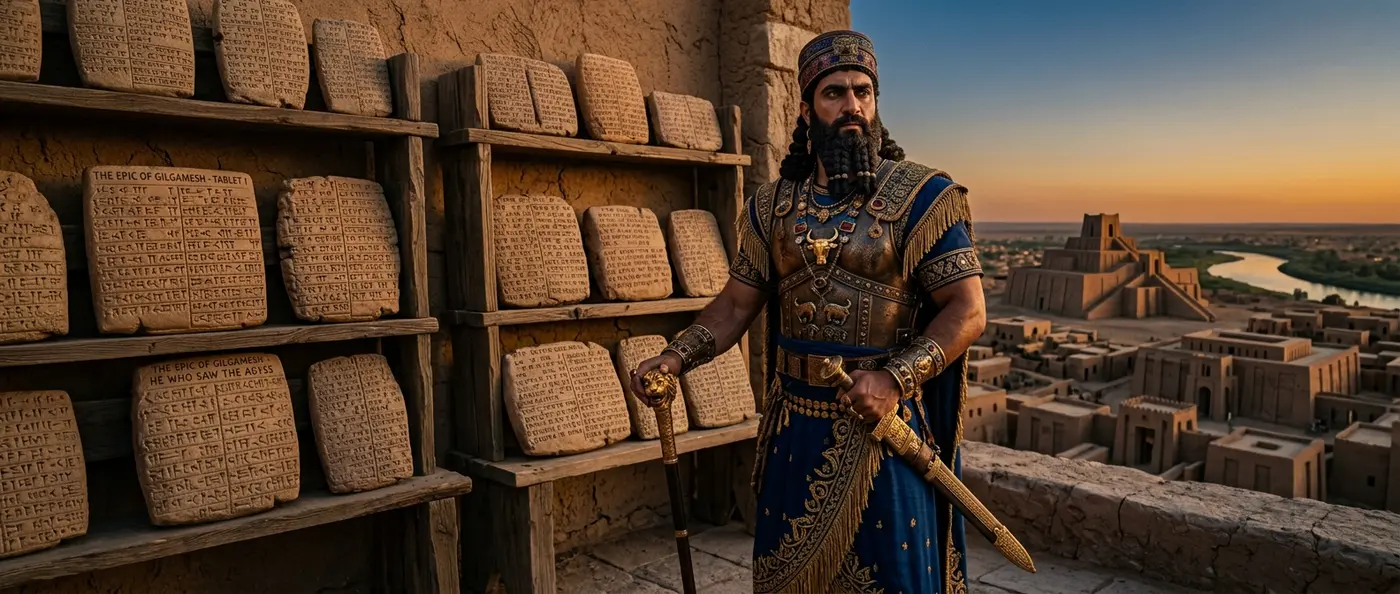
The epic survived in various versions and languages — Sumerian, Akkadian, Babylonian, Hittite, and Hurrian. The most complete version comes from Ashurbanipal's library at Nineveh, dating to the 7th century BC and consisting of 12 clay tablets. Each tablet contains roughly 300 lines, creating an epic of approximately 3,000 lines total.
The creation and preservation of the epic reveals the complexity of ancient Mesopotamian society. Scribes who copied the text were highly educated, as cuneiform writing required years of apprenticeship. The fact that the epic was copied and preserved for millennia shows its importance to ancient civilizations.
⚔️ The Story of Gilgamesh
Gilgamesh appears as king of Uruk, two-thirds god and one-third human. At the epic's start, he's a tyrant oppressing his people. The gods, hearing human complaints, create Enkidu, a wild man who lives with animals, to challenge Gilgamesh.
After an initial clash, the two men become inseparable friends and embark on adventures together. They kill Humbaba, guardian of the Cedar Forest, and the Bull of Heaven sent by goddess Ishtar. But the gods punish their hubris by causing Enkidu's death.
Devastated by his friend's death and terrified of his own mortality, Gilgamesh begins a journey to find immortality. In his quest, he meets Utnapishtim, the only human who has won eternal life. Here appears the flood story that Smith discovered.
🌊 The Great Flood
According to the epic, the gods decided to destroy humanity with a flood. The god Ea warned Utnapishtim to build a massive ship and save his family along with "birds and beasts of every kind." The flood lasted six days and six nights. When the waters receded, the ship came to rest on Mount Nizir.
🔱 Themes and Symbolism
The Epic of Gilgamesh isn't simply an adventure story. It tackles fundamental questions of human existence that remain relevant today. The search for immortality, fear of death, the value of friendship, the relationship between humans and nature, the limits of human power — all are examined through the hero's adventures.
Gilgamesh's transformation from tyrant to wise leader reflects human maturation. His friendship with Enkidu transforms him, while his friend's death forces him to confront his own mortality. Ultimately, though he fails to win physical immortality, he understands that true immortality comes through the works and legacy one leaves behind.
The epic also explores the relationship between civilization and nature. Enkidu begins as a wild man living harmoniously with animals, but becomes "civilized" and joins Uruk's urban society. The destruction of the Cedar Forest by the two heroes can be read as an early ecological allegory about human exploitation of nature.
Quest for Immortality
Gilgamesh travels to the ends of the earth seeking the secret of eternal life, encountering gods and monsters along his path.
Power of Friendship
The Gilgamesh-Enkidu relationship is the epic's emotional center, showing how friendship transforms people.
Confronting Death
The epic examines the universal human fear of death and acceptance of mortality as part of the human condition.
📚 Influence on the Bible and World Literature
Smith's discovery brought to light stunning similarities between the Mesopotamian flood and the biblical story of Noah. In both cases, gods/God decide to destroy humanity with a flood. A righteous man is warned to build a ship and save his family and representatives of all animals. After the flood, birds are sent to check if the waters have receded.
These similarities suggest that the flood story was widespread in the ancient Near East, long before the Hebrew Bible was written. Archaeologists have discovered even older cuneiform tablets with similar flood stories, indicating the theme circulated for millennia.
Beyond the Bible, the Epic of Gilgamesh has influenced countless works of world literature. Themes like the heroic quest, confronting death, and the importance of human connection that first appear in the epic are repeated in works from Homer's Odyssey to modern literature.
🗿 Archaeological Expeditions and New Discoveries
After Smith's discovery, the Daily Telegraph funded an expedition to Nineveh to find the epic's missing pieces. Amazingly, within just a few days of digging, Smith found fragments that completed the flood story. This success led to further expeditions and discovery of additional epic portions.
Mesopotamian excavations continued through the 20th and 21st centuries, bringing to light new fragments and versions of the epic. Each new find adds details to our understanding of this ancient text. Modern technologies like digital imaging and artificial intelligence help researchers decipher worn sections and connect fragments housed in different museums worldwide.
In 2023, researchers at Ludwig Maximilian University in Germany developed an AI tool called "Fragmentarium" to digitally connect ancient Babylonian texts. The software can match fragments stored in different museums across continents — potentially reuniting pieces of tablets separated for over a century.
📊 The Epic in Numbers
🌍 Global Legacy and Modern Significance
Today, the Epic of Gilgamesh is recognized as a fundamental work of world cultural heritage. It's taught in universities worldwide, has been translated into more than 40 languages, and continues to inspire artists, writers, and thinkers.
The timeless nature of its themes makes it relevant in the 21st century. In an age when science promises extension of human life and perhaps someday "immortality," Gilgamesh's thoughts on the meaning of life and death remain deeply relevant. The epic's emphasis on the importance of human relationships and the legacy we leave behind resonates in a world seeking meaning beyond material success.
The epic also has special significance for Middle Eastern peoples as proof of the region's rich cultural past. In an era when archaeological sites are threatened by wars and looting, preserving and studying such texts becomes even more urgent.
As new technologies enable deeper analysis of ancient texts, the Epic of Gilgamesh continues revealing new facets. Each new discovery, each new translation, each new interpretation adds to our understanding not only of the ancient world, but of ourselves. Because at its core, the Epic of Gilgamesh is a story about what it means to be human — a story that began 4,000 years ago and continues being told today.