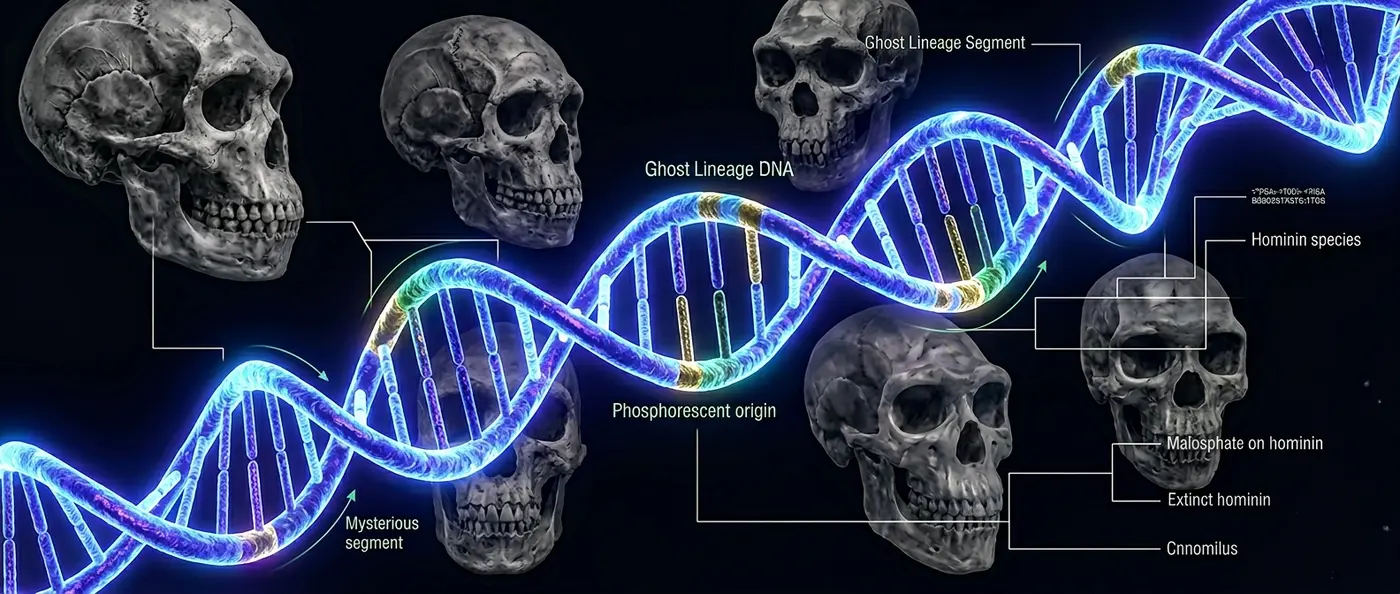
🧬 The Mystery of Ghost Lineages
Ghost lineages are human populations we never knew existed from skeletal remains. Their existence only came to light through statistical analysis of ancient and modern DNA. These groups lived isolated for tens of thousands of years, leaving genetic traces in modern populations like fingerprints from a vanished world.
Discovering these hidden lineages became possible thanks to technological breakthroughs in ancient DNA analysis. Scientists can now extract genetic material from bones thousands of years old, even in challenging conditions like Africa's hot, humid climate. The petrous bone surrounding the inner ear proved especially valuable — its hardness protects the fragile DNA inside.
These discoveries upend assumptions about human evolution. Multiple groups evolved in parallel, sometimes isolated for dozens of millennia before meeting and mixing with other populations.
🏜️ The Green Sahara Discovery
At the rocky shelter of Takarkori in southwestern Libya, archaeologists uncovered remains of 15 individuals dating from 3,000 to 8,000 years ago. Two of these individuals had naturally mummified in the dry climate, preserving their DNA in stunning condition. Nada Salem from the Max Planck Institute described her shock: "When I got the email from the lab saying we had these incredibly high-quality results, I was speechless."
The period when these people lived was completely different from today's Sahara. Between 14,500 and 5,000 years ago, the desert was a green savanna with lakes and rivers, known as the "Green Sahara" or African Humid Period. Inhabitants hunted and later herded animals in an environment that resembled modern central Africa more than desert.
These people belonged to a completely unknown lineage. Their DNA showed they diverged from sub-Saharan African populations around 50,000 years ago. Despite the two pairs of individuals living 5,000 years apart, they had remarkably similar genetic characteristics, suggesting their population remained stable and isolated for millennia.
Even more intriguing, the individuals from each time period were relatives. The 3,000-year-old pair were second-degree relatives, like uncle and niece, while the 8,000-year-old pair were fourth-degree relatives. Mary Prendergast commented: "Maybe this was like a family cemetery. It might have been special for reasons we can't fully understand."
🗿 The Xingyi Mystery in China
Thousands of miles away, in Yunnan province of southwestern China, another discovery brought to light yet another ghost lineage. At the Xingyi archaeological site, beneath dozens of Neolithic and Bronze Age burials, researchers found the skeleton of a woman with no grave goods.
Radiocarbon dating showed she lived around 7,100 years ago, and isotopic analysis of her diet suggests she was likely a hunter-gatherer. But genomic analysis revealed something completely unexpected: her ancestry wasn't similar to East and South Asian populations, but was closer to a "deeply divergent" Asian population.
💡 The Tibet Connection
Xingyi_EN's DNA revealed she belongs to the mysterious "ghost" ancestry found only in modern Tibetans. This lineage diverged from other humans at least 40,000 years ago and remained isolated for thousands of years before mixing with other populations.
Qiaomei Fu, a paleontologist at the Institute of Vertebrate Paleontology and Paleoanthropology in Beijing, explained: "The possible isolation allowed this ancestry to persist without apparent admixture with other populations. The admixed population persisted for quite some time and contributed genes to some Tibetans today."
The find solves a long-standing mystery about Tibetan ancestry. Previous studies had shown Tibetans have ancestry from northern East Asia along with a unique "ghost" ancestry that had puzzled researchers. Now, for the first time, we have physical evidence of this ancient lineage.
🌍 The First Genetic Analysis of West Africa
In Cameroon, at the rocky shelter of Shum Laka, scientists conducted the first analysis of complete ancient genomes from West Africa. Results from four children who lived 3,000 and 8,000 years ago revealed yet another unexpected complexity in human evolution.
Despite Shum Laka being considered the cradle of Bantu languages spoken today by hundreds of millions of people across Africa, the four individuals weren't genetically related to modern Bantu speakers or to today's inhabitants of western Cameroon. Instead, they were genetically closer to Central African hunter-gatherers.
The Shum Laka Children
An 8-year-old boy buried 3,000 years ago and a 15-year-old boy buried 8,000 years ago provided complete genomes. Two 4-year-old children from the same periods provided additional genetic data.
The Bantu Mystery
Despite the location in the supposed cradle of Bantu languages, the individuals weren't related to modern Bantu speakers, suggesting more complex population movements.
Cultural Exchange
Despite genetic isolation, cultural exchange existed. Pottery from sub-Saharan Africa and the Nile Valley was found in the region.
Savino di Lernia, an archaeologist at Sapienza University of Rome, emphasized: "We know now that they were isolated in terms of genetics, but not in cultural terms. There are many networks that we know from various parts of the continent, because we have pottery that comes from sub-Saharan Africa. We have pottery that comes from the Nile Valley."
🧪 The Technology Behind the Discoveries
Extracting DNA from ancient bones is an extremely difficult process, especially in hot and humid climates like Africa's. High temperatures can rapidly break down DNA, leaving few examples of ancient genetic material in the region. Scientists targeted DNA stored in the petrous bone, an extremely dense bone that encloses the inner ear.
The hardness of this bone offers additional protection to the delicate DNA spirals from the destructive heat and acidic soils of the region. Using advanced sequencing techniques, researchers could reconstruct entire genomes from samples thousands of years old.
Comparing ancient DNA with modern populations requires extensive databases. For the Shum Laka study, researchers compared the ancient genomes with DNA from about 800 modern individuals from Africa, the Middle East, and southern Europe, along with 117 ancient genomes from the same regions.
🔬 What Ghost Lineages Teach Us
Our history isn't a simple linear progression, but a complex network of populations that evolved, migrated, isolated, and eventually mixed.
🧬 Ghost Lineage Characteristics
Mark Lipson, a geneticist at Harvard Medical School, explains: "It gives you access to additional branches of the human tree." These branches represent populations that have vanished as separate groups but continue to exist as DNA traces in distant relatives.
The existence of these isolated populations raises important questions. How did they manage to remain genetically isolated for such long periods? What conditions eventually led to their mixing with other populations? And how many more ghost lineages are waiting to be discovered?
🗺️ Implications for Human Migration
The Green Sahara discoveries have particular significance for understanding human migrations in Africa. For decades, scientists believed the Green Sahara functioned as a migration corridor between sub-Saharan Africa and northern Africa. The new genetic evidence shows something different.
Despite the region being habitable and supporting human populations, there doesn't appear to have been significant genetic exchange between north and south. Populations remained genetically isolated despite geographic proximity. This suggests cultural or social barriers may have been as important as geographic ones in shaping human migrations.
Meanwhile, archaeological evidence shows cultural exchange existed. The spread of pastoralism in the Sahara likely came from interactions with other groups that herded domesticated animals, rather than from large-scale migrations. This shows ideas and technologies can travel independently of genes.
«By shedding light on the deep past of the Sahara, we aim to increase our knowledge of human migrations, adaptations, and cultural evolution in this critical region.»
🔮 The Future of Research
As ancient DNA analysis technology improves, more ghost lineages will emerge from the genetic record. The field has barely scratched the surface of human evolutionary complexity.
Researchers emphasize the need for caution. Carina Schlebusch from Uppsala University warns: "I think we have a lot more to do, and I don't think this should be the final verdict." With only a few samples from each location, the story is likely much more complex than we can see now.
Sarah Tishkoff from the University of Pennsylvania adds that these discoveries "shed light on recent population history from Africa," but emphasizes that more samples are needed to fully understand the picture. Many regions of Africa and Asia remain unexplored from a genetic perspective.
Each ghost lineage reveals how little we know about our own species. Human history stretches back through populations that left no bones, no artifacts—only genetic echoes in our blood. Our ancestors didn't follow a simple route from Africa to the rest of the world, but created a complex mosaic of populations, each with its own unique story.