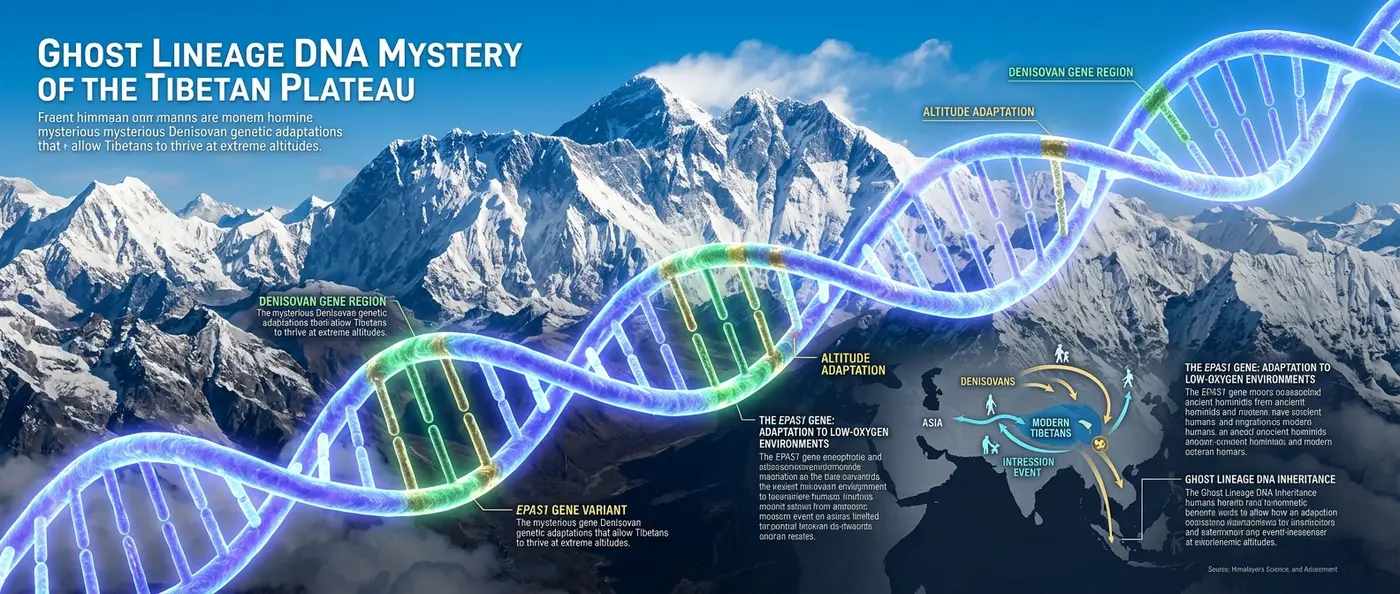
A woman died 7,100 years ago in China's Yunnan province. Her bones lay buried until archaeologists pulled them from the Xingyi site, expecting another routine Neolithic find. Instead, they found something that defied explanation. Her DNA carries the signature of a "ghost lineage" — an unknown human population that split from other groups at least 40,000 years ago and left its genetic fingerprint in modern Tibetans.
🧬 The Discovery That Rewrites Prehistory
The team analyzed 127 ancient human genomes across southwestern China. Most skeletons date between 1,400 and 7,150 years old, all pulled from Yunnan province — the region with China's highest ethnic and linguistic diversity today.
Qiaomei Fu, a paleogeneticist at Beijing's Institute of Vertebrate Paleontology and Paleoanthropology who co-authored the Science study, suspects this skeleton isn't alone. "There were probably more like her, but they just haven't been sampled yet," she explains. Her team thinks ancient humans from this region can explain prehistoric population movements across East and Southeast Asia.
The numbers tell the story. Yunnan's modern diversity — 25 recognized ethnic minorities speaking dozens of languages — has roots stretching back millennia. This woman's genome proves it.
🗿 The Xingyi_EN Enigma
At the Xingyi archaeological site in central Yunnan, researchers uncovered dozens of burials spanning the Neolithic period (7000-2000 BCE) through the Bronze Age (2000-770 BCE). Beneath all other graves, they found a female skeleton with no burial goods.
Radiocarbon dating placed her death around 7,100 years ago. Isotope analysis of her diet suggested she lived as a hunter-gatherer. Then came the genome results.
The woman, dubbed Xingyi_EN, carried ancestry unlike East and South Asians. Instead, she traced back to a "deeply diverged" Asian population whose genes contributed to the ghost population seen only in modern Tibetans.
Her genetic profile didn't match anything in the database. Not Neanderthals. Not Denisovans. Not any known human group. She represented something entirely different — a lineage that had survived in isolation for tens of thousands of years.
💀 Decoding the "Ghost Population"
Ghost populations show up throughout genetic research. These groups leave no skeletal remains but their existence gets inferred through statistical analysis of ancient and modern DNA. When geneticists find DNA signatures that don't match any known population, they've spotted a ghost.
Xingyi_EN isn't Neanderthal or Denisovan — two archaic human species that did contribute ghost DNA to modern humans. She represents something else entirely: a previously unknown lineage that split from other humans at least 40,000 years ago. Researchers named it the Basal Asian Xingyi lineage.
For millennia, this lineage remained isolated from other human groups. No mixing. No gene flow. Just survival in whatever refuge they called home. This isolation preserved their unique genetic signature until something changed.
🔬 Why This Discovery Matters
This discovery explains Tibetan origins. Previous studies showed Tibetans descend from northern East Asians plus a unique ghost ancestry that had puzzled researchers for years. Now they've found the source.
🏔️ The Tibetan Connection
Fu explains that "the likely isolation allowed this ancestry to persist without apparent admixture with other populations." But eventually, Xingyi_EN's relatives did interbreed with other East Asian groups, mixing their DNA.
"The admixed population persisted for some time and contributed genes to some Tibetans today," Fu continues. Modern Tibetans carry traces of this ancient, mysterious population that lived isolated for tens of thousands of years.
The Tibetan Plateau, averaging over 13,000 feet elevation, creates natural barriers that maintained population isolation for millennia. These geographic constraints shaped not just culture but genetics — preserving ancient lineages that vanished elsewhere.
Geographic Isolation
The Tibetan Plateau's extreme elevation created natural barriers that preserved isolated populations for millennia, maintaining genetic distinctiveness.
Genetic Uniqueness
Tibetans evolved unique adaptations for high-altitude living, some potentially inherited from this ancient ghost lineage.
The Missing Link
Xingyi_EN represents the missing connection between Tibetans and the ghost ancestry scientists had been searching for.
🔍 Yunnan: Genetic Crossroads of Asia
Yunnan province isn't randomly diverse. Its location bordering Myanmar, Laos, and Vietnam makes it a natural corridor for population movements between East and Southeast Asia. Today's 25 recognized ethnic minorities reflect deep historical patterns.
The province sits at the intersection of major river systems flowing toward the Indian Ocean, South China Sea, and interior China. These waterways served as migration highways for prehistoric peoples. Mountains and valleys created pockets where isolated groups could survive for millennia.
Researchers believe ancient humans in this region hold keys to understanding prehistoric migration and population mixing across the continent. Each genome sequenced adds another piece to the puzzle of how humans spread and adapted across Asia's diverse landscapes.
⚗️ The Technology Behind the Discovery
Ancient DNA analysis pushes the limits of molecular biology. DNA degrades over time, especially in hot, humid climates like southern China. Researchers used next-generation sequencing to reconstruct Xingyi_EN's genome from microscopic DNA fragments.
The statistical analysis compared her genome against thousands of modern and ancient genomes worldwide. This comparison revealed her unique genetic profile that matched no known population.
The process requires extreme contamination control. Modern human DNA can easily contaminate ancient samples, creating false results. Researchers work in sterile cleanrooms, using specialized extraction techniques to isolate authentic ancient DNA from bacterial contamination and environmental degradation.
🧬 Genetic Lineage Comparison
📊 Implications for Human Evolution
Xingyi_EN changes how we see human evolution and migration in Asia. The story is far more complex than previously thought. Multiple human groups lived in isolation for vast periods before eventually mixing.
Each isolated group developed unique adaptations to local environments. When they finally encountered other populations, they brought these adaptations into the broader gene pool. Some of these ancient adaptations persist in modern populations.
The existence of this ghost lineage suggests many more isolated groups await discovery. Each represents a unique experiment in human adaptation and survival. Some lineages vanished without trace. Others, like Xingyi_EN's, left genetic echoes in modern populations.
Researchers emphasize caution interpreting results from a single individual. More ancient DNA from the region is needed to fully understand the relationship between Xingyi_EN and Tibetan ghost ancestry. But this skeleton provides the first concrete evidence of a population scientists had only theorized.
🌏 The Future of the Research
This discovery opens new research directions. Scientists plan to analyze more ancient samples from Yunnan and surrounding regions, searching for additional members of this mysterious lineage.
Understanding how these ancient populations adapted to their environments could reveal insights about unique genetic adaptations in modern populations — like Tibetans' ability to thrive at extreme altitudes.
Better ancient DNA technology will reveal more ghost lineages in humanity's genetic record. Each discovery shows more about human history and our origins.
The Tibetan Plateau still holds secrets. Somewhere in its valleys and peaks, more skeletons wait to tell their stories. Each one carries the potential to rewrite another chapter of human prehistory.