🎨 When Art Was Born in Darkness
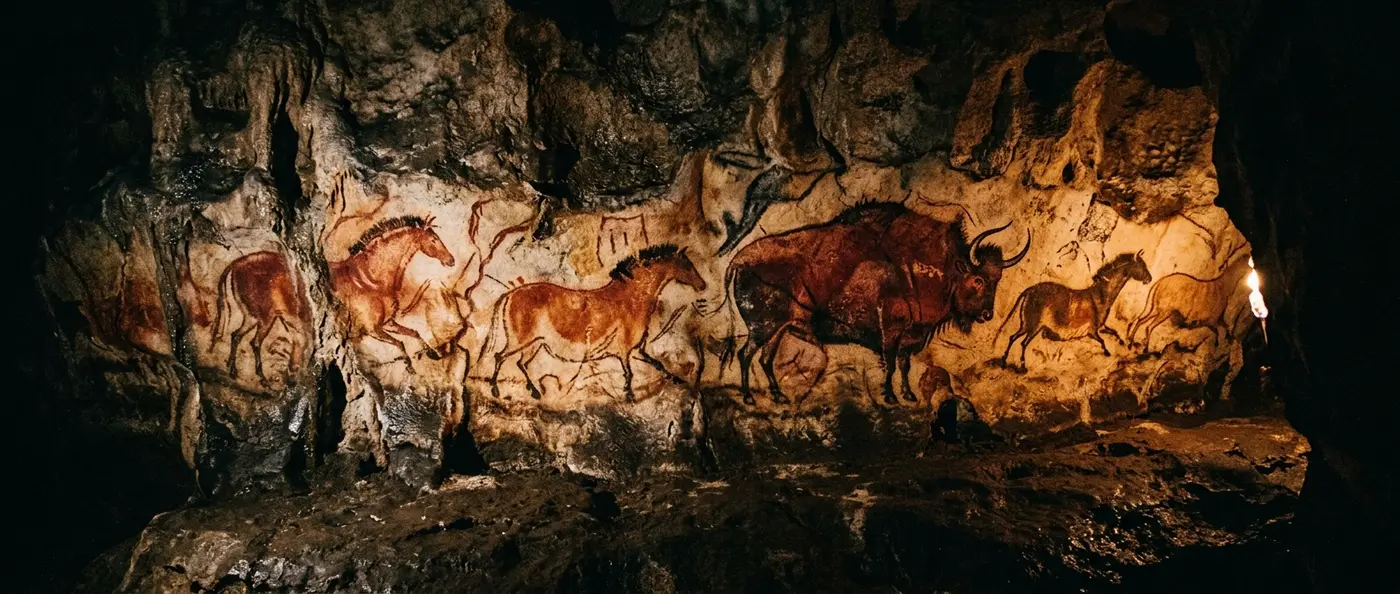
France's Paleolithic cave art spans 30,000 years of human creativity, from 40,000 to 10,000 years ago. The artists who crawled into limestone caverns across the Dordogne and Pyrenees weren't just making pictures. They were inventing visual language itself.
These weren't crude scratches on stone. The techniques rival anything produced today. Artists ground ochre, manganese, and charcoal into pigments that still blaze with color today. They mixed binders from animal fat and plant saps. They understood perspective, using rock contours to give their animals three-dimensional form.
The most stunning technique? Spray painting. Artists would place their hands against cave walls and blow pigment through hollow bird bones, creating negative handprints that served as prehistoric signatures. Over 500 of these ghostly handprints survive across French caves — the world's oldest autographs.
The most remarkable discovery: most of these masterpieces were painted in total darkness, deep underground where sunlight never reached. Artists worked by the light of stone lamps burning animal fat, creating art in conditions that would challenge any modern painter.
🦌 The Menagerie on Stone
Walk into Lascaux and you enter a Paleolithic zoo. Horses thunder across the ceiling. Bison charge down corridors. Mammoths lumber through narrow passages. Every animal is rendered with anatomical precision that would make a modern zoologist jealous.
The spotted horses at Pech-Merle stumped scientists for decades. Surely these polka-dotted creatures were fantasy, right? Wrong. DNA analysis of 30,000-year-old horse fossils proved that spotted horses really did roam Paleolithic Europe. The artists painted what they saw, not what they imagined.
Human figures appear too, but they're different. While animals burst with realistic detail, people are often stick figures or strange hybrid forms. The most famous scene at Lascaux shows a bird-headed man confronting a wounded bison — possibly the world's first narrative art.
Why did they choose these remote locations? The caves weren't homes — they were sacred spaces. They weren't homes. They were sacred spaces. The act of painting by flickering lamplight, watching animals seem to move in the dancing shadows, was likely part of ritual ceremonies that connected the living with the spirit world.
Werner Herzog, who filmed inside Chauvet cave, described the experience as "traveling to another dimension." Under flickering lamplight, the painted animals seem to move and breathe.
Lighting Techniques
Stone lamps burning animal fat provided steady light for hours. Artists positioned light sources strategically to highlight specific details and create dramatic shadows.
Using Natural Forms
Rock bulges became animal shoulders. Cracks turned into spear wounds. Artists didn't just paint on walls — they painted with them, using every natural contour.
Acoustic Dimension
Many paintings cluster in areas with exceptional acoustics, suggesting they accompanied songs, chants, or ceremonial performances that echoed through the caves.
🏛️ The Greatest Galleries Underground
Lascaux is the superstar. Discovered in 1940 by four teenagers chasing their dog down a hole, it contains over 600 paintings and 1,500 engravings dating to 17,000 years ago. The Great Hall of Bulls showcases monumental animal figures that dwarf anything in modern museums.
But Chauvet, found in 1994, rewrote the textbook. At 36,000 years old, it's nearly twice Lascaux's age — yet the art is just as sophisticated. Lions prowl the walls. Panthers stalk through shadows. Rhinoceros charge in herds. The sophisticated artwork proved that artistic skill didn't evolve gradually from primitive beginnings.
Pech-Merle stands out for its accessibility. Unlike Lascaux, which closed to protect the paintings from tourist damage, visitors can still experience Pech-Merle's original chambers. The spotted horses and hand stencils feel immediate, personal — like the artists just stepped away.
💡 Did You Know?
Paleolithic artists created the world's first "movies." In several caves, animals appear with multiple legs or heads in different positions. When lit by flickering flames, these overlapping images create the illusion of movement — cinema born 30,000 years before Edison.
🔬 Dating the Undatable
How do you date a painting? Traditional radiocarbon dating required samples that damaged the art. New techniques like uranium-series imaging with laser ablation need samples just 44 microns wide — smaller than a human hair.
The new techniques produced unexpected results. Some paintings are far older than expected. Others were created in multiple phases, with thousands of years between layers. The caves weren't decorated once — they were revisited, repainted, and reimagined across millennia.
Pigment analysis tells its own story. Artists didn't just use whatever they found nearby. They traveled miles to collect specific minerals, mixing them with precise recipes to achieve desired colors. This was planned, purposeful art-making.
French cave art isn't isolated. Similar paintings appeared worldwide during the Late Paleolithic — from Indonesia to Spain. But the concentration and quality in southern France is unique. This region was a cultural hotspot where artistic techniques developed and spread.
The influence reaches modern times. Picasso studied cave paintings and declared, "We have learned nothing in 12,000 years." Miró, Klee, and countless others drew inspiration from these primal masterpieces. The direct, powerful expression of Paleolithic artists continues to move us.
🗿 Major Cave Comparison
🎭 What Did It All Mean?
Why paint in darkness? Theories abound. Some researchers see hunting magic — images of animals ensuring successful hunts. Others detect astronomical symbolism, with animal groups representing constellations.
A compelling recent theory suggests initiation rites. Young people may have undergone coming-of-age ceremonies in these dark chambers, with paintings serving as teaching tools about their world and their place in it.
Whatever their specific meaning, these paintings reveal humanity's fundamental need to create and communicate. In an age before writing, images carried ideas, emotions, and knowledge across generations.
🔮 The Future Underground
Research accelerates with new technology. 3D scanning and virtual reality allow detailed study without physical presence, protecting fragile cave environments. Every year brings new decorated caves to light. The region still hides secrets — archaeologists estimate we've found only a fraction of Paleolithic art.
Interdisciplinary approaches reveal hidden aspects. Machine learning algorithms analyze painting patterns, uncovering recurring themes and techniques invisible to the naked eye. Collaboration between archaeologists, geologists, biologists, and AI specialists opens new windows into the past.
New caves continue emerging from the French countryside. A farmer's field in the Dordogne might hide the next Lascaux. Each discovery reveals more about how our ancestors understood their world — and ours.