A wife complains her husband blows all their money at the tavern. A father writes to his son studying abroad, begging him not to forget his family back home. These are 4,000-year-old grievances preserved on Mesopotamian clay tablets. Between laws and trade receipts, these ancient documents capture something extraordinary: the intimate lives of ordinary people who lived when civilization was still finding its footing. Their stories show family as the foundation of society, controlling everything from economics to religion in ways that echo through to our own time.
📖 Read more: Babylon's Hanging Gardens: Archaeological Hoax or Wonder?
👨👩👧👦 The Architecture of Mesopotamian Family
Power flowed downward in Mesopotamian households. The father wielded absolute authority as "abu," but this wasn't arbitrary tyranny — it came with crushing responsibility. When the Akkadian language used "bītu" to mean both "house" and "family," it wasn't coincidence. The physical structure and human relationships were inseparable, bound by duty and survival.
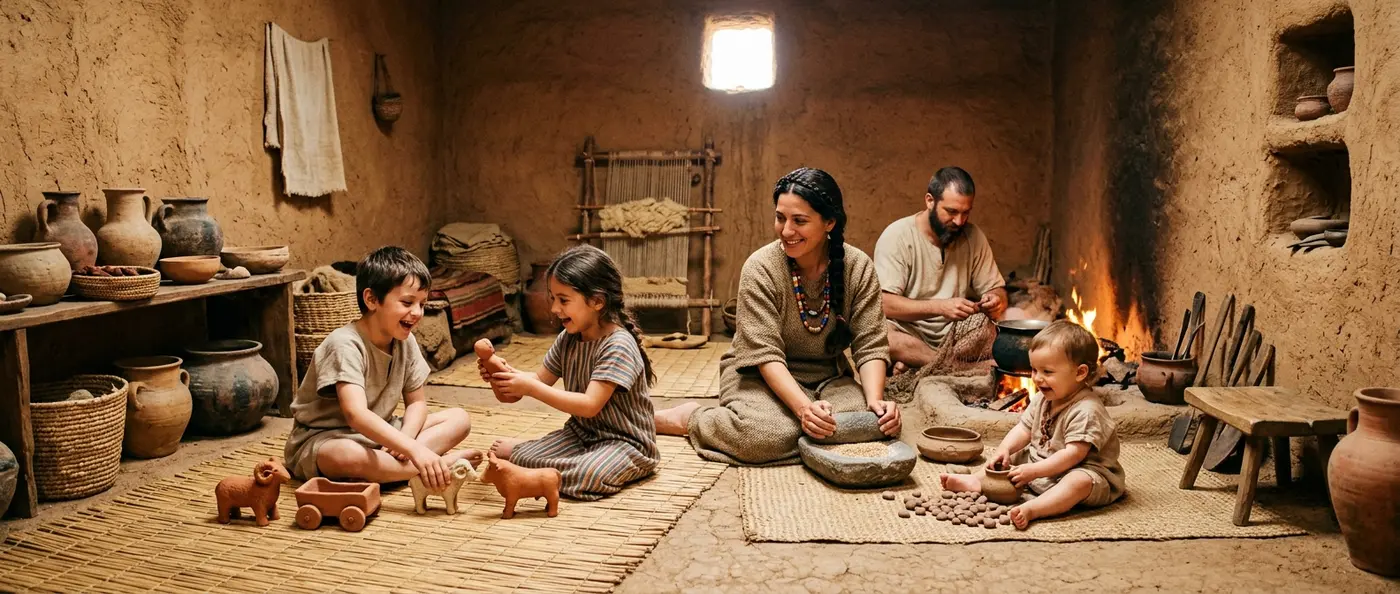
Three generations packed under mud-brick roofs. Grandparents, parents, children, sometimes uncles with their own broods — all sharing a central courtyard where life unfolded under open sky. Extended families weren't a lifestyle choice — they were the only insurance against disaster, old age, and death.
Children meant wealth. More hands for the fields, the workshop, the loom. But infant mortality claimed nearly half before they reached adulthood. Archaeological evidence paints a stark picture: tiny skeletons buried beneath house floors, silent testimony to the fragility of ancient life. Every child who survived became exponentially more precious to their family's future.
The Courtyard Center
Mesopotamian houses wrapped around central courtyards where families cooked, wove, and lived most of their waking hours. These open spaces provided light, air, and communal gathering spots in otherwise windowless mud-brick structures.
Women's Legal Rights
Despite patriarchal structure, women could own property, run businesses, and petition for divorce under specific conditions. The law recognized their economic contributions and protected certain rights.
Economic Units
Families functioned as miniature corporations. Every member contributed to household income through farming, crafts, or trade. Success or failure affected the entire extended network for generations.
💑 Marriage Markets and Dowry Negotiations
Marriage was business. Two families negotiating terms while teenagers watched their futures get decided over barley beer and dried dates. Girls married around 14-16, boys slightly later at 18-20. Love might grow, but economics came first.
The "terhatu" — bride price — wasn't buying a wife. Think of it as insurance. The groom's family paid silver, livestock, or land to the bride's family. If he abandoned or mistreated her later, he forfeited everything. Smart system, actually. It gave women leverage in a male-dominated world.
Marriage contracts read like modern prenups, but with more creative clauses. One Babylonian tablet from 1750 BCE states bluntly: "If Iltani bears no children to Warad-Sin within two years, she must purchase a slave woman to bear his offspring." Fertility meant survival — the contracts said so plainly.
Wedding ceremonies themselves were surprisingly elaborate. Processions through city streets, feasts lasting days, gifts exchanged between families. The bride wore her finest jewelry — often representing her family's entire wealth displayed on her body. The ceremonies announced new alliances and economic partnerships sealed with vows.
🏺 Daily Rhythms and Gender Roles
Dawn meant work. Men and older boys headed to fields or workshops. Women and girls stayed home, but "staying home" meant grinding grain for hours — a back-breaking daily necessity. They brewed beer (the standard drink), tended gardens, wove textiles, and managed complex households that functioned like small businesses.
Meals brought everyone together twice daily. Light breakfast, substantial evening dinner. Barley bread formed the base of every meal, accompanied by vegetables, legumes, occasional fish or meat. Beer was so common that even children drank it, though in diluted form. Water was often unsafe; fermentation killed dangerous bacteria.
Gender roles had boundaries, but exceptions existed. Most women managed households, but archives reveal female tavern keepers, textile merchants, even doctors. Enheduanna, daughter of Sargon of Akkad, became history's first known poet around 2300 BCE, composing hymns to the goddess Inanna that survived for centuries.
📚 Childhood Education and Growing Up
School was for the elite. Only wealthy families or those grooming future scribes sent children to the "edubba" — house of tablets. These institutions were brutal. Students started at 5-7 years old and spent a decade or more mastering cuneiform, mathematics, and legal texts. Beatings were routine. One student text complains: "The teacher caned me for talking, for standing up, for improper dress."
Most children learned by watching parents. A boy followed his father to fields or workshop from age 5, mastering the family trade by 10. Girls learned cooking, weaving, and household management from their mothers. Children learned the skills that would keep them alive.
Discipline was harsh but not without affection. A Sumerian proverb warns: "A child who has not been slapped by his mother will never obey." Yet lullabies preserved on tablets speak of children as "sweet figs" and "precious jewels." Love and strictness coexisted in ways modern parents would recognize.
Children's toys included clay animals, hoops, leather balls stuffed with straw. Archaeologists have found board games like the Royal Game of Ur, played by kids and adults alike. Boys played war with wooden swords while girls had dolls made from cloth and clay. Play prepared them for adult roles while providing precious moments of childhood joy.
💡 The First Adoption Contract
Mesopotamia produced the world's oldest known adoption contract, dated around 2000 BCE. Adoption was common for childless couples, and adopted children gained full inheritance rights. The contract stated: "From today, Gimil-Marduk is the son of Bunini-abi. If Bunini-abi says 'You are not my son,' he shall lose house and property. If Gimil-Marduk says 'You are not my father,' he shall be shaved and sold as a slave."
🏛️ Religion and Family Traditions
Gods lived in every household. Small shrines honored family deities and ancestral spirits, receiving daily offerings of food and drink. The dead weren't gone — they were hungry neighbors who could influence the living's fortune. Neglect them at your peril.
Major religious festivals were family affairs. During Akitu (New Year), households gathered for feasts and prayers. Children received gifts, everyone wore their finest clothes. These moments strengthened family bonds and transmitted traditions to the next generation through shared celebration and ritual.
Illness brought both practical medicine and magic. Families called the "asu" (doctor) who used herbs and bandages, plus the "ashipu" (exorcist) who blamed demons for disease. Entire households participated in purification rituals, combining medical treatment with spiritual cleansing in ways that made perfect sense to ancient minds.
📖 Read more: Babylonians Used Pythagorean Theorem 1000 Years Before Pythagoras
Pregnancy and childbirth were particularly dangerous times requiring divine protection. Women wore amulets, recited incantations, and made offerings to Ninlil, goddess of childbirth. Infant mortality was so high that children weren't named until they survived their first month. Names themselves carried protective power — many included divine elements like "Marduk-protects" or "Sin-gives-life."
⚖️ Inheritance Laws and Family Succession
Inheritance rules were complex and varied by period and city, but one principle held firm: the firstborn son received double portions. This wasn't just privilege — it came with responsibility for aging parents and preserving family property. Primogeniture with strings attached.
Daughters typically received dowries instead of land inheritance, but exceptions existed. If a family had no sons, daughters could inherit everything. The "naditu" — unmarried priestesses — could own and manage property independently, creating a class of powerful women operating outside traditional family structures.
Wills were carved on clay tablets before witnesses. A father could disinherit a son only for serious offenses like striking his parent or committing major crimes. Even then, formal court proceedings were required. Family property was too important for arbitrary decisions.
📊 Inheritance Distribution
🌅 Old Age and Elder Care
Without pensions or nursing homes, caring for elderly parents was sacred duty. Hammurabi's Code mandated children support aging parents. Abandoning elderly family members ranked among the worst crimes imaginable.
Elders retained respected positions in households. Their experience was invaluable in a society relying on oral tradition. They told stories, preserved family histories, and advised on important decisions. Age brought wisdom, not obsolescence.
When a parent died, mourning lasted seven days. Families wore simple clothes, avoided bathing and perfume, ate only plain food. Rituals for the dead continued for years, with monthly offerings of food and drink at the grave. Death didn't end family relationships — it transformed them.
Burial typically occurred beneath house floors, keeping the dead close to living family. This allowed easy honoring of ancestors and maintained their presence in daily life. Wealthy families included personal belongings, food, drink, even musical instruments for the journey to the underworld. Death was transition, not termination.
💔 Divorce and Family Crisis
Despite ideals of harmonious families, Mesopotamians faced relationship problems too. Divorce was legal but complicated. Men could divorce wives relatively easily but had to return dowries and pay compensation. Women could petition for divorce under specific conditions — abandonment, abuse, or failure to provide support.
One Old Babylonian tablet records a woman who won divorce because her husband "spent everything on beer and gambling." Courts took economic irresponsibility seriously when it threatened family survival. Marriage was too important for society to ignore when it broke down.
Adultery carried harsh penalties, especially for women. A married woman caught with another man could be drowned along with her lover. However, if her husband forgave her, the lover was also pardoned. Even severe laws allowed room for mercy and reconciliation.
Property disputes between family members filled court records. Brothers fighting over inheritances, sons accusing uncles of mismanagement, widows battling for their rights. These conflicts remind us that across millennia, some human problems remain constant. Family dynamics haven't changed as much as we might think.
Legal Documents
Thousands of clay tablets containing marriage contracts, divorce proceedings, and inheritance disputes provide detailed insight into family relationships and legal procedures in ancient Mesopotamia.
Family Courts
Specialized courts with community elders resolved family disputes. Their decisions were recorded and archived for future reference, creating a legal precedent system that influenced later civilizations.
🎭 The Legacy of Mesopotamian Family Life
Studying ancient Mesopotamian families reveals startling similarities to modern life. Parents worried about their children's futures, couples faced financial stress, and families struggled to maintain unity in a changing world. The clay tablets that survived give us rare glimpses into the human side of this ancient civilization.
Family controlled everything in Mesopotamia — economics, religion, and law all flowed through kinship networks. A family's success or failure determined the fate of all its members for generations to come.
The preserved tablets offer intimate moments that bridge millennia. A father writes to his distant student son: "Why haven't you written me? Your mother cries every day." A mother pleads with gods for her sick child's health. A grandfather leaves instructions for tending his garden after death.
These small moments of humanity span the gap of thousands of years. They remind us that despite vast differences in technology and social organization, fundamental human needs for love, security, and belonging remain unchanged. The family, with all its joys and challenges, was and remains the core of human experience. In the end, we're not so different from those ancient people who lived when the world was young and writing was still a miracle.