🌾 The Goddess Who Lost Her Daughter
At the heart of the Mysteries lies one of Greek mythology's most moving tales. According to the Homeric Hymn to Demeter, the goddess of agriculture lost her daughter, Persephone (or Kore), when Hades abducted her to make her queen of the underworld. The desperate mother wandered the earth searching for her child, eventually arriving at Eleusis.
There, disguised as an elderly woman, she became a nursemaid at King Celeus's palace. Demeter attempted to make the young prince Demophon immortal by placing him in fire each night. When Queen Metaneira discovered and stopped her in terror, the goddess revealed her true identity. Furious that her work was interrupted, she commanded that a temple be built in her honor, where mysteries would be taught that would give humans hope for life after death.
The story concludes with Zeus's compromise: Persephone would spend one-third of the year in the underworld and two-thirds with her mother. This cycle of death and rebirth drove the Mysteries — winter's barrenness followed by spring's return, death followed by promised resurrection.
Demeter
Goddess of agriculture and fertility, protector of seeds and harvest. Her grief over losing her daughter brought winter to the earth.
Persephone
Daughter of Demeter, queen of the underworld. Her return each spring symbolized nature's rebirth and the hope of immortality.
Hades
God of the underworld who abducted Persephone. His act set in motion the cycle that led to the creation of the Mysteries.
🏛️ The Sanctuary of Eleusis
Eleusis, 21 kilometers west of Athens, grew from farming village to the Greek world's holiest site. The sanctuary, which began construction in the 7th century BCE, evolved into a massive complex that included temples, altars, and the mysterious Telesterion.
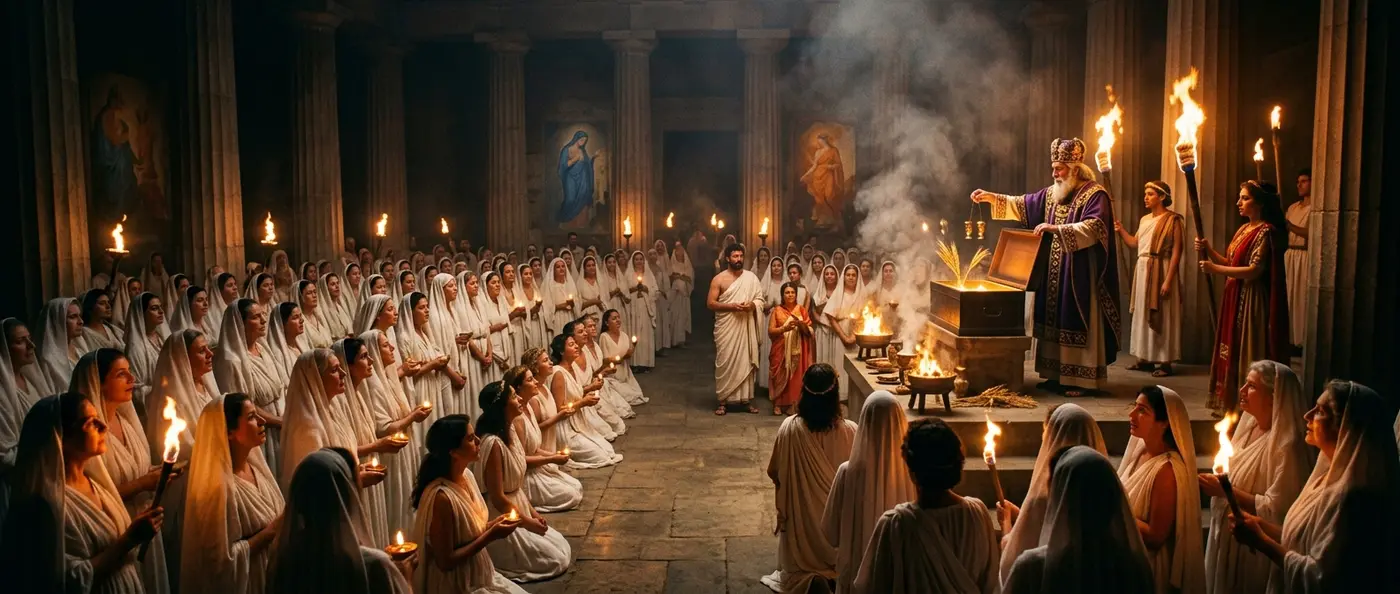
The Telesterion, the Hall of Initiation, was a massive square chamber that could accommodate up to 3,000 mystai. Unlike typical Greek temples, the Telesterion was designed to house large gatherings indoors. Its walls were decorated with scenes from Demeter's myth, while at the center stood the Anaktoron, a small rectangular space where the sacred objects of the Mysteries were kept.
⚡ The Stages of Initiation
Initiation into the Eleusinian Mysteries wasn't a simple ceremony but a lengthy process lasting nearly a year. It began with the Lesser Mysteries in Anthesterion (February-March) at Agrae, near the Ilissus River. There, candidate mystai underwent purification rituals and preparation.
The Greater Mysteries took place in Boedromion (September-October) and lasted nine days. On the first day, hierophants carried sacred objects from Eleusis to Athens. The second day brought the official proclamation: "Mystai to the sea!" All candidates rushed to Phaleron to purify themselves in the waters of the Saronic Gulf, each carrying a small piglet they would sacrifice.
The fifth day was the most spectacular: the great procession from Athens to Eleusis. Thousands of mystai, dressed in white and crowned with myrtle, began their journey. Along the route, they stopped at sacred points for prayers and rituals. At the Cephissus bridge, masked figures teased and mocked them — an act believed to help with humiliation before initiation.
🔮 The Secret of the Ceremonies
The Telesterion's secrets died with the last initiate. The mystai swore never to reveal what they saw and heard, and breaking this oath was punishable by death. Nevertheless, from scattered references and hints, we can reconstruct some elements.
The ceremony included three components: the dromena (things done), the deiknymena (things shown), and the legomena (things said). The mystai drank the kykeon, a sacred drink made from barley, water, and mint. Some scholars argue the drink contained psychotropic substances that enhanced the experience.
💡 The Mystery of the Kykeon
Modern research examines the possibility that kykeon contained ergotine, a psychoactive substance found in infected grains. This could explain the intense visions described by mystai and the sense of transcendent experience they underwent during the ceremony.
At the ceremony's climax, the hierophant showed the mystai something that changed them forever. Perhaps it was a wheat stalk, symbol of eternal rebirth. Perhaps it was a reenactment of Demeter and Persephone's reunion. Whatever it was, the mystai emerged from the Telesterion transformed, with absolute certainty that death was not the end.
👥 Who Could Be Initiated
Unlike many other religious ceremonies of antiquity, the Eleusinian Mysteries were open to all — men, women, even slaves, as long as they spoke Greek and hadn't committed murder. This unprecedented equality before the divine made the Mysteries extremely popular throughout the ancient world.
Emperors and philosophers, generals and ordinary citizens, all stood equal before Demeter. Cicero, Marcus Aurelius, Hadrian — all were initiated into the Mysteries. Plato and Aristotle refer to them with reverence, though they never reveal details.
🌟 Impact on the Ancient World
For over a thousand years, the Eleusinian Mysteries did more than promise immortality — they shaped how Greeks and Romans lived and died. The promise of immortality they offered profoundly influenced philosophy, art, and religion.
The mystai returned to their cities changed. They no longer feared death in the same way. They had seen something that gave them hope and comfort. This inner transformation had practical consequences — the initiated were considered more trustworthy, more ethical, more capable of assuming positions of responsibility.
⚖️ Comparison with Other Mysteries
The Mysteries' influence extended far beyond religion. Eleusis became a kind of international sanctuary where people from across the Greek world met. During the Mysteries, a sacred truce was declared — wars stopped so mystai could travel safely.
📜 The End of an Era
The Eleusinian Mysteries continued for nearly two millennia, surviving political changes, conquests, and empires. Even when Rome conquered Greece, Roman emperors not only respected the Mysteries but were themselves initiated.
The end came with Christianity's rise. In 392 CE, Emperor Theodosius I banned all pagan ceremonies. In 396 CE, Alaric's Visigoths destroyed the sanctuary at Eleusis. After nearly 2,000 years of continuous operation, the lights in the Telesterion went out forever.
Despite the physical sanctuary's destruction, the Mysteries' legacy survived. The ideas of soul immortality, personal salvation, and secret knowledge they cultivated profoundly influenced Western thought. Even today, when we speak of "mysteries" and "initiation," we use concepts born on the ancient roads of Eleusis.