📖 Read more: 10 Lost Cities That Vanished Without a Trace
🌳 Who Were the Druids?
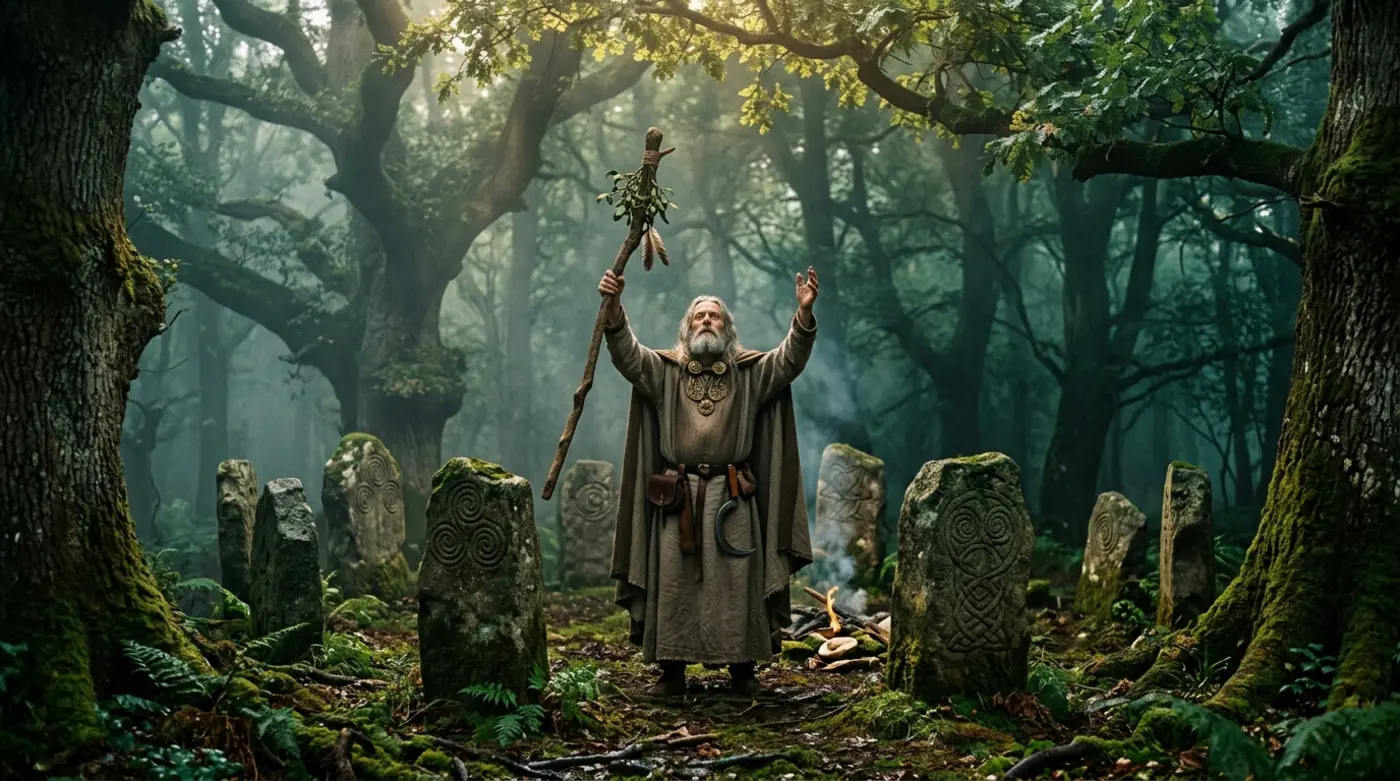
The first detailed references to Druids date to the 1st century BC, but they likely established their specialized role in ancient communities of present-day Britain, Ireland, and France much earlier. The word "Druid" comes from the Latin transcription of a Celtic word describing a social class of people involved in divination and ritual ceremonies.
The biggest obstacle to understanding the Druids is that the ancient Celts didn't use written language. All our information comes from external observers, primarily the Romans. Julius Caesar, writing in the 50s BC after the Roman invasion of Gaul, described the Druids as people who "attend to sacred matters, conduct public and private sacrifices, and interpret all matters of religion."
The emperor also noted their interest in astronomy, education, and bravery. However, his most shocking reference concerned their practice of sacrificing fellow humans to win the favor of the gods, using giant anthropomorphic effigies made of wicker filled with living people that they then set on fire.
🔥 The Wicker Man Myth
The image of the "Wicker Man" — the giant anthropomorphic cage of branches where Druids supposedly burned their victims alive — comes exclusively from Julius Caesar. No other ancient writer describes this practice in such detail, raising questions about the reliability of the account.
🩸 Bloody Rituals or Roman Propaganda?
Other Roman writers also focused on the Druids' supposed love of blood and violence. Pliny the Elder wrote about their reverence for both mistletoe and human sacrifice. According to him, "to murder a man was an act of the greatest devotion, and to eat his flesh was to secure the highest blessings of health."
Tacitus described a battle in Wales where the Druids "covered their altars with the blood of captives and consulted their deities through human entrails." These accounts may say more about Roman fears than Celtic reality.
📖 Read more: Aksum Empire: Africa's Forgotten Superpower That Ruled Three Continents
The pagan priests posed an existential threat to the Romans, who feared the Druids' power over the Celtic communities Rome had conquered. Classicist Jane Webster argues that the Druids' apocalyptic visions and rituals were seen as acts of resistance against Roman conquerors, who suppressed the Druids and their ceremonies starting from Augustus's reign in 27 BC.
In 1984, a peat cutter in Cheshire, England, unearthed human remains about the Druids' allegedly violent rituals. The human remains found were no ordinary discovery: Lindow Man, as he was named, had been preserved in the bog for nearly 2,000 years.
Examination of the body revealed a shocking story. He had suffered blows to the head, been stabbed and strangled before being left dead in the bog. His stomach contained mistletoe pollen.
This discovery led to controversial speculation that the man was ritually sacrificed, perhaps by Druids, or that he was himself a Druid prince. The presence of mistletoe pollen in his stomach directly connects to Pliny's references about the plant's sanctity in Druidic religion.
📜 The Legacy of the Druids
Christianity began penetrating France and the British Isles in the 1st century AD, and as centuries passed, it covered many Celtic traditions. Nevertheless, Druids continued to appear in medieval literature, suggesting that the pagan priests later transformed into healers and magicians.
The Druids have attracted renewed interest across different eras. The Romantic era brought a resurgence of interest, while the 21st century has seen the modern incarnation of Modern Druidism.
📖 Read more: Alexandria's Great Library: The Ancient World's Google
Oral Tradition
Druids didn't use writing, transmitting their knowledge orally from generation to generation. This explains why we have no direct testimonies from them.
Astronomers
According to Caesar, the Druids had deep knowledge of astronomy and the movements of celestial bodies.
Judges
Besides priests, Druids functioned as judges, resolving disputes and imposing penalties in Celtic communities.
🔬 What Does Modern Archaeology Say?
It's tempting to speculate about the true nature of the Druids, but since most of our knowledge about this ancient social class comes from secondary sources, it's impossible to verify most claims.
Even the term "Druid" appears to have been a general designation for scholars, philosophers, teachers, and priests who dealt with nature, justice, and magic. Archaeology hasn't provided clear answers.
Historian Ronald Hutton notes: "There is currently no consensus among archaeologists about how material evidence relates to the Druids, even within the same country. Not a single object has been found anywhere that experts universally and unquestionably agree is Druidic."
📖 Read more: Ancient Egypt's Millions of Mummified Animals Revealed
One of the few elements that seems confirmed by multiple sources is the special significance of mistletoe in Druidic religion. Pliny describes in detail the ritual of collecting mistletoe from oak trees, performed on the sixth day of the moon with a golden sickle.
Mistletoe was considered sacred because it was a parasitic plant that grew on oak trees without touching the ground. The Druids believed it had healing properties and could fertilize sterile animals. The discovery of mistletoe pollen in Lindow Man's stomach lends some credibility to these ancient references.
⚖️ Druids vs Other Ancient Priests
💭 Myth and Reality
Then and now, the idea of Druids evokes both magic and mystery. Were they peaceful priests or dangerous prophets? Did they worship nature or incite rebellions? The truth is they were likely a complex mixture of many roles.
What we know for certain is that the Druids constituted a powerful and respected class in Celtic society. They were the guardians of knowledge, tradition, and law. The absence of written records from themselves means their true history will remain forever wrapped in mystery.
Perhaps that's what makes them so fascinating. In a world where almost everything can be researched and documented, the Druids remain an enigma — shadows from the past that refuse to fully reveal their secrets.