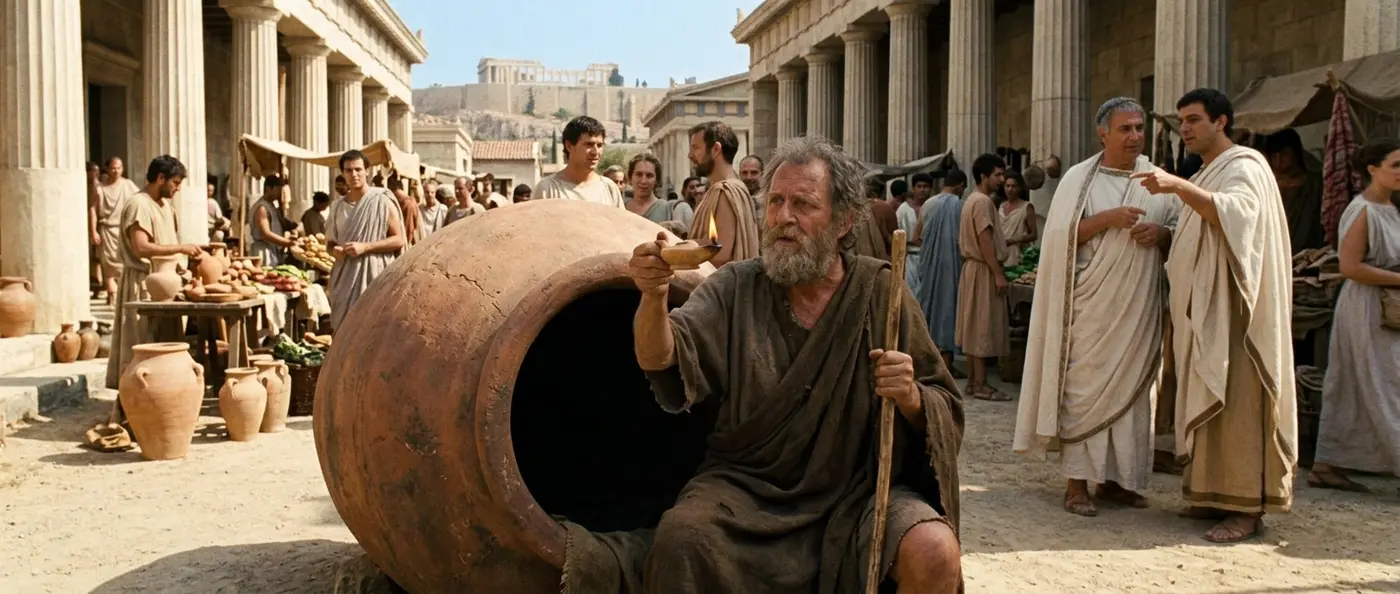
Inside a clay jar in ancient Corinth's marketplace, a ragged man sat conversing with Alexander the Great. When the young conqueror asked what he could do for him, the answer was simple: "Get out of my sunlight." This was Diogenes the Cynic, the philosopher who lived in a barrel and challenged every assumption about what humans truly need.
📖 Read more: Alexander the Great: World Conqueror Who Changed History
🏺 The Man Who Abandoned Everything
Diogenes was born in Sinope around 412 BCE. His life took a dramatic turn when his father, who ran the city's mint, was accused of defacing currency. Exiled from his homeland, Diogenes fled to Athens, where he met Antisthenes, a student of Socrates and founder of the Cynic school of philosophy.
Cynic philosophy preached absolute self-sufficiency and rejection of unnecessary needs. But Diogenes took these ideas to extremes. He abandoned every material possession and chose to live inside a large clay jar in Corinth's marketplace. This wasn't withdrawal—it was theater. Every morning, Corinthians would see him emerge from his jar, a daily reminder that their possessions owned them more than they owned their possessions.
Diogenes' jar wasn't just a home. It was a statement. A declaration that humans need nothing more than what nature provides to be happy. When he saw a child drinking water with cupped hands, he threw away his only cup, saying: "A child has surpassed me in simplicity."
🔱 The Philosophy of the Barrel
Diogenes' Cynic philosophy rested on four principles that scandalized his era. First, autarky (self-sufficiency) - the belief that humans should depend only on themselves. Second, apathy - indifference to external conditions and social conventions. Third, parrhesia - the courage to speak truth without fear. Fourth, askesis - constant practice of virtue through harsh living.
While Plato built an Academy and Aristotle wrote treatises, Diogenes turned the streets into his classroom. He walked Athens and Corinth's streets carrying a lantern in broad daylight, searching for "a human being" - implying most people had lost their humanity within social conventions.
His actions were deliberately provocative. He ate in the marketplace, considered improper behavior. When criticized, he replied: "If it's not shameful to eat, why is it shameful to eat in the marketplace?" He satisfied bodily functions publicly, shocking and disgusting onlookers. For Diogenes, every natural act was innocent - only social conventions made it "shameful."
⚔️ Encounters with the Powerful
Diogenes' most famous encounter was with Alexander the Great. The young conqueror, having heard about the strange philosopher, went to meet him in Corinth. He found Diogenes sunbathing outside his jar. "I am Alexander the Great," he announced. "And I am Diogenes the Dog," the philosopher replied.
When Alexander asked what he could do for him, Diogenes' answer became legendary: "Move a little, you're blocking my sun." Alexander's generals expected punishment for such audacity, but the young king said: "If I were not Alexander, I would want to be Diogenes."
Another time, when pirates captured Diogenes and sold him as a slave, he was asked what skills he possessed. "Ruling men," he answered. At the auction, he shouted: "Who wants to buy a master?" Eventually a wealthy Corinthian bought him and made him tutor to his children.
The Shock Method
Diogenes used deliberately provocative acts to awaken people from their spiritual lethargy. He believed only through shock could one see the truth behind social conventions.
Why "The Dog"?
He called himself a "dog" because he lived like one - without shame, without home, satisfying needs wherever he felt them. For him, the dog was the most honest and authentic creature.
Cosmopolitan
Diogenes first used the term "cosmopolitan." When asked where he was from, he replied: "I am a citizen of the world," rejecting every notion of national identity.
🏛️ Life in the Marketplace
Diogenes' daily life in Corinth's marketplace was a continuous spectacle. He begged for food, but did it in a unique way. When someone refused to give, he said: "If you had given in the past, you would have something to give now. If you've never given, start with me."
He observed people around him with a sharp eye and commented on their hypocrisy. He saw a thief stealing from a temple and remarked: "The big thieves lead the little one to prison." When he saw wealthy people offering large sums to temples while ignoring the poor, he accused them of showing off.
His diet was simple - bread, olives, water. Once he saw a mouse eating crumbs and thought: "Even this creature finds a way to live without anxiety." From then on, he stopped worrying about tomorrow.
💡 The Wisdom of Paradox
Diogenes said: "People compete in digging and kicking, but no one competes in virtue." He used paradox to show the absurdity of human priorities.
📜 Teaching Without Words
Though Diogenes left no written works, his influence was enormous. His students recorded his words and deeds in collections called "Chreiai." Each chreia was a short story containing a moral lesson.
One famous chreia involves a young man who wanted to become his student. Diogenes gave him a cheese and told him to follow. The youth was embarrassed to carry cheese publicly and threw it away. "A piece of cheese dissolved our friendship," Diogenes commented, showing how fragile the young man's commitment was.
His method was always practical. When someone asked how to become wise, he told him to go to the cemetery and insult the dead. When the man returned saying the dead didn't react, Diogenes said: "Then become like them - indifferent to praise and insults."
🗿 The Legacy of Cynicism
Diogenes' death around 323 BCE was as unconventional as his life. According to one version, he died holding his breath. Another says he died from a dog bite while trying to share an octopus with strays. He had requested his body not be buried but thrown outside the walls for animals to eat.
Diogenes' influence extended far beyond Cynicism. Stoic philosophers like Epictetus and Marcus Aurelius incorporated many of his ideas. The emphasis on self-sufficiency, indifference to material goods, and inner freedom became central elements of Stoic philosophy.
Medieval monks claimed him as a proto-ascetic. Enlightenment thinkers praised his war on hypocrisy. Each age found in Diogenes what it needed most. Even today, the image of the man living in a barrel remains a powerful symbol of rejecting consumerism.
⚔️ Diogenes vs Contemporary Philosophers
🌍 The First Cosmopolitan
Perhaps Diogenes' most revolutionary idea was cosmopolitanism. In an era when human identity was determined by one's city-state, Diogenes declared himself a "citizen of the world." He rejected every distinction based on origin, social class, or gender.
He taught that all humans are equal by nature - distinctions are artificial constructs. He spoke to slaves and free people, men and women, Greeks and barbarians the same way. This radical equality shocked Athenian society.
The idea of cosmopolitanism deeply influenced Stoic philosophy and through it, Roman law. The concept of universal human rights has its roots in Diogenes' declaration that all humans are fellow citizens in the cosmopolis.
💭 The Paradox of Freedom
Diogenes' great paradox was that through absolute poverty, he found absolute freedom. Having nothing to lose, he feared nothing. Needing nothing, he depended on no one. This freedom gave him the courage to speak with parrhesia to kings and beggars alike.
His life was a continuous exercise in freedom. Every day he consciously chose to live according to his principles, regardless of consequences. This daily choice, this constant exercise of will, was for him the essence of philosophy.
Twenty-three centuries later, Diogenes still sits in his jar in Corinth's marketplace, asking the same uncomfortable question: What do you really need? The jar is empty now, but the question remains.