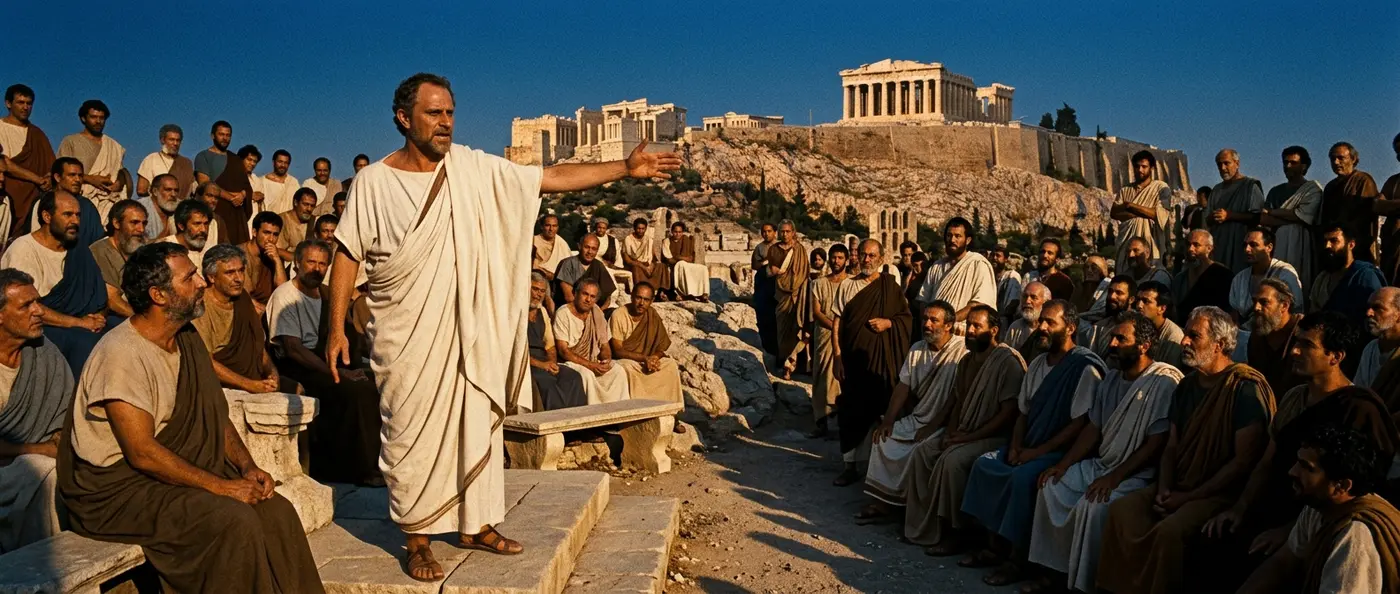
A boy who couldn't pronounce his own name would become antiquity's most feared orator. Demosthenes, once mocked in Athens' assembly for his stutter, transformed himself into the voice that would shake an empire. When Philip II of Macedon cast his shadow over Greece, most Athenians saw a distant barbarian king. Demosthenes saw the end of democracy itself.
🎭 The Stammerer's Revolution
Born in 384 BC to a wealthy sword-maker, Demosthenes lost everything before he turned eight. His father died young. The inheritance vanished into the pockets of corrupt guardians. By the time he came of age, the family fortune had evaporated, leaving him with nothing but a speech impediment and burning rage.
Plutarch describes the young man's affliction in brutal detail: "inarticulate and stammering pronunciation." His weak frame barred him from the gymnasium where Athenian boys learned to be men. Instead of accepting defeat, he built an underground study where he practiced alone. He shaved half his head so shame would keep him indoors, away from distractions.
His training methods bordered on masochistic. Pebbles filled his mouth as he recited poetry, forcing clear articulation around the stones. He delivered speeches while running uphill, gasping for breath, building lung capacity that would power his voice across Athens' vast assembly. A massive mirror reflected his gestures back at him, each awkward movement corrected through endless repetition.
The transformation took years. The stammering boy who couldn't speak his own name evolved into a weapon of pure rhetoric. When he finally emerged from his self-imposed exile, Athens had no idea what was coming.
⚖️ From Courtroom to Assembly
At twenty, Demosthenes faced a choice: starve or fight. He chose to fight. His first public speeches crashed and burned. The assembly laughed him off the platform. But in Athens' law courts, where citizens defended themselves without lawyers, his carefully crafted arguments began winning cases.
Democratic Athens created a unique profession: the logographer. These ghostwriters crafted speeches for citizens who lacked the skill to defend themselves in court. Demosthenes excelled at the work. Rich clients paid handsomely for his words, and his reputation grew with each victory.
In 354 BC, at thirty, he delivered his breakthrough speech to the full assembly. "On the Symmories" addressed a rumored Persian threat and proposed strengthening Athens' navy through discrete reforms. The assembly, composed of up to 6,000 male citizens, listened. They voted. They acted on his recommendations.
The stammering boy had found his voice.
🏛️ Champion of Democracy
From 354 BC onward, Demosthenes' career merged with Athens' foreign policy. His rhetorical brilliance made him leader of what we'd call the democratic faction. While some wealthy citizens preferred oligarchy to democracy, and many merchants favored peace at any price, Demosthenes stood for the old ideals.
The Athenian assembly was political theater at its rawest. Six thousand men packed into an outdoor amphitheater, shouting down speakers they disliked, laughing at those who bored them. Any citizen could speak, but only the best survived the crowd's brutal judgment. In this gladiatorial arena of words, Demosthenes dominated.
His contemporaries called him "the water-drinker" - a stern, perhaps repulsive personality who avoided wine and parties. His wit cut like a blade. When his lifelong rival Aeschines attacked him in court, Demosthenes responded by calling him "a wicked beast," "an idle babbler," "a hireling of the court," and "polluted."
No mercy. No quarter. Just words wielded like weapons.
Master of History
Demosthenes studied Greek history obsessively, weaving detailed historical parallels throughout his speeches. Legend claims he copied Thucydides' "History of the Peloponnesian War" eight times to perfect his prose style. Every argument rested on historical precedent.
Democracy's Defender
He constantly reminded Athenians of their history, their democratic faith, their hatred of tyrants. Love of democracy permeated every speech he gave, becoming the central theme of his political career and the foundation of his opposition to Macedonian expansion.
⚔️ The Philip Problem
Then came Philip II of Macedon. While most Athenians dismissed the Macedonians as barbarians unworthy of serious concern, Demosthenes recognized the existential threat. This wasn't just another regional conflict. Philip represented the death of everything Athens stood for.
The famous "Philippic" orations stand as monuments to political rhetoric. With passion and precision, Demosthenes tried to wake his fellow citizens from their lethargy. He warned that Philip wouldn't stop until he'd subjugated all of Greece. He proposed specific measures: strengthen defenses, forge alliances, act before it was too late.
His words painted vivid pictures of what defeat would mean. No more democracy. No more freedom. No more Athens as they knew it. The city that had given birth to democracy would become just another Macedonian province.
Despite his efforts, Athens and her allies fell at Chaeronea in 338 BC. Philip became master of Greece. The democracy Demosthenes had fought to preserve lay broken on a Boeotian battlefield.
📜 The Surviving Legacy
About 60 speeches attributed to Demosthenes survive today, though only half are considered genuine. His orations provide invaluable insights into 4th-century BC Athenian political, social, and economic life. The most famous, "On the Crown," is considered a masterpiece of ancient rhetoric and political autobiography.
💀 The Final Act
After Alexander the Great died in 323 BC, Demosthenes led one last rebellion against Macedonian rule. The uprising failed. Condemned to death by the Macedonians, he fled to Poseidon's temple on the island of Calauria.
When soldiers came to arrest him, Demosthenes asked for time to write a letter. Instead, he bit down on a reed pen filled with poison he'd carried for years. He died on October 12, 322 BC, choosing death over capture.
Even in defeat, he controlled his own ending.
🌟 The Eternal Voice
Demosthenes' influence stretches across millennia. Romans studied him as the ultimate model of oratorical excellence. Cicero worshipped him, naming his own speeches against Mark Antony "Philippics" in tribute. For centuries, European students learned rhetoric by memorizing his speeches.
His story - from stammering child to master orator - defied every expectation of his age. The boy who couldn't speak became the voice that warned a civilization of its approaching doom. Though he couldn't save Athens, his words outlasted Philip's kingdom and Alexander's conquests.
Today, when democracy faces new threats, Demosthenes reminds us that one voice, properly trained and fearlessly used, can still make history. The boy who filled his mouth with pebbles had found a way to shake empires with words alone.