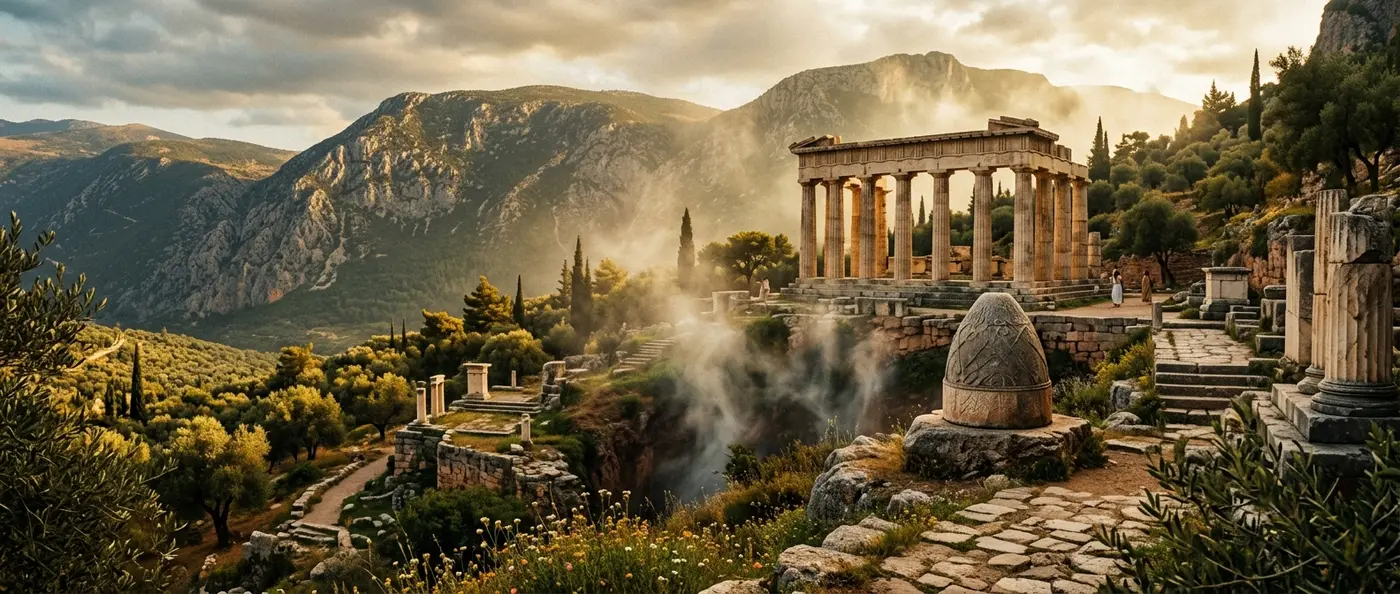
🏛️ The Sacred Center of the Ancient World
About 100 miles northwest of Athens, Delphi occupied a unique position in the ancient Greek consciousness. According to mythology, Zeus sent two eagles flying from opposite ends of the earth. Where they met, he placed the "omphalos," a sacred stone marking the world's center.
Originally, the sanctuary belonged to Gaia, the earth-mother, who had stationed her son Python, a massive serpent, as guardian of the site. Apollo, god of light and music, slew Python and claimed the sanctuary. In honor of the dead dragon, the priestesses serving Apollo were called "Pythias."
Apollo's cult at Delphi appears to have functioned from the 8th century BC. Two centuries later, leaders from across Greece consulted the oracle on critical matters: wars, founding colonies, religious ceremonies. Delphi evolved into a pan-Hellenic center where every city-state could display its power through dedications and monuments.
🔮 The Pythia and the Prophecy Process
The Pythia was always a woman over 50, living apart from her husband and dressed as a virgin. Ancient sources record that oracles were given only on the seventh day of each month, excluding the three winter months when Apollo supposedly visited the Hyperboreans in the north.
The process was strictly regulated. Visitors needed sponsors and had to offer pelanos (ritual cake) and a sacrificial animal meeting specific requirements. The Pythia and her advisors first bathed in the Castalian spring. Then the Pythia drank from the sacred Cassotis spring and entered the temple.
There she descended to an underground chamber, mounted the sacred tripod, and chewed laurel leaves, Apollo's sacred tree. In a state of ecstasy, the Pythia spoke — sometimes clearly, sometimes incomprehensibly. Priests interpreted and recorded her words in verses that were often deliberately ambiguous.
⚗️ The Mystery of the Vapors
For centuries, scientists dismissed Plutarch's traditional explanation that the Pythia drew her prophetic powers from vapors. In 1927, French geologists examined the sanctuary and found no evidence of chasms or gases, rejecting the explanation as myth.
But a four-year study published in Geology revealed that two fault lines intersect directly beneath Delphi's temple. The research also found evidence of hallucinogenic gases rising from a nearby spring and preserved in the temple's rocks.
Geologist Jelle De Boer from Wesleyan University discovered that one of the gases is ethylene, which has a sweet smell and produces narcotic effects described as feelings of levitation or euphoria. If the Pythia was exposed to concentrations of this gas in the enclosed underground space, she could indeed enter a state of ecstasy.
🌋 Geological Phenomenon
Greece sits at the junction of three tectonic plates. 70-100 million years ago, the limestone rocks beneath Delphi lay under the sea, enriched with hydrocarbon deposits. Every 100 years or so, major earthquakes shake the fault lines, heating the rocks and vaporizing hydrocarbons that mix with underground waters.
👑 Oracles That Changed History
The Delphic Oracle played a decisive role in some of ancient history's most significant moments. Lawmakers, colonists, and cult founders sought Apollo's approval. The Pythia's advice was especially sought for predicting the outcome of wars or political actions.
One of the most famous oracles was given to Oedipus, who learned it was his fate to kill his father and marry his mother. Terrified, Oedipus decided never to return to Corinth, unaware that his adoptive parents weren't his real parents. His attempt to avoid fate led him directly to its fulfillment.
Another crucial oracle came when the Persians invaded Greece in 480 BC. The Pythia predicted that "wooden walls" would save Athens. Themistocles correctly interpreted the oracle as referring to ships, leading to the Battle of Salamis that changed history's course.
Royal Decisions
Kings and emperors from across the Mediterranean consulted the oracle before major campaigns or political changes. Croesus of Lydia received the ambiguous oracle that if he attacked the Persians he would destroy a great empire — which turned out to be his own.
Colony Founding
No Greek city founded a colony without first consulting Delphi. The oracle determined the location, founder, and gods to be worshipped in the new city, ensuring divine favor.
Legislation
Great lawmakers like Lycurgus of Sparta sought Apollo's approval for their laws. Divine validation gave absolute authority to legislation and ensured citizen acceptance.
🏺 Treasures and Monuments of Power
Delphi became an open-air museum of Greek history. Every city wanting to display its achievements built dedicatory monuments. Athenians, Spartans, Macedonians, and later Romans competed in wealth and magnificence.
The Athenian Stoa, built in the early 5th century BC, housed trophies from naval victories. The island of Naxos dedicated a column with a Sphinx. The famous Charioteer, one of ancient Greek sculpture's masterpieces, was part of a monument celebrating chariot racing victory.
Delphi also hosted the Pythian Games every four years, second in importance only to the Olympics. Beyond athletic competitions, they included music and poetry contests. Delphi's theater, with a 5,000-seat capacity, hosted musical, poetic, and dramatic performances.
⚔️ Raids and Decline
Even its sacred status couldn't protect Delphi from attackers. The Persians attacked in 480 BC and the Gauls in 279 BC. Rome captured Delphi in 191 BC but allowed religious ceremonies and games to continue.
The situation changed dramatically when Christianity became the Roman Empire's official religion in 380 AD. Between 391 and 392, Emperor Theodosius I banned pagan practices and closed Greek temples, including Delphi. Without their religious function, Delphi declined. A small settlement established in the area evolved into the village of Kastri.
📊 Delphi by the Numbers
🔬 Discovering the Lost Sanctuary
For nearly 400 years under the Ottoman Empire, Delphi remained in obscurity. In 1436, Italian merchant Cyriacus of Ancona visited the area and recorded what remained of the stadium and theater, misinterpreting a circular building as Apollo's temple.
After Greek independence in 1832, efforts began to excavate Delphi. The major obstacle was the village of Kastri built over the archaeological site. Residents demanded enormous compensation to relocate.
A devastating earthquake that destroyed the village and killed 30 people changed the situation. The French Archaeological School took over excavations in 1892. Under Théophile Homolle's direction, the "Great Excavation" lasted from 1892 to 1903. They uncovered Apollo's temple, the theater, stadium, Athenian Stoa, and hundreds of statues and inscriptions.
🌟 Legacy and Modern Significance
Today Delphi is a UNESCO World Heritage Site and one of Greece's most visited archaeological sites. The Delphi Archaeological Museum houses some of ancient Greek art's most important works, including the Charioteer and the Sphinx of the Naxians.
Beyond their archaeological value, Delphi draws millions of visitors annually. The motto "Know thyself" carved on Apollo's temple remains timeless. The idea of a place where answers to fundamental questions of human existence are sought still resonates.
Modern scientific research confirming the existence of vapors shows how science can illuminate ancient myths without diminishing their magic. The oracle may be silent, but the fault lines beneath Delphi still release their ancient gases into the mountain air.