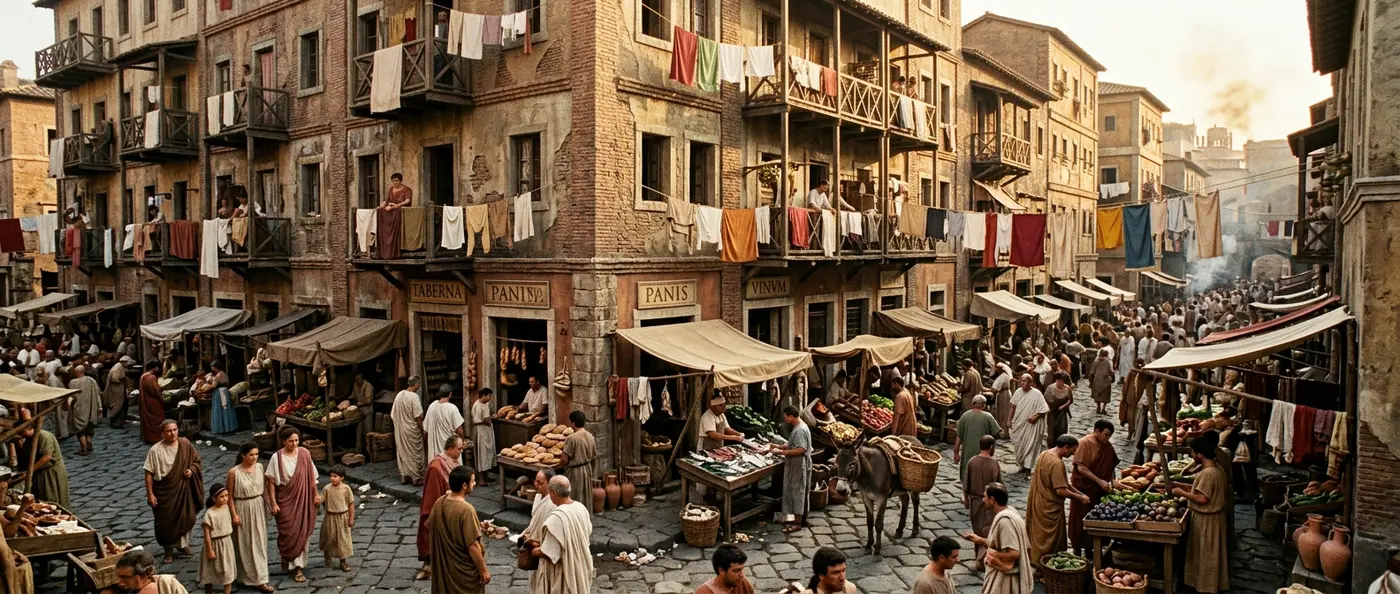
Narrow alleyways, creaking apartment buildings swaying with every wind, the smell of fish and garlic wafting through the air. This was daily reality for 95% of ancient Rome's inhabitants. While historians focus on emperors and epic battles, the lives of ordinary citizens—the plebeians—have left traces in tomb inscriptions, graffiti, and legal records that tell a different story.
📖 Read more: Colosseum: Rome's Arena of Death and Glory
🏛️ Rome's Social Pyramid
Roman society was rigidly stratified. At the top sat the patricians—aristocrats descended from Rome's founding families. Below them came the equites, a class of wealthy merchants and landowners. The vast majority, however, were plebeians—free citizens working as craftsmen, traders, farmers, or day laborers.
At the bottom were slaves, comprising roughly one-third of the population. Though they had no legal rights, many slaves lived better than the poorest plebeians, especially those serving wealthy households.
🏠 Housing: From Villas to Insulae
Housing differences were the most visible sign of social status. The wealthy lived in domus—single-family homes with courtyards, gardens, and private baths. Ordinary citizens crammed into insulae, apartment buildings reaching up to six stories high.
Insulae were built from wood and brick, without running water or sewage systems on upper floors. The higher you climbed, the poorer the tenants. Fires were common—so frequent that Emperor Augustus created the first organized fire brigade, the vigiles.
A typical insula apartment had just one or two rooms. Families cooked, slept, and lived in the same space. Windows had no glass—only wooden shutters that closed at night. In winter, small portable braziers provided meager warmth while increasing fire risk.
🍞 Diet and Daily Meals
Breakfast (ientaculum) was simple—bread dipped in wine or water, perhaps some cheese. Lunch (prandium) was also light, usually cold leftovers from the previous evening. The main meal (cena) happened in the afternoon.
For the poor, diet centered on grain distributed by the state. From the 1st century BC, roughly 200,000 citizens received free grain monthly. They made it into bread or boiled it into porridge (puls). Legumes, vegetables, a little cheese, and rarely meat completed their diet.
Staple Foods
Bread, grain, legumes, olive oil, wine diluted with water, garlic, onions
Luxuries
Meat (mostly pork), fish, eggs, fruit, honey, spices from the East
Thermopolia
Taverns serving hot food—ancient fast food for those without kitchens
⚒️ Work and Professions
Rome was a city that never slept. Before dawn, bakers lit their ovens. Craftsmen—blacksmiths, carpenters, shoemakers, potters—opened their workshops at sunrise. Most shops were small spaces on the ground floor of insulae, with workshops in back and sales counters in front.
Merchants sold everything from Syrian textiles to Indian spices. In the markets, vendors shouted advertisements for their wares. Barbers, doctors, and teachers set up on street corners. Fullones (launderers) cleaned clothes using urine as detergent—a smelly but essential job.
Many plebeians organized into collegia—professional associations functioning like guilds. They provided mutual aid, organized festivals, and ensured dignified burial for members. It was a way to gain voice in a society that marginalized them.
🎭 Entertainment and Leisure
"Panem et circenses"—bread and circuses—wasn't just a slogan. It was policy. Emperors won popular favor by providing free entertainment. At the Colosseum, 50,000 spectators watched gladiatorial combat. At Circus Maximus, 250,000 people packed in to watch chariot races.
Public baths (thermae) were more than hygiene facilities. They were social centers where rich and poor mingled. For a small fee, a plebeian could spend hours in hot and cold baths, exercise, listen to poetry, or simply gossip.
🎲 Did You Know?
Dice and gambling were so popular they were officially banned—except during Saturnalia, when all rules were overturned and slaves played with their masters!
👨👩👧👦 Family Life and Social Relations
Roman families were patriarchal. The pater familias held absolute power—theoretically he could even sell his children as slaves. In practice, however, family bonds were strong. Plebeian women had more freedom than aristocrats—they worked in shops, taverns, as midwives or weavers.
Poor children grew up fast. From age seven, they helped with work. Few attended school—only those with financial means. Others learned their father's trade. Girls married around 14, boys slightly later.
📖 Read more: Gladiator Tomb Discovered on Via Appia Rewrites History
Religion permeated every aspect of life. Each home had its lararium—a small shrine to household protective gods. Plebeians enthusiastically participated in public festivals—opportunities for food, wine, and celebration.
🏥 Health and Hygiene
Life in densely populated neighborhoods was unsanitary. Without sewage systems on upper floors, waste was thrown from windows—endangering passersby. Diseases spread quickly. Child mortality was high—one in three children died before age five.
Doctors were expensive. Most plebeians turned to folk healers or the gods. Temples of Asclepius filled with votive offerings from those who believed they were cured. Despite hardships, Romans had developed some healthy habits—public baths and clean water from aqueducts helped.
⚖️ Rich vs Poor
⚖️ Legal Rights and Political Participation
Despite exclusion from high offices, plebeians had won significant rights after centuries of struggle. From 287 BC, decisions of the plebeian assembly had force of law. Tribunes (tribuni plebis) could veto Senate decisions.
In practice, political power remained with the wealthy. Elections were expensive—candidates had to organize spectacles and distribute gifts. Still, the popular vote mattered. Politicians like the Gracchi brothers built careers promising reforms for the poor.
The patronage system connected rich and poor. Every plebeian had a patronus—a wealthy protector who provided legal and financial help. In exchange, the client (cliens) offered political support and social prestige. Each morning, hundreds of clients gathered at their patrons' homes for salutatio—the morning greeting.
🌅 A Typical Day in a Plebeian's Life
Marcus, a small-time shoe seller, wakes before dawn. His fourth-floor apartment is dark and cold. He quickly dresses in his tunic, eats some bread, and carefully descends the creaking stairs.
First stop: his patron's house for salutatio. Along with other clients, he waits in the courtyard. The patron appears, accepts greetings, and distributes small monetary gifts—the sportula. Marcus receives enough for two days' food.
Next, he opens his small shop near the forum. By midday he's sold three pairs of sandals. He closes briefly—the heat is unbearable. He eats at a thermopolium, discusses new taxes with other craftsmen.
The afternoon is spent at the baths. There he meets friends, hears news, makes small deals. As night falls, he returns home. His wife has prepared lentils with oil. They eat by lamplight. The children are already asleep. Tomorrow, it all begins again.
Morning (4-8 AM)
Wake up, salutatio with patron, open shop, first transactions
Midday (12-2 PM)
Break from heat, light meal, rest or visit to forum
Evening (5-9 PM)
Baths, social contacts, dinner with family, early sleep
🏛️ The Legacy of Ordinary People
Rome's great historians rarely wrote about plebeians. What we know comes from tomb inscriptions, Pompeii graffiti, legal texts. These ordinary people built the empire's roads and aqueducts.
They built the roads and aqueducts. They staffed the legions that conquered the world. Their arts and crafts survived for centuries, passed from generation to generation. Their daily lives—with all their hardships and small joys—perhaps offer the most authentic picture of what it meant to be Roman.
Today, as archaeologists excavate insula ruins and study simple everyday objects, a new picture emerges. Not just marble temples and glorious victories, but the living, noisy, often harsh reality of a megacity where millions of people struggled, dreamed, and loved.
Every morning, hundreds of thousands of plebeians left their cramped apartments to work the jobs that kept Rome running. Without them loading grain ships, hammering horseshoes, and mixing concrete, the empire's marble monuments would never have risen.