Four clay cylinders the size of your finger could overturn everything we thought we knew about writing. Archaeologists in Syria discovered these tiny objects bearing symbols from 2400 BCE — five centuries before the oldest known alphabet. If they're right, these finger-sized objects predate the oldest known alphabet by five centuries.
🏺 The Discovery That Shook Archaeology
Elaine Sullivan almost threw them away. In 2004, excavating an Early Bronze Age tomb at Umm el-Marra in northern Syria, she found four small clay cylinders that looked like dirt clods. She was about to toss them when something caught her eye — carved symbols.
Glenn Schwartz from Johns Hopkins University, leading the dig, knew immediately this was different. These weren't cuneiform — the wedge-shaped writing that dominated Mesopotamia. These symbols looked like nothing they'd seen in Syria before.
Radiocarbon dating placed the cylinders around 2400 BCE. That's 500 years older than Proto-Sinaitic script, previously considered the world's first alphabet. If confirmed, this discovery doesn't just push back dates — it demolishes our understanding of where and when alphabetic writing began.
📜 How Cuneiform Conquered the Ancient World
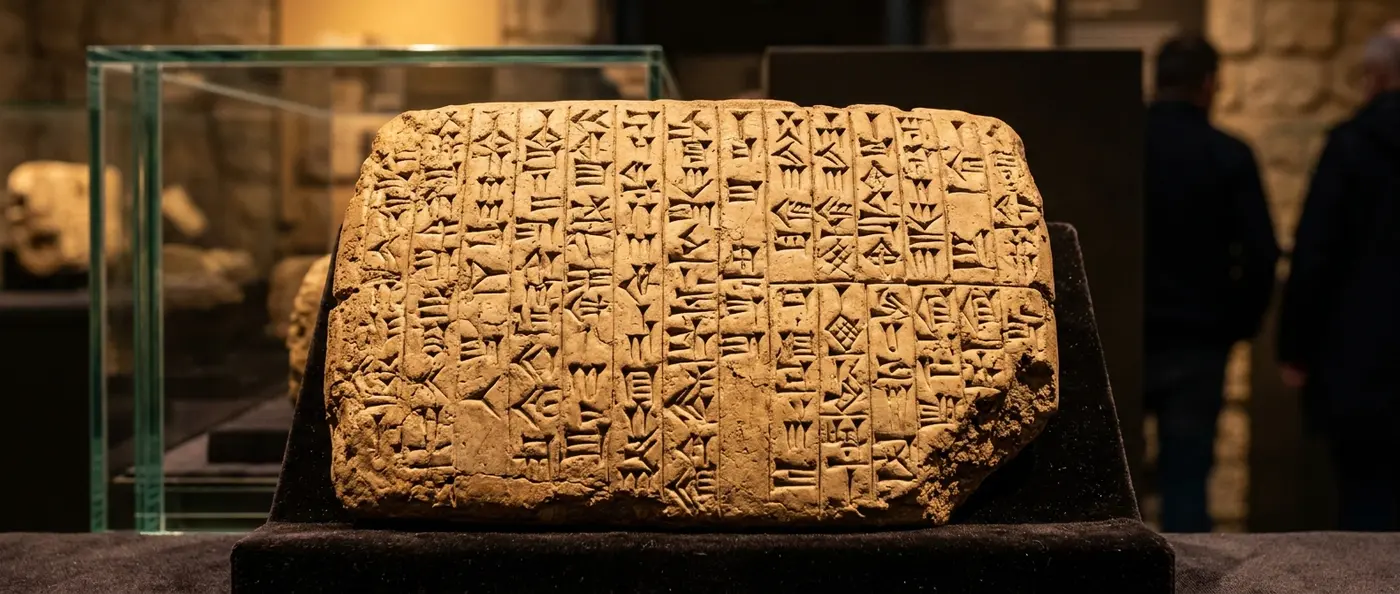
Before we grasp what makes this discovery revolutionary, we need to understand the writing system that ruled the ancient Near East for over three millennia. Cuneiform — named for the wedge-shaped marks made by pressing a stylus into soft clay — emerged in Mesopotamia around 3200 BCE.
The Sumerians created this breakthrough. Initially, they used it for accounting — tracking goods, transactions, taxes. But cuneiform evolved into something far more powerful. It could express complex laws, literature, scientific knowledge. The Epic of Gilgamesh. Hammurabi's Code. Mathematical treatises.
Other civilizations adopted and adapted the system. Babylonians, Assyrians, Hittites — they all bent cuneiform to their languages. Thousands of clay tablets have been unearthed across the Middle East, each one a window into ancient minds. But cuneiform had a problem: it was brutally complex, requiring scribes to memorize hundreds of symbols.
🗿 The Mystery of the Umm el-Marra Cylinders
These four cylinders are unique in several ways. They're perforated — holes suggest they were tied with string to other objects. Schwartz thinks they might have been gift tags or labels for container contents.
The breakthrough came when Semitic language expert Ted Lewis from Johns Hopkins identified the word "silanu" on one cylinder. He believes it's a personal name — possibly the owner or gift recipient. If he's right, we're looking at the oldest written personal name in human history.
Location matters too. Umm el-Marra sat at the crossroads of ancient trade routes between Mesopotamia and Aleppo. The city was a major Bronze Age commercial hub, and the tombs where these cylinders were found belonged to society's elite.
Strategic Position
Umm el-Marra controlled key ancient trade routes, connecting Mesopotamia with western Syria and the Mediterranean coast.
Elite Burials
The cylinders were found in high-status tombs alongside precious objects made from gold, silver, and lapis lazuli.
Probable Use
The perforated cylinders likely functioned as labels, tied with string to gifts or trade goods.
⚔️ The Alphabet Revolution
If the Umm el-Marra cylinders represent alphabetic writing, we're witnessing a revolution in human communication. Until now, scholars believed the alphabet developed around 1900-1800 BCE in the Sinai Peninsula, when Semitic workers in Egyptian mines adapted hieroglyphs to write their own language.
Proto-Sinaitic script is considered the ancestor of all alphabetic writing systems we use today. From it came Phoenician script, then Greek, Latin, Arabic, and Hebrew alphabets. The entire family tree of modern writing.
But what if the alphabet was invented 500 years earlier in a different place? We'd have to rewrite the entire history of writing. It would mean the revolutionary idea of alphabetic writing — where each symbol represents a sound instead of a whole word or syllable — developed much earlier than we thought.
💡 Why the Alphabet Was Revolutionary
Unlike cuneiform, which required learning hundreds of symbols, an alphabetic system needs only 20-30 characters. This made writing accessible to far more people, democratizing knowledge and communication.
🔬 The Slow Acceptance of a New Theory
Despite the discovery's significance, the scientific community has shown skepticism. When Schwartz first published drawings of the symbols in 2006, few scholars showed interest. Even when he proposed in 2010 that they might represent alphabetic writing, few paid attention.
Only in 2019, when he presented the findings at a Milan conference, did some experts start taking the hypothesis seriously. Christopher Rollston from George Washington University and Madadh Richey from Brandeis University backed his theory.
Rollston notes that paradigm-shifting discoveries gain acceptance gradually, not quickly. For widespread acceptance, more discoveries of similar texts are needed — preferably larger ones that would allow better analysis of the writing system.
🏛️ The Treasures of Umm el-Marra
The cylinders weren't the only significant finds in Umm el-Marra's tombs. The elite necropolis, dating between 2600 and 2150 BCE, contained a stunning wealth of objects that illuminate Early Bronze Age elite life.
Among the finds were gold and silver jewelry of exceptional craftsmanship, necklaces of lapis lazuli imported from distant Afghanistan, and high-quality ceramic vessels. Stone eye inlays were also discovered, likely belonging to wooden statues that had rotted away over time.
Particularly intriguing are the animal burials found in the necropolis. These were hybrids of donkeys and wild asses — animals of great value in ancient society. Their presence in tombs indicates the high social status of the deceased and the complex burial practices of the era.
📊 Writing System Comparison
🌍 Implications for Human History
The potential discovery of the world's oldest alphabet at Umm el-Marra challenges the linear narrative of how writing evolved. It shows that communication innovation may have occurred in multiple places and times, not necessarily in linear evolution.
Syria emerges not just as a trade corridor, but as a center where writing itself may have been invented. The region wasn't just a corridor between the great civilizations of Mesopotamia and Egypt — it was an innovation center in its own right.
If confirmed that the cylinders represent alphabetic writing, we'll need to reexamine many assumptions about cultural evolution. It would mean the alphabet idea — this simple but revolutionary concept that we can represent speech sounds with a few symbols — was born much earlier than we believed.
Schwartz plans to return to Umm el-Marra, hoping to uncover more cylinders that could settle the debate once and for all.
The history of writing is the history of human civilization. From the first commercial records to great literary works, from laws and treaties to personal letters, writing allowed us to preserve and transmit knowledge through time. The small clay cylinders of Umm el-Marra may represent the first steps in that long journey.