📖 Read more: Battle of Actium: Cleopatra and Antony's Last Stand
🏛️ Engineering Marvel That Defied Gravity
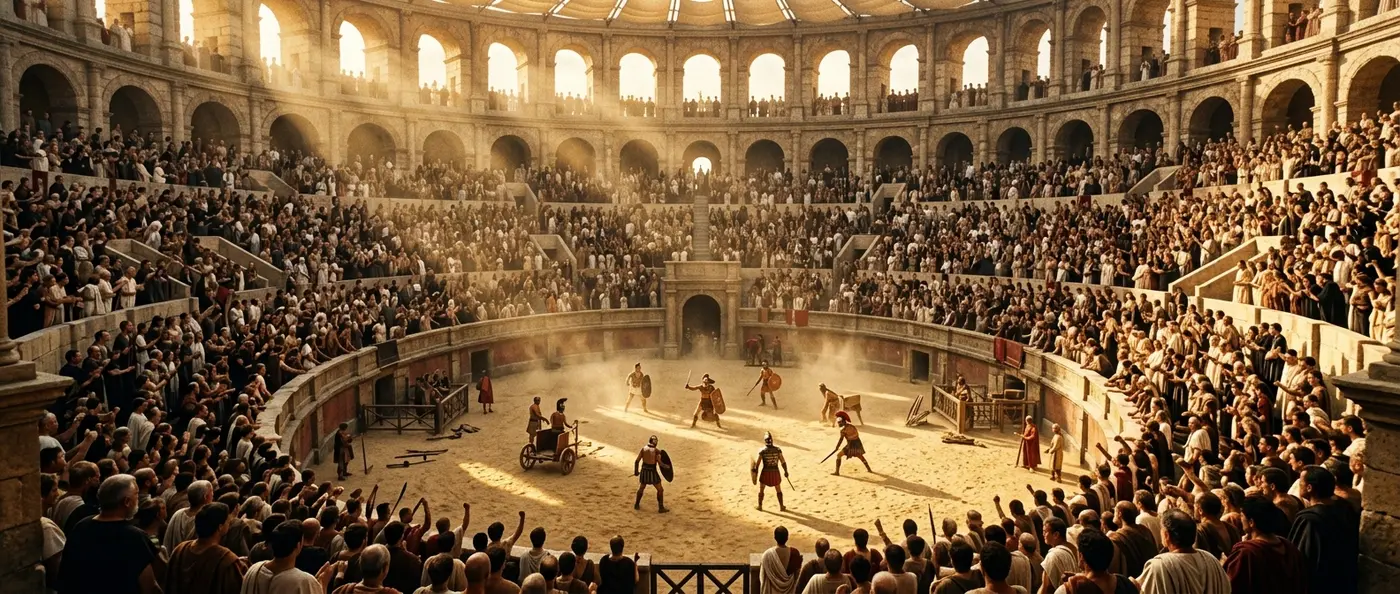
Construction began around 70 AD, at a time when amphitheaters were built into hillsides for stability. Romans had bigger plans. They decided to build the world's first freestanding amphitheater — a structure that would stand alone without natural support, defying every architectural convention of the era.
The numbers tell the story. Nearly 160 feet tall and over 600 feet long, the Colosseum could pack in roughly 50,000 spectators. The best seats went to senators and VIPs, but every Roman citizen could watch the games for free. This wasn't generosity — it was calculated politics.
Roman engineering genius showed in every detail. Spectators could enter through 80 different entrances, making the journey to their seats quick and efficient. Beneath the arena floor lay a complex network of corridors, secret passages, and trapdoors connecting gladiator schools, animal cages, and storage rooms.
⚔️ Gladiators: Hollywood Got It Wrong
Forget everything you've seen in movies. Gladiatorial combat wasn't chaotic slaughter where men fought to the death without rules. Recent digs show these were highly organized performances by specialized athletes, choreographed for maximum drama.
In the early days of the Roman Empire, gladiators were slaves, criminals, or prisoners of war dragged to the arena in chains. But by the first century AD, being a gladiator had become a lucrative position. Literary sources suggest that for some, it was even a career choice.
Some free citizens signed away their rights and became slaves as a high-risk way to pay off debts or escape a life of poverty. Others were criminals sentenced to serve as gladiators — a lighter punishment than execution, since there was a chance they might earn freedom someday.
🗿 Gladiator Types and Their Deadly Specialties
Each gladiator had their own fighting specialty, known as "armatura" — the ancient world's version of a social media persona. Based on their specialty, skill level, and experience, they were matched in the arena to pit strengths against weaknesses and ensure thrilling contests.
Retiarius
Agile fighter nearly naked, armed only with a net, trident, and small dagger. Speed was his primary weapon against heavily armored opponents.
Murmillo
Heavily armored warrior wearing over 45 pounds of protective gear. Slow but well-protected, built to outlast faster opponents.
Thraex
Distinguished by his characteristic crested helmet and curved sword. Combined flexibility with protection in balanced fighting style.
But crowds craved variety beyond the standard lineup. Literary sources and tombstones include references to a variety of more exotic gladiator types used to add excitement to familiar programs.
🏋️ The Brutal Training Regimen
Professional fighters needed professional training. Scholars have found evidence of dozens of gladiator schools throughout the Roman Empire, where gladiators trained year-round for games that happened only a few times per year.
One gladiator training complex in Rome had at least four facilities in the shadow of the Colosseum, one with a tunnel leading directly to its lower levels. The complex included a medical facility, storage for props and accessories, and a rehabilitation center for injured fighters.
💡 Did You Know?
A spectator area in one of Rome's facilities suggests that training sessions may have been attractions themselves. Gamblers wanting to see fighters up close or fans eager to watch their muscular favorites may have even paid to watch practice sessions.
Gladiator barracks were expensive to operate and many belonged to the emperor or wealthy Romans. They were managed by impresarios called "lanistae," usually former gladiators who had won their freedom in battle. Staff included doctors responsible for the fighters' medical care, "unctores" responsible for oiling and massaging gladiators after training, and a full team of cooks, weapon smiths, and other personnel.
📖 Read more: Gladiator Tomb Discovered on Via Appia Rewrites History
🌟 Arena Celebrities and Fan Culture
Brave performances in the arena could transform gladiators into popular heroes and even win imprisoned fighters their freedom. This contradiction — slaves who became stars — fed the fan obsession.
Watching and approaching them offered Romans with their strict social rules a taste of the forbidden. Roman writers rolled their eyes when wealthy women swooned over gladiators, but the attraction appears to have been more or less universal.
⚔️ Famous Gladiators of Pompeii
💀 Death in the Arena: Rare but Real
Contrary to popular belief, most gladiators didn't fight to the death. For every 10 gladiators who entered the arena, scholars estimate nine lived to see another day. However, death was occasionally the inevitable outcome, especially if the sponsor — the wealthy patron paying for the spectacle — demanded it.
If the defeated wasn't going to be saved, the victor was expected to deliver the final blow with his sword, usually a quick stab below the neck to the heart. If neither fighter was capable at the end of a particularly bloody contest, a masked executioner with a heavy hammer was ready to deliver the fatal blows.
🏛️ The Daily Program of Death
The Colosseum's program was carefully designed to hold the audience's interest all day. It started early morning with "venationes," wild animal hunts featuring beasts brought from the empire's most remote corners. Gladiatorial combat followed at midday, while records also exist of executions performed here.
For over 400 years, battles, blood baths, and death were routine here. How many people actually died here remains a matter of speculation. The only thing we know is that it wasn't a small number.
✝️ The End of an Era
As Christianity gained ground in the Roman Empire, disapproval of the spectacles increased. Emperor Constantine I banned gladiatorial games in 325 AD, but they likely continued in various, more discreet forms for over a century afterward.
Eventually, gladiatorial combat faded away, leaving behind only the mythical allure we know today. But the Colosseum remains, a stone monument reminding us of an era when life and death were spectacle, politics was conducted with bread and circuses, and people from the lowest social strata could become heroes — if only briefly.