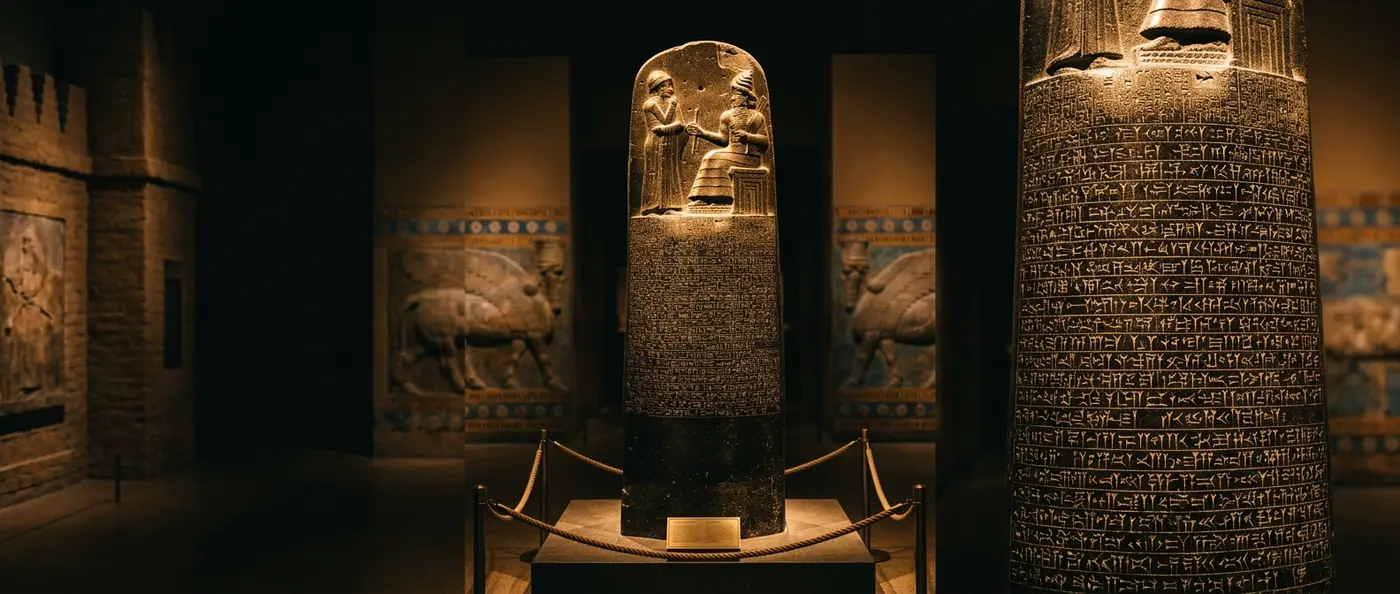
In 18th century BCE Babylon, a king carved 282 laws into a towering diorite pillar that stands today in the Louvre as the world's oldest known legal code. The Code of Hammurabi wasn't just a collection of rules — it was the first systematic attempt to impose order on the chaos of human coexistence.
📖 Read more: Mesopotamian Gods: Enlil, Marduk, and Ishtar
🏛️ Hammurabi's Babylon
Hammurabi ascended to Babylon's throne around 1792 BCE, when the city was just another Mesopotamian kingdom among many. During his 42-year reign (1792-1750 BCE), he transformed Babylon into a cosmopolitan center that attracted migrants from across the region. He conquered cities like Ur, Eshnunna, Assur, Nineveh, and Tuttul, creating an empire spanning much of Mesopotamia.
Daily life in Hammurabi's Babylon was surprisingly modern. Families lived in two or three-room houses built around open courtyards. Wealthy homes featured bathrooms, rooms with metal security systems protecting valuables, even private shrines. Marriage was primarily monogamous, though polygamy was permitted in special circumstances — for instance, if the first wife couldn't bear children.
Divorce was legal and documented cases show both men and women initiating separations. One 18th century BCE text records a man named Aham-nirsi wanting to cancel his upcoming marriage. When asked if he still considered the woman his wife, he replied: "You can hang me, dismember me — I will not remain married!" The woman declared she still loved her husband, but he refused and cut the hem of her dress, symbolizing divorce.
Adoption was common practice. Childless couples could adopt infants, older children, or teenagers. The reasons varied: to gain an heir, an apprentice, or someone to care for them in old age. One text states: "Yasirum and Ama-Suen have taken as their son a nursing infant, called Ili-awili, son of Agiyartum, from Agiyartum, his mother, and Eristum, her husband."
📜 Creating the Code
The Code of Hammurabi was carved into an imposing diorite stele placed in Marduk's temple in Babylon. At the top, a relief shows Hammurabi standing before Shamash, the god of justice, receiving divine blessing. In the code's prologue, the king justifies his role as lawgiver:
"When Anu and Bel gave to Marduk the lordship over mankind... they called me, Hammurabi, to bring about the rule of righteousness in the land, to destroy the wicked and the evil-doers, so that the strong should not harm the weak."
The code's purpose, he declared, was to make justice "rise like the sun over the people and illuminate the land." Based partly on Sumerian laws, the code prescribed harsher penalties for certain crimes, including death or mutilation for offenses by commoners that resulted in bodily harm.
This wasn't just legal innovation — it was a revolution in how power worked. Before written law, justice depended entirely on the whims of whoever held authority. Hammurabi carved his laws in stone to make them permanent, visible, and theoretically unchangeable.
⚖️ The Laws Themselves
The 282 laws covered a staggering range of social life. Economic provisions for prices, tariffs, and trade. Family law for marriage and divorce. Criminal law for assault and theft. Civil law for slavery and debt. Penalties varied based on the social status of offenders and the circumstances of crimes.
The code's most famous element was the principle of "eye for an eye" — the idea of retributive justice. But this principle wasn't applied equally. The wealthy and noble could often pay fines instead of suffering physical punishment, while the poor faced harsher penalties.
Despite its inequalities, the code offered some protection to women, commoners, and slaves. Women abused by their husbands could seek divorce. All accused were somewhat protected from false testimony, as the law prescribed death for witnesses who committed perjury.
📖 Read more: Ishtar Gate: Babylon's Cosmic Marvel That Defied Time
Young people typically learned a trade at home, following their father's footsteps. Dozens of documented cases show scribes, priests, and craftsmen passing their professions through multiple generations. The code regulated these apprenticeships, ensuring masters couldn't exploit students and students couldn't abandon their training.
Economic Laws
Regulated prices, wages, rents, and commercial transactions. Set compensation for damages and established rules for loans and interest rates.
Family Law
Covered marriage, divorce, inheritance, and adoption. Defined rights and obligations of spouses, parents, and children.
Criminal Law
Set penalties for theft, robbery, murder, and injury. Punishment severity depended on social class and circumstances.
🏺 Babylonian Society
Thousands of surviving cuneiform texts from this period offer fascinating glimpses into Babylonian life. They record not just royal achievements and military conflicts, but ordinary people's daily lives — their jobs, worries, thoughts about family, what they bought and sold.
The cuneiform texts show contradictions the stone code couldn't capture. Business partnerships between men and women were common. Women could own property, run businesses, and serve as witnesses in legal proceedings. Some became scribes or priestesses, wielding considerable influence.
Religious life permeated everything. People consulted omens before major decisions, made offerings to household gods, and participated in elaborate festivals. The code itself claimed divine sanction — Hammurabi wasn't just a king making rules, but a divinely appointed agent of justice.
Trade networks stretched across the known world. Babylonian merchants traveled to Anatolia, the Levant, and the Persian Gulf, bringing back exotic goods and foreign ideas. Governing Akkadian merchants alongside Sumerian farmers required laws that crossed cultural boundaries.
💡 Did You Know?
The Code of Hammurabi stele was discovered in 1901 at Susa, Iran, by French orientalist Jean-Vincent Scheil. It had been carried there as war booty by the Elamites in the 12th century BCE. Today it's housed in the Louvre Museum in Paris.
🔱 Impact on Justice
Writing laws down was revolutionary for its time. It discouraged judges from deciding arbitrarily and promoted the idea of justice as something universal and permanent. The Code of Hammurabi didn't allow personal acts of revenge — that alone was a major contribution to social order.
The code banned blood feuds and marriage by capture, though it still allowed trial by ordeal — throwing accused witches into the river to see if they drowned.
But the code wasn't perfect justice by modern standards. It institutionalized class differences, treating nobles, commoners, and slaves as fundamentally different categories of people. A noble who injured a commoner paid a fine; a commoner who injured a noble faced mutilation or death.
📖 Read more: Assyrian Reliefs: How Ancient Art Weaponized Violence
Still, the principle mattered more than the execution. For the first time in recorded history, a ruler declared that law existed above personal power. Justice wasn't whatever the king decided on a given day — it was written in stone, literally and figuratively.
📚 The Code's Legacy
The Code of Hammurabi set a vital and lasting precedent. Rulers through Napoleon Bonaparte issued their own codes to unite kingdoms containing people with many different customs and concepts of justice — and to discourage them from taking law into their own hands.
Hammurabi's dynasty lasted only a few generations before collapsing. Hammurabi himself, despite his laws about justice, didn't hesitate to betray his longtime ally, the king of Mari. He destroyed his rival's palace along with a temple to Shamash, ignoring an inscription that cursed whoever desecrated the shrine.
The irony is telling. Even the lawgiver couldn't fully live up to his own code. But that's precisely why written law mattered — it created a standard that transcended any individual ruler's character or whims.
Today, nearly 4,000 years later, the Code of Hammurabi remains the most complete and perfect surviving set of Babylonian laws. It reminds us that the need for written laws, for justice applied fairly, and for protection of the weak from the strong is as old as civilization itself.
⚔️ Comparison with Other Ancient Legal Codes
🗿 The Monument That Survived
The Code of Hammurabi stele is a masterpiece of art and technology. Made from diorite, an extremely hard rock, it stands 7.4 feet tall. The material choice wasn't accidental — diorite symbolized eternity and the unchanging nature of law.
The text is written in cuneiform script in the Akkadian language, the Semitic tongue spoken in Babylon. Though no Sumerian version survives, the code was intended to apply across a broader territory than any single country and to incorporate both Semitic and Sumerian traditions.
Most remarkably, this monument survived nearly 4,000 years of history. It survived Babylon's fall, looting by the Elamites, centuries buried in sand. When discovered in 1901, it gave the modern world a window into how ancient people tried to organize their society.
In a world where power meant the strength of your sword arm, Hammurabi carved different rules into stone: 'If a man damages another's property, he shall pay ten-fold.'
The Code of Hammurabi wasn't perfect. It favored the rich over the poor, men over women. But in a world where might often made right, it represented a bold attempt to set boundaries, define rules, create a system where justice could at least be claimed.