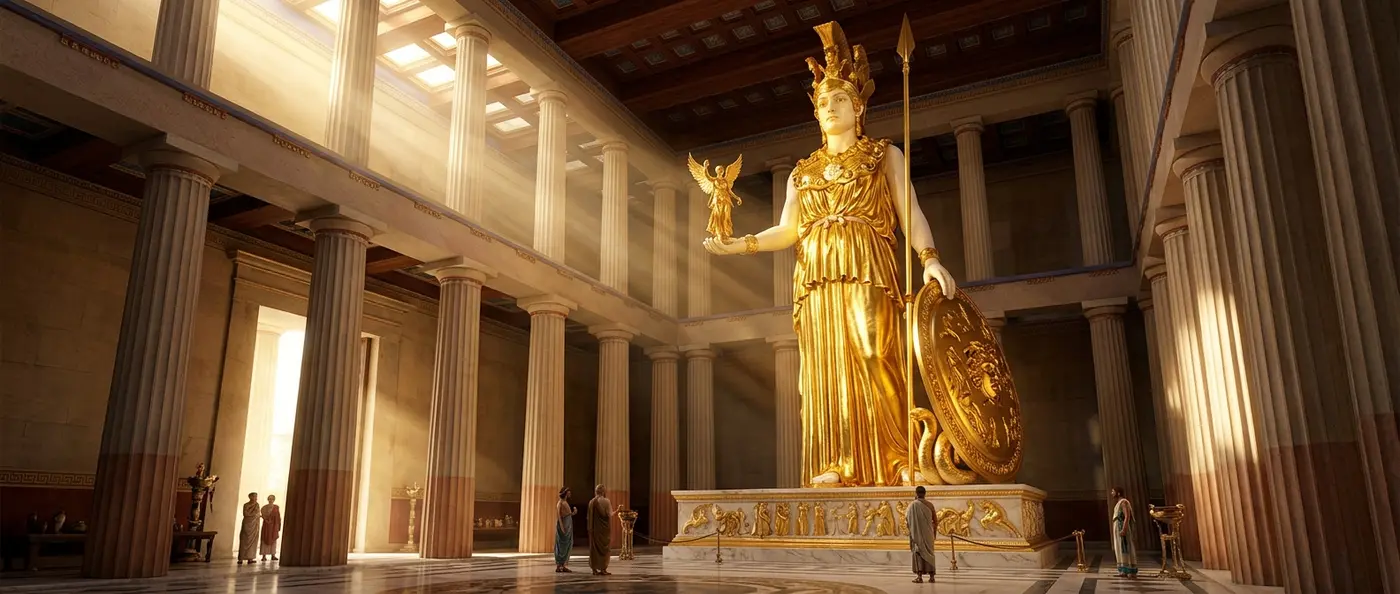
In the heart of the Parthenon, where thousands of pilgrims once knelt in awe, towered a statue so magnificent it took your breath away. Twelve meters tall, covered in gold and ivory, Phidias's chryselephantine Athena Parthenos represented the absolute pinnacle of ancient Greek art — a technique so complex and expensive that only the most powerful temples could afford it financially.
🏛️ The Technique That Combined Luxury and Religious Devotion
Chryselephantine technique stood apart from all other forms of ancient Greek sculpture. Unlike the marble or bronze statues that dominated public spaces, chryselephantine works were destined exclusively for the most sacred spaces — the inner sanctums of great temples.
Their construction required exceptional technical skill. Over a wooden core, usually cypress for its resistance to time, craftsmen placed thin plates of ivory to depict flesh and gold sheets for clothing, jewelry, and weapons. The result was statues that gleamed in lamplight, creating an almost supernatural presence.
The materials alone represented enormous wealth. Ivory was imported from Africa or Asia, while gold came from Thracian mines or was imported from more distant regions. For the construction of the Athena Parthenos statue, according to ancient sources, approximately 1,140 kilograms of gold were used — a quantity that corresponded to a significant part of the Athenian treasury.
⚒️ The Great Masters and Their Masterpieces
Phidias, the most important sculptor of the 5th century BC, established chryselephantine technique as the supreme form of religious art. Besides the Athena Parthenos, he created the colossal statue of Zeus at Olympia, one of the seven wonders of the ancient world. The Zeus statue, approximately 13 meters tall, depicted the father of the gods seated on a throne, holding Victory in one hand and his scepter in the other.
Phidias's workshop at Olympia, discovered by archaeologists, showed exactly how these masterpieces were built. Molds for shaping gold sheets were found, tools for ivory processing, even a cup with the inscription "ΦΕΙΔΙΟ ΕΙΜΙ" (I belong to Phidias).
Other significant artists who worked with chryselephantine technique include Colotes, Phidias's student, who created the statue of Asclepius at Epidaurus, and Theocosmus who constructed the statue of Hera at the Argive Heraeum. Each work required years of labor and collaboration among many specialized craftsmen.
💎 The Materials and Their Symbolic Significance
The choice of gold and ivory wasn't random. In ancient Greek thought, these materials symbolized immortality and divine nature. Gold, which doesn't oxidize, represented the eternal and incorruptible. Ivory, with its whiteness and luster, evoked divine radiance and purity.
Getting these materials meant crossing continents. Ivory reached Greece through complex trade networks extending from sub-Saharan Africa to India. Merchants crossed deserts and seas, facing dangers from pirates and bandits. The price of ivory was so high it was often used as currency in international transactions.
Gold
Symbol of immortality and divine power. Sourced from Pangaeum and Thasos mines, as well as imports from the East.
Ivory
Represented purity and divine radiance. Imported from Egypt, Libya, and Ethiopia through Phoenician merchants.
Cypress Wood
The statue base. Chosen for its resistance to time and insects, sourced from Crete and Cyprus.
🔬 The Construction Technique in Detail
Creating a chryselephantine statue began with constructing a skeleton of wood and metal. This core had to be strong enough to support the enormous weight of precious materials. Next, craftsmen shaped ivory into thin plates, which were heated and bent to follow body curves.
Keeping the ivory intact posed the biggest problem. The material was sensitive to humidity and temperature changes, causing it to crack or deform. For protection, ancient Greeks developed special techniques. At Olympia, in front of Zeus's statue was a pool of oil, and special attendants regularly anointed the ivory to keep it flexible and lustrous.
Golden parts were made using hammering technique. Craftsmen hammered thin gold sheets over special molds, creating folds and details that brought life to garments and decorative elements. Each piece was carefully attached to the wooden core with small pins and glues from natural resins.
💡 Did You Know?
The Athena Parthenos statue was designed so its golden parts could be removed if necessary. During the Peloponnesian War, Athenians seriously considered melting the gold to finance their war efforts.
🏺 The Religious and Political Dimension
Chryselephantine statues weren't merely artworks — they were powerful symbols of religious and political power. The presence of such a statue in a temple meant the city had the resources and piety to honor its gods in the most magnificent way. Simultaneously, they functioned as "banks" — their gold was part of the public treasury.
In Athens's case, the Athena Parthenos statue symbolized the city's hegemony in the Greek world. It was financed by revenues from the Delian League, which provoked reactions from other cities that considered Athenians were misusing common funds for their own glory.
Visitors arriving at the Parthenon and beholding the statue described the experience as overwhelming. The size, the gleam of gold in light entering through the eastern door, the expression of the goddess's face — created an experience that felt truly divine.
🗿 The Decline and Destruction
These statues rose and fell with the gods they represented. As Christianity spread through the Roman Empire, statues of pagan gods became targets for destruction. The Zeus statue at Olympia was transferred to Constantinople in the 4th century AD, where it was destroyed in a fire in 475 AD.
Athena Parthenos met a similar fate. After surviving for nearly 900 years, it was removed from the Parthenon sometime in the 5th century AD. Historians disagree about its exact fate — some believe it was destroyed by Christian fanatics, others that it was plundered for its gold.
Today, no original chryselephantine statue has survived. Our knowledge is based on ancient descriptions, coins depicting the statues, and smaller marble copies. However, their legacy remains alive — they represent the pinnacle moment of ancient Greek art, when technical skill, religious zeal, and political wealth combined to create works of incomprehensible magnificence.
⚔️ The Greatest Chryselephantine Statues
🔍 Modern Reconstruction Attempts
The allure of chryselephantine statues has led to many reconstruction attempts. In 1990, American sculptor Alan LeQuire created a full-scale replica of Athena Parthenos for the Parthenon in Nashville, Tennessee. Though constructed from modern materials, the statue gives an impressive sense of the original's size and magnificence.
In Greece, archaeologists and art historians continue studying the minimal remains found. Ivory fragments from Phidias's workshop at Olympia, molds and tools, offer valuable information about construction techniques. 3D scanning and digital reconstruction now let researchers build detailed models from fragments and ancient descriptions.
Chryselephantine technique shaped art for centuries after. From Byzantine mosaics with gold backgrounds to medieval reliquaries with precious metals and stones, the idea of using precious materials to create religious images continued inspiring artists for centuries. Even today, the gleam of gold combined with white continues to be considered a symbol of divine presence and supreme beauty.