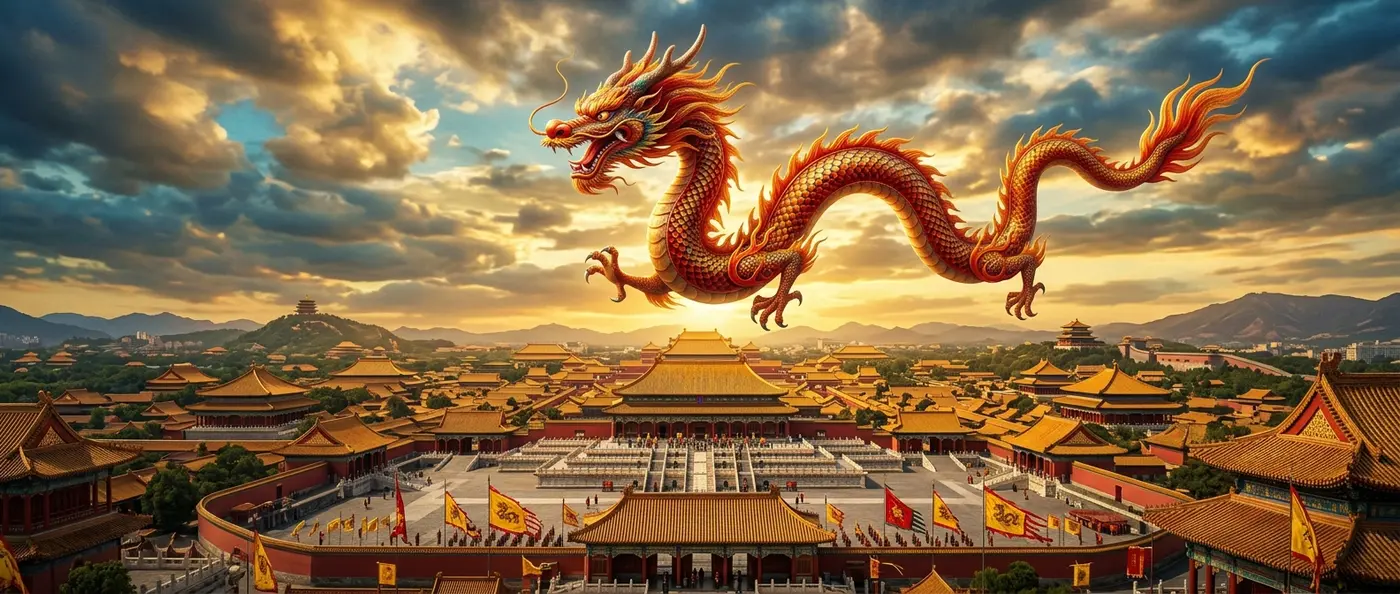
On the banks of the Yellow River, 3,600 years ago, a Shang dynasty bronze worker carefully carved symbols onto a turtle shell. He couldn't know he was creating one of the earliest examples of Chinese writing that would survive millennia. From that moment until the fall of the Ming dynasty in 1644, China would witness the rise and fall of 13 major dynasties, each leaving its indelible mark on human history.
🏛️ The First Dynasties: Foundations of Civilization
Chinese dynastic history begins with the mythical Xia dynasty, founded according to tradition by Da Yu or "Yu the Great." While many scholars consider the Xia semi-legendary due to lack of historical records, its existence remains deeply rooted in the collective memory of the Chinese people.
The first historically documented dynasty, the Shang (c. 1600-1046 BCE), brought revolutionary advances in mathematics, astronomy, and art. During this period, early forms of the Chinese language developed, with oracle bones serving as the oldest known examples of Chinese writing. Shang rulers lived in imposing palaces and maintained sophisticated administrative systems that laid the foundation for future dynasties.
The Zhou dynasty (1046-256 BCE) that followed became the longest-lasting dynasty in Chinese history. During its reign emerged the great philosophical schools of Confucianism, Taoism, Legalism, and Mohism. Great philosophers like Lao Tzu, Confucius, and Sun Tzu lived and taught during this period, shaping thought that would influence China for millennia to come.
⚔️ The Age of Wars and Unification
The Warring States period that began during the Zhou dynasty was marked by continuous conflicts between rival kingdoms. This turbulent era ended with the establishment of the Qin dynasty (221-207 BCE), when Qin Shi Huang became the first emperor of a unified China.
Despite its brief duration, the Qin dynasty left an indelible mark. During this period, the first sections of the Great Wall were constructed and a standardized writing system was established that linguistically united the vast empire. Qin Shi Huang also implemented a unified monetary system and standardized weights and measures, creating conditions for China's economic development.
The Han dynasty (206 BCE - 220 CE) marked the beginning of a new era of prosperity. During this period, the Silk Road opened, bringing foreign trade, Buddhism, and innovations like silk paintings and paper. The invention of paper, attributed to Cai Lun around 105 CE, enabled the wider dissemination of knowledge and literature.
After a period of division and upheaval, the Tang dynasty (618-907 CE) elevated China to one of the world's largest and most advanced states. It's considered one of the high points of Chinese civilization, with major achievements in sciences and humanities. Empress Wu, the first female monarch to rule under her own name, left her mark on this era.
Silk Road
The trade network that connected China to the West, enabling the exchange of goods, ideas, and cultures for over 1,500 years.
Invention of Paper
The revolutionary invention that transformed how knowledge was recorded and disseminated, influencing the entire world.
Examination System
The unique merit-based system for selecting civil servants that influenced administration for centuries.
🐉 Foreign Conquests and Renaissance
China's history wasn't always one of native dynasties. The Yuan dynasty (1271-1368) was established by the Mongols under Kublai Khan, grandson of Genghis Khan. Despite their foreign origins, the Mongol rulers adopted many elements of Chinese culture, and their period was characterized by extensive foreign trade and cultural exchanges.
Mongol rule was overthrown by a peasant rebellion that led to the establishment of the Ming dynasty (1368-1644). The Ming brought a period of economic prosperity and population explosion. The Great Wall was strengthened and expanded to the form we know today, while the Forbidden City was built in Beijing, an architectural masterpiece that housed 24 emperors.
During the Ming dynasty, Admiral Zheng He conducted seven legendary naval expeditions that reached Africa, decades before Columbus. His fleets included hundreds of ships and tens of thousands of sailors, demonstrating China's naval supremacy.
🚢 Did You Know?
Zheng He's "treasure ships" were massive for their time, reaching lengths of 137 meters - nearly five times larger than Columbus's Santa María! These colossal naval constructions carried porcelain, silk, and other precious goods to distant lands.
👑 The Last Imperial Dynasty
The Qing dynasty (1644-1912), ruled by the Manchus from the northern Chinese region of Manchuria, was the last imperial dynasty. Despite their foreign origins, the Qing adopted and preserved many Chinese traditions while expanding the empire's borders to their greatest extent in history.
On February 12, 1912, 6-year-old Puyi, China's last emperor, abdicated the throne. This ended Chinese imperial rule after more than 2,000 years, paving the way for the Republic of China. The abdication of a small child marked the end of a governance system that had shaped the fate of hundreds of millions of people for millennia.
Each dynasty left its unique legacy to Chinese culture. From Shang oracle bones to Zhou philosophy, from the Qin Great Wall to Han paper, from Tang poetry to Ming porcelain - each period contributed to shaping what we recognize today as Chinese civilization.
The dynastic system, though it ended more than a century ago, continues to influence our understanding of Chinese history. Modern scholars recognize that these "dynasties" are actually retrospective constructs, as experts note, but they remain useful for organizing and understanding China's long and complex history.
The study of Chinese dynasties teaches us that history isn't linear progress but cyclical alternation of rise and fall, innovation and tradition, unity and division. From the mythical founders of the Xia to the last emperor of the Qing, the history of Chinese dynasties is the story of a civilization that survived, adapted, and flourished for more than three millennia.
📊 Major Dynasty Comparison
🌏 Impact on the Modern World
The influence of ancient Chinese dynasties extends far beyond China's borders and time. Inventions made during these periods - gunpowder, the compass, movable type printing, paper - changed the course of global history. The examination system for selecting civil servants, developed during the Sui dynasty and perfected in subsequent dynasties, influenced modern public administration systems worldwide.
The philosophical traditions developed during the Zhou dynasty - Confucianism with its emphasis on ethics and social harmony, Taoism with its connection to nature and balance - continue to influence millions of people today. These ancient wisdoms find new relevance in a world seeking balance between progress and tradition.
The architectural legacy of the dynasties - from the Great Wall to the Forbidden City, from the Ming Tombs to the First Emperor's Terracotta Army - today constitute world heritage monuments that attract millions of visitors and remind us of the grandeur of these ancient civilizations. Every stone, every statue, every inscription tells a story of millennia.