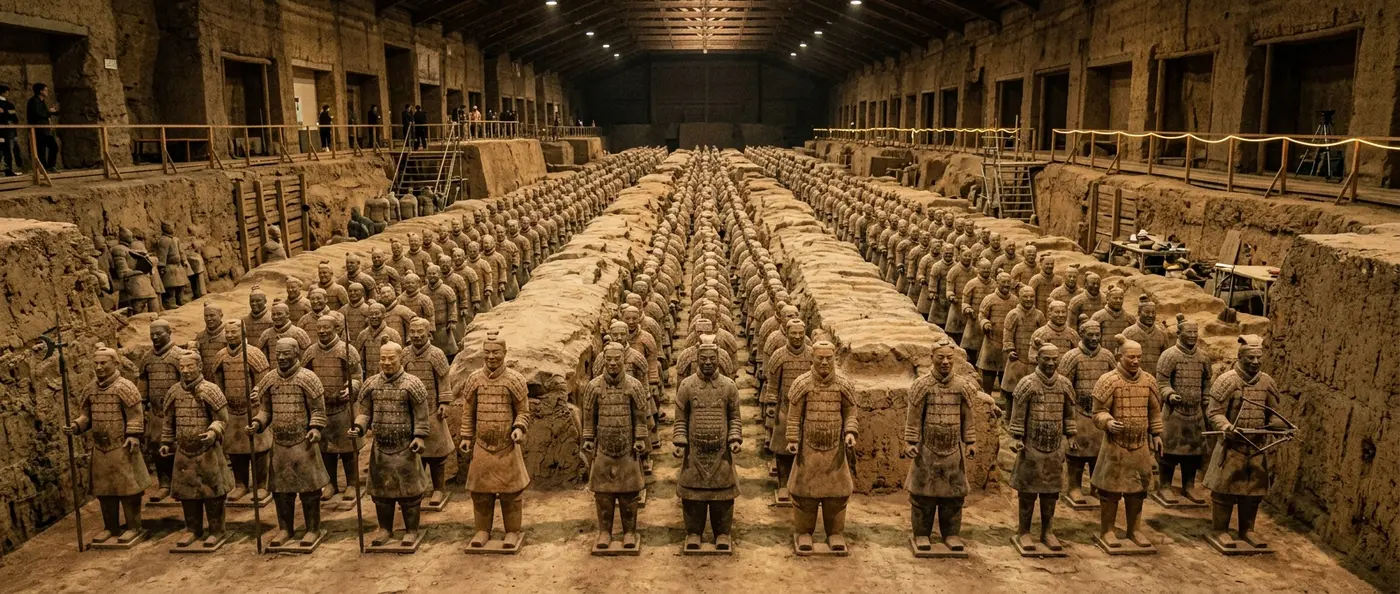
March 1974. Farmers in China's Shaanxi Province dig for a well when their shovels strike something hard. What they uncover changes archaeology forever — an entire army of clay warriors that had been guarding China's first emperor's tomb for over 2,000 years. No two faces are alike. Each warrior stands ready for battle. And somehow, their bronze weapons still gleam razor-sharp after two millennia underground.
🏺 The Discovery That Stunned the World
The farmers' accidental find revealed an underground chamber packed with life-sized clay statues. Archaeologists who rushed to the site stood speechless. Before them stretched an army of roughly 8,000 warriors and horses, arranged in military formation, ready for combat. Each warrior bore unique facial features, different heights, and distinct body postures.
The army stood about 1.2 kilometers east of Emperor Qin Shi Huang's main tomb, faces turned toward the direction of his ancient enemies. The positioning wasn't random — these clay guardians protected the dead ruler from threats of the past.
What makes this discovery extraordinary isn't just the scale. Every single face is different. Archaeologists have documented thousands of unique expressions, hairstyles, and even wrinkles that make each warrior an individual masterpiece.
⚔️ The First Emperor and His Quest for Immortality
Qin Shi Huang took the throne at just 13 years old in 246 BC. Within decades, he unified China's scattered kingdoms under one central power, becoming the first emperor of a united China. His obsession with immortality drove him to begin construction of his mausoleum immediately after rising to power.
Ancient sources report that over 700,000 workers labored for decades on the tomb complex. The emperor didn't want just a burial site — he wanted an entire underground empire to accompany him in the afterlife. The terracotta army was only one piece of this colossal project.
Recent discoveries confirm the emperor's fixation on eternal life. In September 2025, archaeologists uncovered an authentic Tibetan inscription referencing Qin Shi Huang's quest for immortality, adding new evidence to our understanding of his beliefs.
The tomb complex covers 56 square kilometers — larger than Manhattan. That's larger than Manhattan. And most of it remains unexcavated.
🗿 The Art of Creation
Each terracotta warrior is a unique work of art. Craftsmen built the statues in sections — heads, torsos, arms, and legs were fired separately, then assembled. The most striking aspect is that no two faces are identical. Archaeologists have cataloged different features, hairstyles, expressions, and even wrinkles that make each warrior one-of-a-kind.
The statues were once vibrantly painted with mineral colors — red, green, blue, yellow, and purple. Unfortunately, exposure to air after excavation caused most paint to flake off and vanish within minutes. Today, scientists use special techniques to preserve paint remnants they discover in new excavations.
The detail work is extraordinary. Armor patterns vary by rank. Shoe treads show different designs. Even fingernails are individually carved. These weren't mass-produced figures — they were personalized portraits of an ancient army.
Construction Technique
Statue parts were made separately in molds and fired at high temperatures. They were then assembled and hand-detailed with individual features.
Colors and Decoration
Each warrior was painted with bright colors indicating their position in the military hierarchy. Uniforms featured detailed patterns and motifs.
Uniqueness
Craftsmen added individual characteristics to each face, creating thousands of different expressions and physiognomies.
💀 The Military Formation
The terracotta army's arrangement mirrors actual Qin-era military tactics. Archers and crossbow men stand in the front line, ready to unleash the first attack. Behind them, infantry units with spears and swords form ranks, while chariots with horses guard the flanks. The rear guard consists of heavily armored warriors.
In January 2025, archaeologists discovered a rare statue depicting a high-ranking military commander. The 2,000-year-old figure stands out for its detailed armor and commanding posture. The discovery reveals details about ancient Chinese military ranks and structure.
Beyond the warriors, archaeologists have found thousands of bronze weapons — swords, spears, arrows, and crossbows. Most remarkably, these weapons, made from a special 13-element alloy, remain sharp and gleaming after two millennia, thanks to advanced metallurgical technology of the era.
The weapons weren't ceremonial. They were battle-ready. Swords still slice paper. Arrowheads remain lethal. This wasn't just an artistic monument — it was a functional army frozen in time.
🏛️ The Broader Tomb Complex
The terracotta army is just the tip of the iceberg. Emperor Qin Shi Huang's mausoleum spans 56 square kilometers and includes hundreds of underground chambers. Four main pits containing clay statues have been discovered so far. The first and largest contains the main army, the second houses over 1,300 warriors and chariots, the third contains 68 members of what appears to be an elite command unit, while the fourth was found empty.
💎 Treasures Among the Warriors
In June 2024, archaeologists discovered a hidden chamber filled with treasures among the terracotta warriors. The chamber contained jade, gold, and bronze objects, as well as rare silk textiles preserved by the tomb's special conditions.
Many finds show fire damage. Archaeologists believe that shortly after the emperor's death, rebels invaded the mausoleum and set fires, causing wooden roofs to collapse onto the statues. However, the destruction wasn't complete, and thousands of statues survived nearly intact.
Every dig turns up something unexpected. Musicians with instruments. Acrobats in performance poses. Court officials in ceremonial dress. The emperor didn't just want soldiers in his afterlife — he wanted an entire civilization.
🔬 Modern Technology Serves Archaeology
Modern archaeologists use advanced technologies to study the terracotta army. 3D scanning allows digital recording of every detail. Spectroscopic analysis reveals the composition of paints and materials. Even DNA analysis of organic remains helps understand construction techniques.
In 1987, the site was designated a UNESCO World Heritage Site. Since 1994, a unique on-site museum has operated where visitors can watch archaeologists work in real time. Protective roofs cover the excavation areas, allowing work to continue under controlled conditions.
The preservation challenges are immense. When exposed to air, the clay can crack within hours. Humidity must be carefully controlled. Each warrior requires individual conservation treatment. It's archaeology at the pace of surgery.
🏺 Comparison with Other Tomb Monuments
🗺️ The Mystery of the Central Tomb
Despite decades of excavation, the emperor's central tomb remains untouched. Ancient sources describe an underground paradise with mercury rivers representing China's great waterways, celestial domes with precious stones, and automatic crossbows protecting the dead ruler. Modern measurements have indeed detected unusually high mercury levels in the soil above the tomb.
The descriptions sound like fantasy, but evidence keeps supporting them. Ground-penetrating radar shows massive underground structures. Soil samples confirm mercury contamination. Magnetic surveys detect metallic objects in precise geometric patterns.
Chinese authorities have decided to leave the central tomb sealed until preservation technology improves. They've seen what happened when King Tut's tomb was opened — priceless organic materials crumbled to dust within hours. They won't make the same mistake twice.
Archaeologists estimate it will take decades more to complete excavation of the entire complex. Every find reveals more about this massive undertaking. The terracotta army captures imperial China of the 3rd century BC — its military might, advanced technology, and imperial ambitions.
As work continues, Qin Shi Huang's terracotta army keeps guarding its secrets, revealing them gradually to modern researchers. Each warrior excavated, each weapon discovered, each new chamber uncovered brings us closer to understanding one of humanity's most ambitious projects — one man's attempt to conquer immortality.