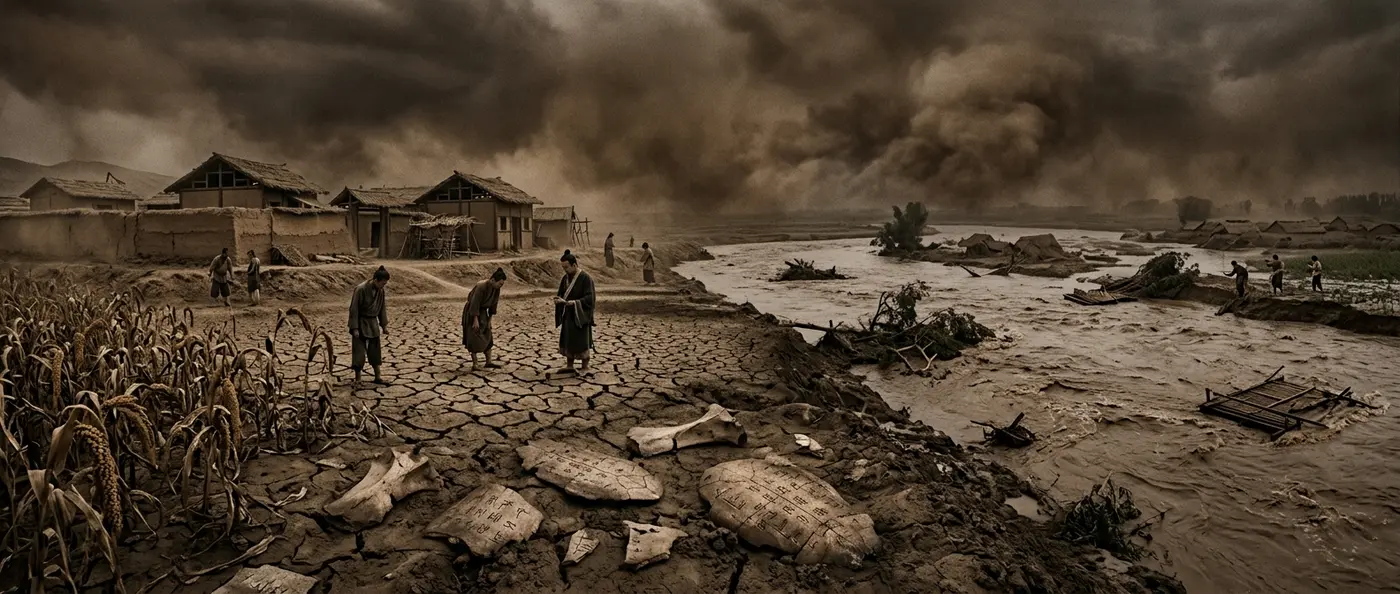
The Yellow River changed course. Again. For the third time in a century, China's most unpredictable waterway had carved a new path across the landscape, drowning entire cities and leaving millions of acres of farmland buried under silt. But this wasn't modern China — this was 3,000 years ago, during the Bronze Age, when climate disasters could erase dynasties overnight.
🌊 Bronze Age China: A Civilization on the Edge
Bronze Age China stretched from roughly 2000 BCE to 771 BCE. The Shang and Zhou dynasties ruled during this era, building complex societies and mastering advanced metallurgy. But their greatest challenge wasn't war or politics — it was water.
Chinese society lived and died by agriculture. Millet crops in the north, rice paddies in the south. When the rains came on schedule, civilizations flourished. When they didn't, empires crumbled. The ancient Chinese developed sophisticated irrigation systems to tame their environment, but nature always held the upper hand.
This went far beyond simple farming. They built canals, dams, and reservoirs that would impress modern engineers. Underground drainage systems protected cities from floods. Terraced hillsides maximized every drop of rainfall. Yet despite their ingenuity, they remained hostage to forces beyond their control.
💡 Did You Know?
The Shang dynasty kept detailed weather records carved into turtle shells and ox shoulder blades — the famous "oracle bones" that now provide scientists with 3,000-year-old climate data.
🌾 When the Monsoons Failed
Ancient Chinese farmers lived by a lunar calendar that tracked seasonal changes with mathematical precision. They knew exactly when to plant, when to harvest, when to prepare for floods. But the climate didn't always cooperate.
Millet cultivation in northern China required specific rainfall patterns. Too little rain meant crop failure. Too much meant rotting grain. In the south, rice farming demanded steady water supplies and protection from devastating floods. A single bad season could trigger famine. Multiple bad seasons could topple governments.
Ancient Chinese texts describe prolonged droughts that alternated with catastrophic floods. The Yellow River earned its nickname "China's Sorrow" for good reason — it regularly jumped its banks, destroying everything in its path. Entire villages vanished under muddy water. Survivors fled to higher ground, becoming climate refugees millennia before the term existed.
The Yellow River's floods were particularly vicious. This massive waterway, carrying enormous loads of sediment from the Tibetan plateau, would suddenly shift course, abandoning its old channel for a completely new route hundreds of miles away. Imagine the Mississippi River deciding to flow through Texas instead of Louisiana — that's what the Yellow River did routinely.
🏛️ When Heaven Withdrew Its Mandate
Climate disasters didn't just kill crops — they killed dynasties. Ancient Chinese philosophy linked natural disasters directly to political legitimacy through the "Mandate of Heaven." Bad weather meant the emperor had lost divine approval. Rebellions became righteous acts of cosmic restoration.
Famines triggered mass migrations. Desperate populations abandoned their ancestral lands, creating waves of climate refugees who destabilized neighboring regions. Local warlords stockpiled grain in massive granaries, preparing for the inevitable lean years. These storage systems became targets during times of crisis.
The social fabric unraveled quickly when food ran out. Archaeological evidence shows abandoned settlements, hastily buried hoards of bronze artifacts, and defensive fortifications built during periods of climate stress. Entire cultural traditions disappeared as communities scattered to survive.
🔬 Reading Ancient Climate in Modern Labs
Today's archaeologists extract climate secrets from lake sediments and river deposits. Core samples reveal alternating layers of drought and flood that match historical records of dynastic upheavals. The earth itself became a climate diary, recording every extreme weather event in geological strata.
Plant fossils and pollen analysis reveal dramatic vegetation changes linked to climate shifts. Scientists have identified periods when forest cover collapsed across vast regions, likely due to prolonged drought or human desperation. Tree ring data from ancient wooden artifacts confirms years of stunted growth during climate crises.
Sediment Analysis
Lake bed cores reveal drought and flood cycles through distinct geological layers, creating a natural archive of ancient climate disasters.
Paleobotany
Fossilized seeds and pollen grains reconstruct ancient ecosystems and agricultural practices during climate upheavals.
Animal Remains
Bone analysis from archaeological sites shows dietary changes and livestock patterns that reflect climate-driven adaptations.
🗿 Engineering Against Chaos
Ancient Chinese engineers fought back with new approaches. They abandoned the traditional approach of building higher walls against floods. Instead, they dug channels to redirect water away from populated areas. Working with water instead of fighting it proved far more effective.
Hillside terracing transformed steep slopes into productive farmland while preventing soil erosion. These stepped fields captured rainwater and prevented devastating mudslides. Underground aqueducts carried water across vast distances, ensuring cities could survive extended droughts.
The legendary Great Yu, who supposedly saved China from catastrophic floods, represents this engineering revolution. According to tradition, Yu spent 13 years digging channels and building drainage systems. His approach — diverting floods rather than blocking them — became the foundation of Chinese hydraulic engineering.
⚖️ Flood Control Methods
🌍 Global Climate Chaos
China wasn't alone. Around 1000 BCE, climate disruptions hammered civilizations worldwide. The Bronze Age collapse in the Mediterranean happened simultaneously with China's climate crises. Mycenaean Greece, Hittite Anatolia, and other advanced societies faced similar environmental pressures.
Comparing climate data from different regions reveals a pattern of synchronized global climate variability. Massive atmospheric or oceanic phenomena likely affected multiple continents simultaneously. This suggests that Bronze Age climate disasters were part of a planetary-scale environmental shift.
The timing wasn't coincidental. Ice core data from Greenland and Antarctica show evidence of volcanic eruptions and solar variability that could have triggered widespread climate anomalies. Ancient Chinese climate disasters were part of a global environmental crisis that reshaped human civilization.
💭 Lessons from Ancient Catastrophe
Bronze Age China's climate disasters offer stark lessons for our modern world. The societies that survived were those that adapted quickly, innovated boldly, and built resilient infrastructure. Those that clung to old methods disappeared.
The ancient Chinese understanding that environmental stability and political stability were inseparable remains relevant today. Climate disasters don't just damage crops — they destabilize governments, trigger migrations, and reshape entire civilizations. The Mandate of Heaven wasn't just philosophy; it was political reality.
Most striking is how technological innovation emerged from crisis. The hydraulic engineering techniques developed during Bronze Age climate disasters influenced Chinese water management for millennia. Crisis forced creativity, and creativity enabled survival.