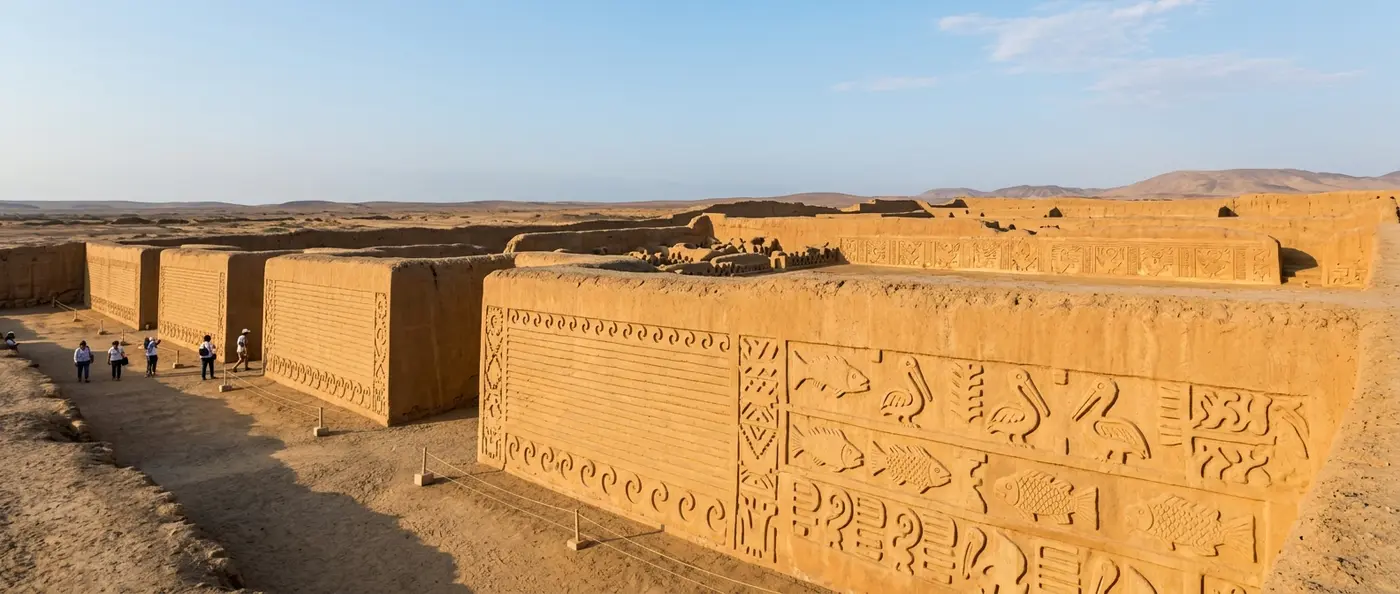
A thousand years before Machu Picchu was built, another empire ruled Peru's coast. The Chimú controlled 600 miles of Pacific shoreline from their mud-brick capital of Chan Chan — the largest city in pre-Columbian South America. Their neighbors, the Chincha, commanded fleets of 100,000 rafts that carried sacred shells across treacherous ocean currents. These weren't backwater kingdoms waiting for the Inca to arrive. They were maritime superpowers that thrived in one of Earth's most unforgiving deserts.
🌊 The Mud-Brick Metropolis
Chan Chan sprawls across 20 square kilometers near modern-day Trujillo. Built entirely from adobe bricks, it housed an estimated 60,000 people at its peak between 900 and 1470 CE. Nine massive rectangular compounds, each surrounded by towering walls, divided the city into royal districts — one for each king in the Chimú dynasty.
The engineering feat wasn't just the city's size. The Chimú built this metropolis in the Atacama Desert, where rainfall measures less than an inch per year. Their solution? An irrigation network that channeled water from Andean rivers across dozens of miles of desert. Canals, reservoirs, and aqueducts turned barren sand into fertile farmland.
Each royal compound contained palaces, temples, gardens, and workshops where artisans crafted gold ornaments and textiles. When a king died, his compound became his tomb — sealed forever while his successor built a new district. This explains Chan Chan's unusual layout: a city of royal neighborhoods frozen in time.
⚓ The Chincha: Masters of the Pacific
While the Chimú dominated the north coast, the Chincha kingdom controlled the southern waters. Spanish chroniclers recorded that the Chincha kingdom contained roughly 30,000 households when the Inca conquered them. But numbers don't capture what made them unique: their obsession with the ocean.
Pedro Pizarro, cousin of conquistador Francisco Pizarro, documented an astonishing claim. Local informants told him the Chincha lord possessed 100,000 rafts in the "South Sea." Even if exaggerated, the existence of thousands of oceangoing balsa rafts with keels and sails represents a maritime enterprise on an almost unimaginable scale.
The Chincha weren't just fishermen. They were long-distance traders who sailed north to Ecuador — a journey of over 1,000 miles through some of the Pacific's most dangerous waters. Their cargo? Spondylus shells, which held sacred significance throughout the Andes.
These spiny oyster shells lived only in the warm waters off Ecuador's coast. To Andean peoples, especially those in the cold highlands, Spondylus brought rain. Quechua texts describe it as "the food of the gods" — inedible to humans but essential for divine favor. The Chincha risked their lives crossing from Peru's cold Antarctic current into Ecuador's warm equatorial waters to harvest this spiritual currency.
🐚 The Sacred Shell Trade
The Spondylus trade reveals the sophistication of pre-Columbian maritime networks. Chincha traders had to navigate shifting currents, seasonal weather patterns, and hostile waters to reach Ecuador's shell beds. They developed specialized rafts with cotton sails and centerboard keels — technology that allowed them to sail closer to the wind than European ships of the same era.
Back in the Andes, Spondylus commanded prices that would make modern luxury goods blush. Highland peoples traded gold, silver, and textiles for these shells. Inca nobles wore Spondylus jewelry. Priests ground the shells into powder for ceremonies. The entire Andean economy partly depended on these maritime expeditions.
Archaeological evidence shows Spondylus reached as far south as Chile and as far inland as Bolivia. The Chincha had created a trade network spanning thousands of miles — all centered on shells that could only be harvested by skilled divers in dangerous waters.
Maritime Technology
Chincha rafts featured centerboard keels for stability and cotton sails to harness Pacific winds for long-distance voyages.
Trade Networks
Commerce extended thousands of miles, connecting Peru's coast with Ecuador and reaching deep into the Andes.
Sacred Commodities
Spondylus shells held such religious significance that they justified dangerous ocean crossings and premium prices.
🏛️ Art and Architecture
Chimú artisans created some of pre-Columbian America's most sophisticated metalwork. They mastered techniques for working gold, silver, and copper — knowledge so advanced that the Inca later relocated Chimú craftsmen to Cusco. Chimú goldsmiths could create paper-thin sheets, intricate filigree, and complex alloys.
Their architecture favored function over flash. Adobe walls rose in geometric patterns, decorated with repeating friezes of fish, birds, and waves. These weren't random designs — they reflected the Chimú worldview where ocean and desert existed in careful balance.
Chimú ceramics, while less colorful than their Moche predecessors, achieved industrial-scale production. Black pottery with burnished surfaces became their signature style. Vessels featured stirrup spouts and bridge handles — practical designs for a society that valued efficiency.
Recent discoveries continue to reveal Chimú artistic sophistication. At Huaca Pintada, archaeologists uncovered a 3,000-year-old mural stretching nearly 20 feet long. The painting depicts fish, stars, and mythological beings in blues, yellows, reds, and blacks — colors that remain vivid after three millennia.
🗿 Recent Archaeological Discoveries
Excavations in Peru's Virú Valley revealed burials dating to 1800 BCE — long before either the Chimú or Inca rose to power. At the Queneto archaeological site, researchers uncovered skeletal remains of four individuals: two children, one teenager, and one adult.
All the dead lay on their sides, faces turned toward a mountain. Grave goods included stone pendants and snail shells. The burials occurred within what appears to be a temple built with pebble walls bound by clay mortar.
Archaeologists believe the Queneto temple related to water worship. In a desert where survival depended on irrigation, water held sacred significance. Mountains, as sources of rivers, carried symbolic meaning in Andean cosmology that persisted for millennia.
💡 Water Worship
The temple at Queneto likely served water-related rituals. In Peru's coastal desert, where survival depended entirely on irrigation from Andean rivers, water wasn't just practical — it was divine. Mountains held sacred status as the source of life-giving streams.
These discoveries push back the timeline of complex coastal societies. The sophisticated water management and ceremonial architecture found at sites like Queneto suggest that Peru's coast supported advanced civilizations for over 3,000 years before the Inca arrived.
⚔️ Conquest by the Inca
Both the Chimú and Chincha eventually fell to Inca expansion. The Chimú resisted fiercely but were conquered around 1470 CE by Inca Tupac Yupanqui. The conquest was so significant that the last Chimú king was relocated to Cusco, along with many of the kingdom's finest craftsmen.
The Chincha faced a different fate. After Spanish conquest, Emperor Charles V requested personal lands in the New World. Francisco Pizarro granted him three indigenous groups: the Aymara kingdom of Lupaca, the tropical island of Puná, and the coastal Chincha state.
Despite royal protection and proximity to Lima, the Chincha population vanished within three decades of Spanish invasion. Disease and exploitation decimated this once-powerful maritime people. Their sophisticated knowledge of Pacific navigation died with them.
📊 Chimú vs Chincha Comparison
🌅 Legacy of the Coastal Empires
The Chimú and Chincha proved that complex civilizations could thrive in Earth's most challenging environments. They turned coastal desert into productive farmland, built massive cities from mud bricks, and created trade networks spanning thousands of miles.
Chimú irrigation canals still supply water to modern farms. Their metallurgy techniques reached Inca workshops in Cusco. Modern Peruvian fishermen still use traditional techniques with roots in these ancient civilizations. The balsa rafts that carried Thor Heyerdahl across the Pacific in 1947 were based on Chincha designs.
As archaeologists continue excavating Peru's coast, new discoveries constantly illuminate the complexity of pre-Inca civilizations. Each find reminds us that South American history extends far beyond the Inca Empire. For over 3,000 years, sophisticated societies flourished along Peru's coast — building cities from mud brick, trading shells across treacherous seas, and creating gold work so fine it resembled lace.
The coastal empires of Peru challenge our assumptions about ancient America. They weren't waiting for the Inca to bring civilization. They were the civilization — maritime powers that ruled the Pacific centuries before Machu Picchu was even imagined.