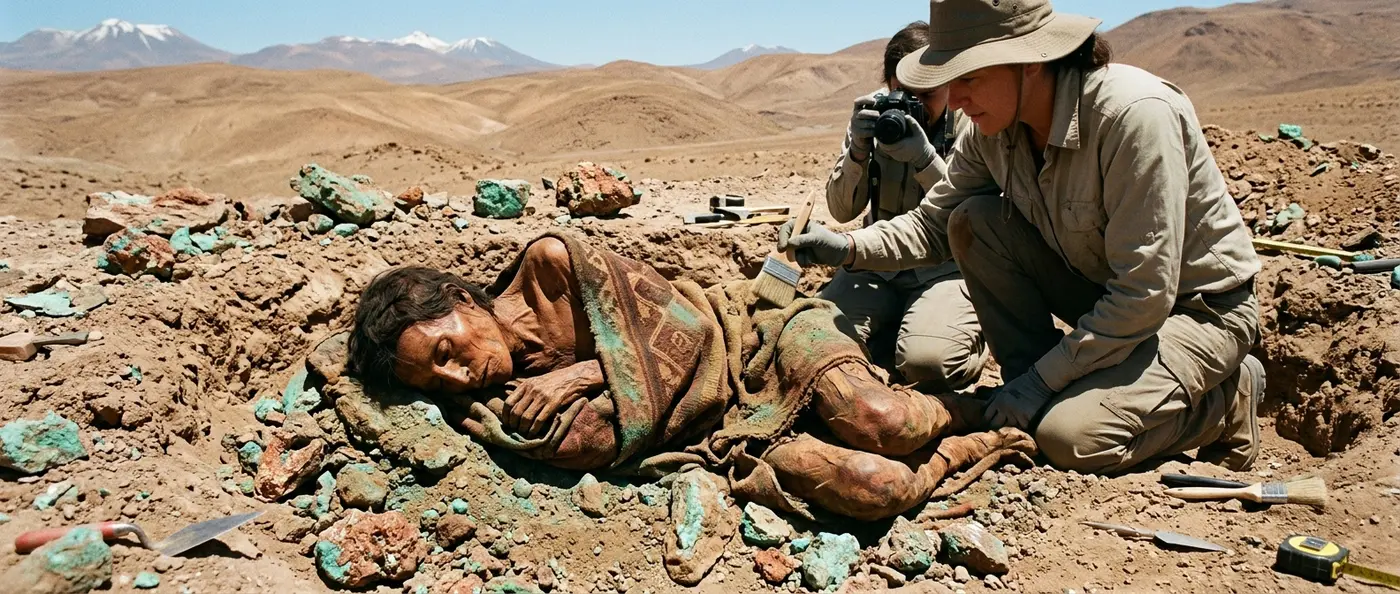
Rock fell. A man died. Five hundred years later, archaeologists pulled his perfectly preserved body from Chile's Atacama Desert. The 25-year-old miner never made it out of the tunnel when the ceiling collapsed, crushing his bones and trapping him forever in the earth's grip. But the world's driest desert had other plans — turning his tomb into a time capsule that would outlast empires.
🏜️ The Desert That Stops Time
The Atacama Desert kills everything it touches. Less than one millimeter of rain falls here each year. Some weather stations have never recorded precipitation. Ever. This moonscape in northern Chile strips life down to its bare elements — zero humidity, salt-rich soil, and temperatures that swing from scorching days to freezing nights.
Decomposition needs water to work. Bacteria and microorganisms that normally feast on dead tissue can't survive in this bone-dry wasteland. Bodies don't rot here. They desiccate. Skin turns to leather. Hair stays put. Even clothing survives centuries without a thread out of place.
Scientists have found mummies in the Atacama dating back 9,000 years — long before Egyptians figured out their fancy embalming tricks. The Chinchorro people who lived here became the world's first mummifiers, probably inspired by the naturally preserved corpses they kept stumbling across in the desert. Death in the Atacama means eternal preservation, whether you want it or not.
⚒️ Death Underground
The miner's bones tell a brutal story. Crushing injuries across his skeleton. Instant death when tons of rock came down. He was working deep in a copper mine when the tunnel gave way — a story that's played out countless times throughout mining history, from ancient Chile to modern-day disasters.
Similar tragedies created the salt mummies of Iran's Chehrabad mine. Workers got trapped in at least two separate collapses centuries apart. The salt sucked moisture from their bodies while the weight of fallen rocks compressed them into human pancakes. But they survived as mummies, preserved by the same mineral they died extracting.
Pre-Columbian mining in Chile was backbreaking work with stone-age tools. Narrow shafts. No support beams. Workers used fire-setting — heating rock faces with flames, then dousing them with cold water to crack the stone. Dangerous doesn't begin to cover it. Cave-ins were inevitable.
🔬 What Dead Bodies Tell Us
Natural mummies tell stories that embalmed bodies can't. Egyptian embalmers removed organs and pumped bodies full of preservatives, destroying evidence. Desert mummies keep everything intact — stomach contents, lung tissue, even parasites.
The Chilean miner's teeth showed heavy wear from chewing coca leaves, the ancient equivalent of energy drinks for high-altitude workers. His stomach contained corn and quinoa, staples of the local diet. His lungs were shot — scarred and blackened from years of breathing mine dust. Classic pneumoconiosis, the miner's curse that's killed workers for millennia.
Pathologists found toxic metal residues throughout his tissues. Lead, copper, arsenic — the periodic table of occupational hazards. This guy didn't just die in a mine collapse. He was slowly poisoning himself every day he went to work. The cave-in just finished what the job had started.
💡 Did You Know?
The Atacama Desert is so Mars-like that NASA tests rovers and equipment there. Some areas haven't seen rain in recorded history — making them more alien than anywhere else on Earth!
🏺 South America's Mummy Masters
The Chinchorro culture turned mummification into high art 7,000 years before King Tut. These coastal people in Chile and Peru didn't just preserve pharaohs and nobles. They mummified everyone — men, women, children, even miscarried fetuses. Death was an equal opportunity employer in their worldview.
Their techniques predated Egyptian mummification by thousands of years. They'd strip flesh from bones, reinforce skeletons with wooden sticks, and stuff bodies with plant fibers and clay. Then came the mud coating, sun-drying, and final paint job with red ochre. The result looked more like sculpture than corpse.
Three distinct styles evolved over millennia. Black mummies got completely disassembled and rebuilt from scratch. Red mummies kept more natural features with smaller incisions. Mud-coated mummies used thick clay shells for preservation. Each technique reflected changing beliefs about death and the afterlife.
Black Mummies
The oldest technique (5000-3000 BC) involved complete disassembly and reconstruction using wooden supports and plant fibers.
Red Mummies
Later method (2500-2000 BC) with smaller incisions and preservation of more natural body features.
Mud-Coated Mummies
Final phase (2000-1300 BC) used thick mud layers to cover and preserve the entire body.
🗿 Natural Mummies Around the World
Chile's desert miner joins a global club of accidental immortals. Different environments create their own preservation recipes. Alpine glaciers gave us Ötzi the Iceman, frozen solid for 5,300 years. European peat bogs produced leather-skinned bog bodies with their bones dissolved by acid but skin intact.
Each type preserves different details. Ice mummies keep organs in pristine condition for medical analysis. Desert mummies excel at preserving textiles and organic materials. Bog bodies maintain skin and soft tissues while their skeletons vanish. Salt mummies dehydrate everything but keep the overall structure.
The Iranian salt miners of Chehrabad represent the closest parallel to Chile's mining victim. Multiple cave-ins across centuries created a whole collection of preserved workers. The salt that killed them also saved them, creating natural mummies that reveal the dangerous reality of ancient extraction industries.
🌍 Types of Natural Mummification
🔍 What Comes Next
The Chilean mine mummy is just getting started with modern science. Researchers plan to extract DNA, analyze isotopes from his bones and hair, and use advanced imaging to peer inside without damaging the body. Every test reveals new details about his life, diet, and final moments.
Isotope analysis can track where he grew up, what he ate, and how far he traveled during his lifetime. DNA might connect him to modern populations or reveal genetic adaptations to high-altitude living. The tools and clothing found with him offer clues about mining techniques and daily life in pre-Columbian Chile.
Climate change threatens the Atacama's mummy-making conditions. Rising humidity and temperature fluctuations could accelerate decomposition of bodies that survived for millennia. Archaeologists race against time to document and study as many mummies as possible before they're lost forever.
📚 Preserving the Past
Natural mummies like the Chilean miner aren't just scientific specimens. They're human beings with their own stories, hopes, and tragedies. Local communities in Chile have developed strong connections to this heritage, demanding respect and protection for what they consider ancestral remains.
This has led to new approaches in archaeological research. Scientists now work closely with indigenous communities to ensure studies are conducted with sensitivity and cultural awareness. The goal isn't just to extract data but to honor the humanity of these ancient people.
Conservation challenges are mounting. Climate change threatens to alter the conditions that preserved these mummies for millennia. Increased humidity or temperature changes could trigger rapid decomposition. Archaeologists and conservators are developing new preservation methods to protect these irreplaceable windows into the past.
The story of the miner who died in a Chilean cave-in 500 years ago reminds us that behind every archaeological discovery lies a human story. Through studying these natural mummies, we gain insight not just into the past but into our place in the continuing human experience. His death was tragic. His preservation, miraculous. His story, eternal.