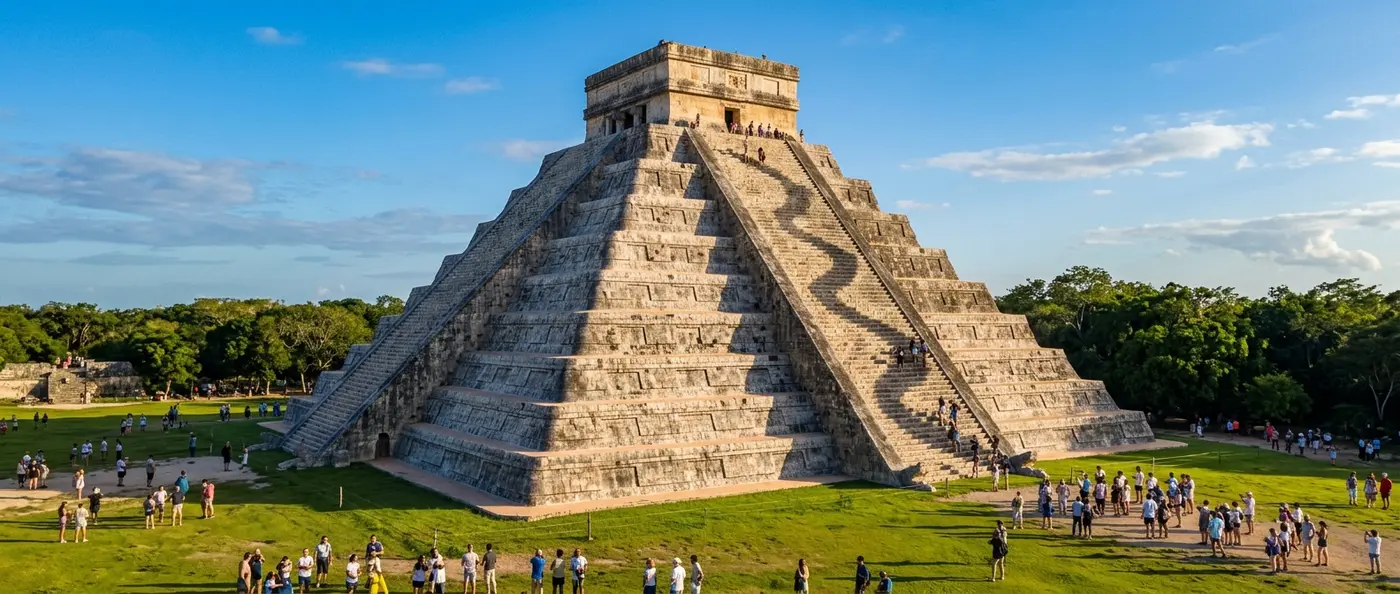
🐍 The Feathered Serpent Descends
The shadow serpent isn't an accident. Maya architects calculated every angle with mathematical precision to sync this phenomenon with celestial movements. As the sun drops toward the horizon during equinoxes, shadows cast by the pyramid's nine terraced platforms create seven triangular shapes along the northern staircase's balustrade. Combined with the carved serpent heads at the base, the effect is unmistakable: a giant snake slithering down from the temple above.
Maya legend says this marks the moment Kukulkan — their feathered serpent god — descends from the heavens to bless his followers before traveling to Xibalba, the underworld. Kukulkan was the Maya version of the Toltec deity Quetzalcoatl, a god combining the power of the serpent with the freedom of the bird. The Maya believed this divine being could move between the three realms of existence: sky, earth, and underworld.
The precision required to create this effect reveals the Maya's advanced astronomical knowledge. Every detail of El Castillo's construction was designed to align with the movements of celestial bodies. The pyramid wasn't just a temple — it was a three-dimensional calendar carved in stone.
🏛️ A Calendar Built in Stone
El Castillo's design encodes time itself. Each of the pyramid's four sides contains a staircase with 91 steps. Add the temple platform at the top, and you get 365 steps total — exactly matching the days in the Maya solar year. The Maya calculated these proportions deliberately. Time ruled their worldview — they tracked celestial cycles across centuries and carved those calculations into stone.
The temple at the summit served exclusively for priests performing sacred rituals at a height that brought them closer to the sky gods. Priests climbed one of the four staircases to reach the temple — the pyramid was never meant to be entered. Its purpose was to serve as a cosmic axis connecting earth to heaven.
But the Maya built in layers. What Spanish conquistadors called "El Castillo" (the Castle) was actually the final version of a structure built and rebuilt over centuries. Each new ruler wanted to surpass their predecessors, often by constructing directly over existing buildings. Archaeologists can now trace how Maya construction techniques changed across five centuries.
🗿 The Secrets Within
In the 1930s, archaeologists broke through El Castillo's walls and found another complete pyramid sealed inside. Further excavations revealed this inner pyramid had nine platforms, a single staircase, and a temple containing human remains.
Inside the temple sat a jaguar throne decorated with jade and a so-called Chac Mool — a type of Maya sculpture depicting an abstract male figure in a reclining position holding a bowl for sacrificial offerings. Researchers believe this pyramid was constructed between 800 and 1000 AD.
Then came an even deeper discovery. In the mid-2010s, archaeologists using non-invasive imaging techniques discovered a third pyramid buried within the other two. They believe it was built between 550 and 800 AD and may have contained a single staircase and altar.
Three Pyramids in One
El Castillo's nested structure isn't unusual. Archaeologists have found earlier constructions inside many Mesoamerican pyramids, revealing how rulers built upon their predecessors' work.
Royal Tomb
The inner pyramid contained a jade-decorated jaguar throne and human remains, suggesting its use as a royal burial chamber for Maya elite.
Successive Construction
Scholars theorize that rulers often built over existing structures as a way to surpass their predecessors and demonstrate their power.
💀 Gateway to the Underworld
In 2015, ground-penetrating radar revealed something unexpected. Using non-invasive imaging techniques, they found what they believe is a cenote — a large sinkhole — beneath El Castillo's base. The cavity resembles Chichen Itza's Cenote Sagrado (Sacred Cenote), located at the city's northern edge.
The Sacred Cenote was connected to worship of the rain gods, the Chaacs, and served as a site for regular offerings including precious objects like jade, gold, and copper, as well as human sacrifices. This cenote connects to the numerous underground rivers and caves beneath Chichen Itza's limestone bedrock, a geological formation called karst.
Such underground cavities weren't just freshwater sources for the Maya — they were, according to their beliefs, entrances to Xibalba, the "place of fear." The Maya believed nine underworlds existed beneath the earth, arranged in layers and ruled by the nine gods called Bolontiku.
🌊 The Underground Water Network
In 2018, a team of archaeologists began exploring the underground water system beneath Chichen Itza, attempting to find a connection to the suspected cenote below El Castillo. Should archaeologists confirm this cenote, El Castillo would connect all three Maya realms: a ladder to the sky gods above, a portal to underworld demons below.
🔱 Maya Cosmology and the World Tree
The Maya believed 13 heavens were arranged in layers above the earth, which itself rested on the back of a massive crocodile or reptilian monster floating in the ocean. Thirteen gods, the Oxlahuntiku, presided over the heavens.
If the cenote beneath El Castillo is confirmed, the pyramid would essentially constitute an axis mundi — the center of the world connecting earth with sky and underworld. It would be a cosmic convergence point where the three spheres of existence meet.
Time was an extraordinarily important element of Maya cosmology. Priest-astronomers viewed time as a magnificent succession of cycles without beginning or end. All time periods were considered gods — time itself was believed to be divine.
🏺 Chichen Itza's Legacy
Chichen Itza, declared a UNESCO World Heritage Site in 1988 and later named one of the New Seven Wonders of the World, continues to break visitation records. Yet dozens of other Maya cities lie buried across the Yucatan Peninsula.
Palenque, hidden in the dense Lacandon rainforest of Chiapas, ranks among the most impressive Maya sites, known for its multi-level pyramids and hieroglyphic inscriptions. The Temple of Inscriptions there has provided archaeologists with an invaluable glimpse into Maya culture.
Calakmul, deep within the Calakmul Biosphere Reserve, is one of the largest Maya cities with thousands of structures scattered across its 331,397 hectares. Historians believe it was the political heart of the Kaan dynasty or Snake Dynasty, one of the most powerful Maya dynasties during the Late Classic period (600-900 AD).
🏛️ Comparing Ancient Maya Cities
🌟 The Future of Discovery
Despite decades of excavation, less than 10% of the ancient city of Palenque has been explored. Palenque continues to hold countless secrets beneath the jungle. The same applies to Chichen Itza, where modern technologies continuously reveal new elements about this ancient civilization.
El Castillo may have played a much more significant role in Maya religion than archaeologists and tourists previously believed. Each excavation reveals more about how the Maya mapped their cosmos onto stone and earth.
Ground-penetrating radar and 3D imaging will likely uncover more hidden chambers in the coming years. Two thousand years after its construction, El Castillo still holds mysteries in its limestone core.