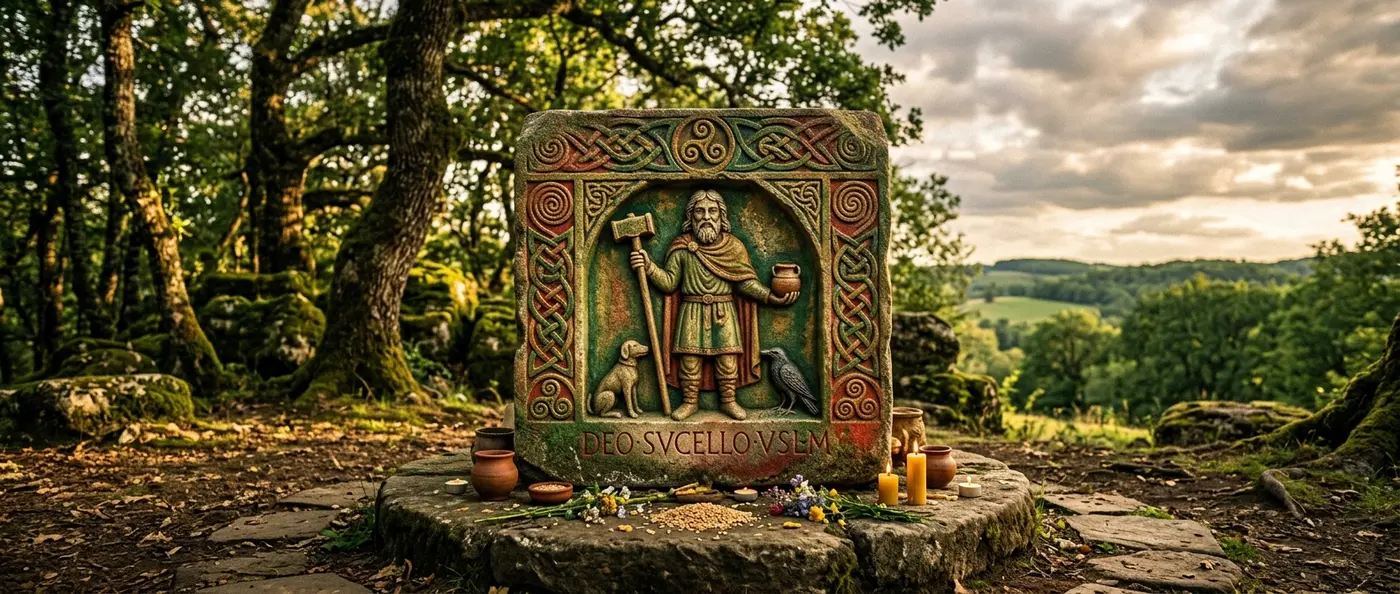
← Back to Ancient Civilizations Painted altar block showing Celtic god Sucellus with hammer and wine barrel found in Burgundy sanctuary
⚓ Ancient Civilizations: Vikings & Celts

Archaeologists Uncover First Painted Depiction of Celtic God Sucellus in Ancient Burgundy Sanctuary

📅 February 28, 2026 ⏱️ 7 min read

A painted altar block sits in a Burgundy laboratory, colors still vivid after 1,800 years underground. The figure depicted holds a long-handled hammer in one hand, a wine barrel in the other. A dog sits loyally at his feet. Archaeologists know they're looking at Sucellus—one of Roman Gaul's most popular gods. But here's what makes this discovery extraordinary: dozens of stone sculptures of Sucellus exist across Europe, yet no painted depiction had ever been found. Until now.

🏛️ The Discovery: Mancey's Sacred Hill

The find came from the Gallo-Roman sanctuary of Mancey in Saône-et-Loire, Burgundy, near the town of Tournus. The sanctuary crowns a forested ridge overlooking the Tournugeois landscape—a strategic position that signals this was no ordinary worship site. Systematic excavations began in 2023, but the breakthrough came during the 2025 research season, when archaeologists uncovered an extensive ritual complex active for nearly five centuries—from the late Iron Age through the final centuries of the Roman Empire.

The painted altar block emerged from the ruins of what researchers designated "Monument M3"—a temple where elite gatherings and ritual banquets took place. The temple floor was littered with thousands of ceremonial meal remnants: pig bones, poultry, fish remains, drinking cups, jewelry, coins, and votive objects. Researcher Grégory Compagnon published the findings in Le Fil d'ArAr in March 2026, calling it unique in Celtic archaeology.

5
Centuries of sanctuary operation
~2.5
Acres of sanctuary area
2
Temples in the complex
1
Painted depiction worldwide

🔨 Sucellus: The God with Hammer and Wine Barrel

Sucellus ranked among Roman Gaul's most widely worshipped deities—a god who combined raw power with abundance in a unique theological package. His name means "He who strikes well" or "The Good Striker," referring to his signature tool: a long-handled hammer or mallet, symbol of both creative force and death. Across Gaul—from France to Germany and Luxembourg—sculptures and inscriptions show him gripping this hammer with his right hand while his left holds a wine vessel (olla) or barrel, symbols of fertility, abundance, and protection of rural life. A dog appears frequently beside him, possibly as faithful guardian or guide for souls to the underworld—an image reminiscent of Greek mythology's Cerberus.

Alongside Sucellus often appears the goddess Nantosuelta, forming a divine couple connected to prosperity, fertility, and the natural world. Nantosuelta, whose name likely means "Shining Valley" or "Valley Sun," typically holds a scepter topped with a small house—symbol of domestic prosperity. Julius Caesar notes in his "Commentaries on the Gallic War" that the Gauls believed they descended from the god Dis Pater—the Roman god of the underworld. Modern scholars consider Sucellus likely the Gallic equivalent of this deity. In Irish mythology, his counterpart was the Dagda—the "Good God" with a magical club capable of killing nine men with one blow and reviving the dead with its other end, plus an inexhaustible cauldron of food that never empties.

Dozens of stone sculptures of Sucellus have been found across France, Germany, and Luxembourg—but painted representations are extraordinarily rare for any Celtic god. The reason is simple: paint on stone deteriorates far faster than sculpture. Time, moisture, and solar radiation erase pigments while stone relief endures for centuries. Finding ancient painting on an altar dating to the Roman period is exceptionally rare—and if the identification holds, it reveals the visual art of Celtic religious worship.

🍖 Ritual Banquets: Religion Through Food

Mancey's sanctuary wasn't just a worship site—it was the social and political center of an entire region. Archaeologists estimate it covered roughly one hectare and included two temples, gathering spaces, and specially designed areas for ritual meals and sacrificial offerings. Thousands of objects recovered from excavations that began in 2023 indicate the sanctuary attracted large numbers of visitors from throughout Burgundy and functioned as a major regional worship center for several centuries. Ritual meals—featuring pork, poultry, and fish—were fundamental to Celtic religion: communal food consumption before the god wasn't simply dinner but a sacred act that strengthened social bonds and secured divine blessing over crops and herds.

The choice of pork as the primary ceremonial meat wasn't random. In Celtic tradition, pigs were closely connected to the underworld and divine abundance—according to Irish myths, animals at the gods' feast came back to life each day after slaughter, providing endless food. Bird and fish bones found at M3 show the meals were rich and varied, designed to reflect Sucellus's generosity as god of abundance. Wine cups, ceramic plates, bronze and silver jewelry, plus Gallo-Roman coins were offered to the god as thanksgiving—a form of reciprocity between humans and the divine world.

Even after the temples collapsed in the late 4th century CE, people continued visiting the sacred hill. Coins, figurines, and votive objects were found deliberately placed among the ruins, proving that faith in the old deities didn't vanish with the buildings. The Christianization of Gaul, which began forcefully in the mid-5th century, couldn't immediately erase the memory of these sacred places. This continuity of worship, extending beyond the architectural life of the sanctuary, shows how deeply place and religious practice were connected in Gaul.

Symbols of Abundance

The wine barrel and hammer represented Sucellus's dual role: protector of agriculture and guardian of the underworld. His relationship with goddess Nantosuelta reinforced the connection to prosperity.

Ritual Feasts

Thousands of animal bones, cups, and vessels were found at M3. Banquets were central to worship—shared food before the god wasn't a meal but a ceremony of unity.

The Dog Companion

Dogs appear regularly in Sucellus depictions—perhaps as guardians, perhaps as guides for souls to the underworld, or as symbols of loyalty and hunting prowess.

Celtic religion faces a major interpretive problem: nearly all sculptural monuments and inscriptions we possess belong to the Roman period and reflect significant syncretism between Celtic and Roman gods. Even where motifs appear to derive from pre-Roman tradition, their interpretation remains difficult without written mythological tradition. The Celts, unlike Greeks and Romans, didn't record their religion in written texts. Transmission occurred exclusively through oral tradition via Druids—the first written texts of Irish mythology date only to the 7th century CE, hundreds of years after Christianization, and were written by Christian monks who inevitably shaped the material according to their own beliefs.

The Mancey discovery matters for this reason. A painted depiction doesn't just show the god's form—it reveals colors, clothing details, ritual symbols, and artistic choices that monochromatic stone sculpture cannot convey. Colors in antiquity carried deep symbolism: red for blood and martial power, blue for sky and divinity, green for earth and fertility. The painted depiction of Sucellus may reveal aspects of Celtic theology that monochrome stone has hidden for nearly two millennia.

⚖️ Celtic Gods and Roman Counterparts

Sucellus Dis Pater — God of the underworld
Lug / Lugus Mercurius — God of trade and crafts
Taranis Jupiter — God of thunder and sky
Nantosuelta Sucellus's consort — Fertility, home
Dagda (Ireland) Irish equivalent of Sucellus — "The Good God"

The Mancey discovery changes Celtic religious studies. For the first time in archaeological history, a painted representation of a Celtic god offers information that cannot be extracted from monochromatic stone sculptures. The continuity of worship at the sacred forested hill near Tournus—five full centuries of active use, followed by additional centuries of informal offerings even among the ruins—shows how deep the connection between humans and gods ran in ancient Gaul. Sucellus, with his hammer, wine barrel, and faithful dog companion, was more than a rural deity—he was the god of communal life itself, guarantor of abundance and guardian of the transition between life and death. Excavations at Mancey continue, and each field season may reveal more about this Celtic god who kept his secrets beneath Burgundy's forests for nearly two millennia.

Celtic mythology Sucellus ancient art archaeological discovery Roman Gaul Burgundy Celtic gods ancient civilizations

📚 Sources: