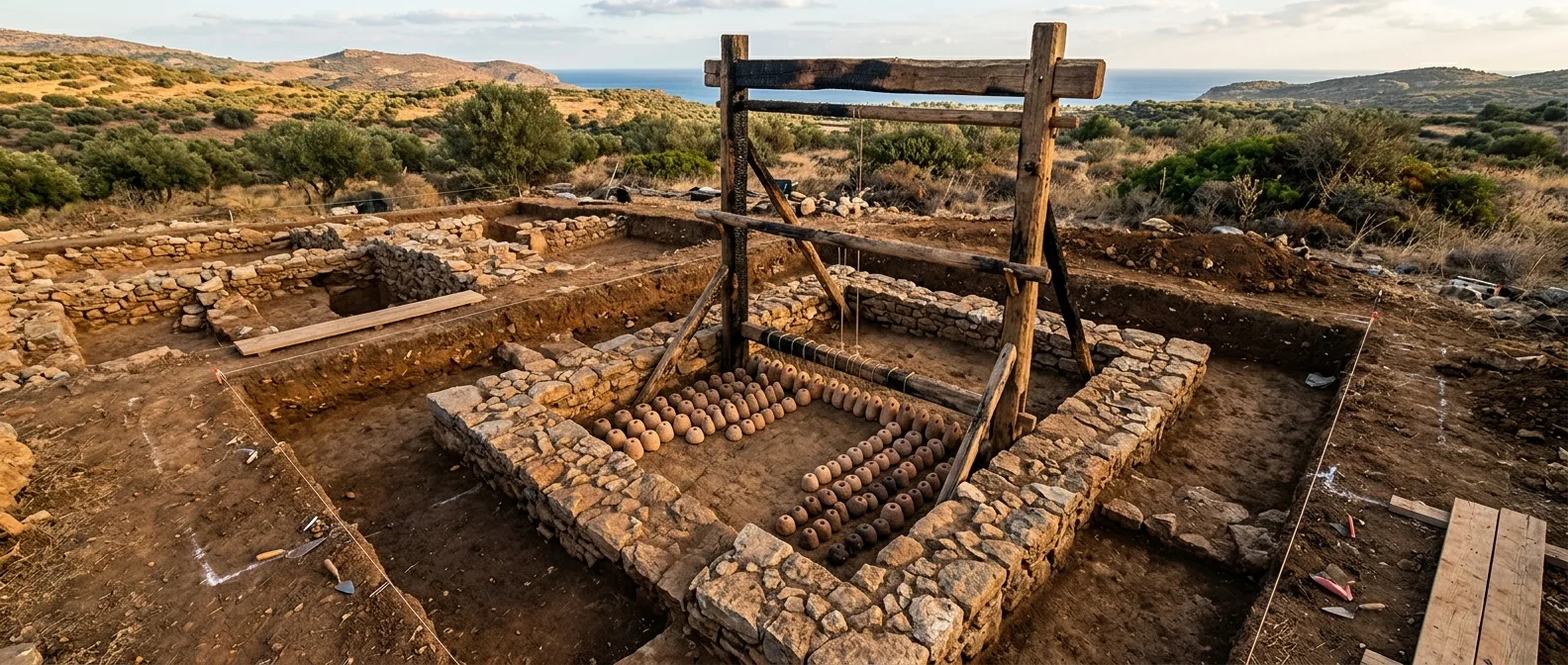
A fire 3,500 years ago torched workshops and homes at Campo Redondo in Alicante, Spain. But that same blaze did something extraordinary — it preserved one of archaeology's rarest treasures: a complete Bronze Age loom with wooden components intact. The 2026 discovery shows ancient weaving technology was far more sophisticated than previously known.
Researchers from universities in Alicante, Granada, and Valencia unearthed what might be the most complete textile production facility ever found in the Mediterranean. Their study, published in Antiquity, reveals not just loom weights but wooden elements, esparto grass ropes, and actual textile fibers — a Bronze Age weaver's workshop frozen in time.📖 Read more: Hittites: The Empire History Forgot
🔥 When Fire Becomes the Ultimate Preservationist
The blaze that hit the settlement around 1470 BCE created what researchers call a "sealed archaeological environment." Gabriel García Atiénzar, professor of Prehistory at the University of Alicante, explains the paradox: "The roof collapse was crucial — it created a sealed space where the area was suddenly destroyed and immediately buried."Preservation Paradox: The fire that destroyed the loom simultaneously saved it. Carbonization of organic materials protected them from natural decomposition for 35 centuries.
Beneath the burned roof, archaeologists found 44 cylindrical clay weights, wooden elements from Aleppo pine, and braided esparto grass ropes. Combined analysis of these elements allowed researchers to reconstruct the loom's operation with stunning precision.Rebuilding Ancient Technology
Ricardo Basso Rial from the University of Granada highlights this rare find: "Although the loom appeared in a destroyed state, the complex of 44 cylindrical weights with central holes characterizes a vertical loom with warp weights." The weights averaged about 200 grams — significantly lighter than the era's typical 400-900 gram weights. This difference isn't random. It points to production of finer, more refined textiles.The Secret of Lightweight Weights
Lighter weights reveal a technological transition. With two rows of weights, weavers produced open, lightweight tabby fabrics — simple weaves similar to modern gauze. When weights were arranged in four rows, they enabled production of complex twill fabrics, denser and more durable.🏛️ The Settlement of Technological Innovation
Campo Redondo wasn't just any settlement. It was a major regional center that flourished from 2100 to 1250 BCE. Continuous habitation and monumental construction indicate a political and economic hub in southeastern Iberia.850 years of continuous habitation
1 hectare settlement area
44 cylindrical loom weights
The Golden Collection Mystery
The same site yielded the famous Villena gold treasure, dating contemporary with the loom. What was happening here? Did weaving connect to some luxury goods trade network?🧵 The Bronze Age Textile Revolution
This discovery fits into what researchers call the "textile revolution" of European Bronze Age. It represents significant technological and economic changes in fabric production. Basso Rial explains: "The textile revolution emerged from convergence of multiple processes — expansion of livestock farming for wool production, technical innovations in looms and spinning tools, plus social changes promoting more intensive and differentiated weaving."At Campo Redondo, these developments are reflected in new, lighter spindles and diverse loom weights. Some are light enough for producing finer, more complex fabrics like woolen twills."This finding advances our knowledge of Bronze Age textile technology in Iberia"
— Ricardo Basso Rial, University of Granada
From Flax to Wool
The shift from coarse flax fabrics to finer woolen textiles shows technological evolution. Weavers experimented with new fabric types, increasing both quality and diversification of produced textiles. But how do we know all this when the actual fabrics rarely survive? Usually we rely on indirect evidence from tools.📖 Read more: Iran's Animal Crater: 5,000-Year-Old Mystery Vessel
👥 Social Organization and Labor
The context where the loom was found illuminates social organization of labor. The structure sat in an open space shared by different dwellings, suggesting collaborative production. Paula Martín de la Sierra from the University of Alicante explains: "This shows different family groups may have cooperated in activities like spinning, weaving, or grain processing." Other crafts — like metallurgy or ivory working — appear concentrated in specialized areas.Women and Weaving
Bioanthropological evidence suggests women's central role in textile production. Various burials show women with characteristic tooth wear related to spinning activities — likely from holding fibers or cutting threads with their teeth. It's remarkable how teeth can reveal daily activities from thousands of years ago. Archaeology often surprises us with such details.🔬 Scientific Analysis and Future Research
Archaeobotanist Yolanda Carrión from the University of Valencia conducted microscopic analysis of wooden remains. "Preservation of organic materials was enabled by fire, which carbonized the remains and limited their subsequent alteration — paradoxically destroying them while simultaneously preserving them."Aleppo Pine
Local wood from mature large-diameter trees, carefully selected for construction
Archaeometric Analysis
Microscopic fibers and isotopic analysis of sheep bones for raw material origins
C-14 Dating
Precise dating to 1507-1428 BCE through radiocarbon dating of charcoal