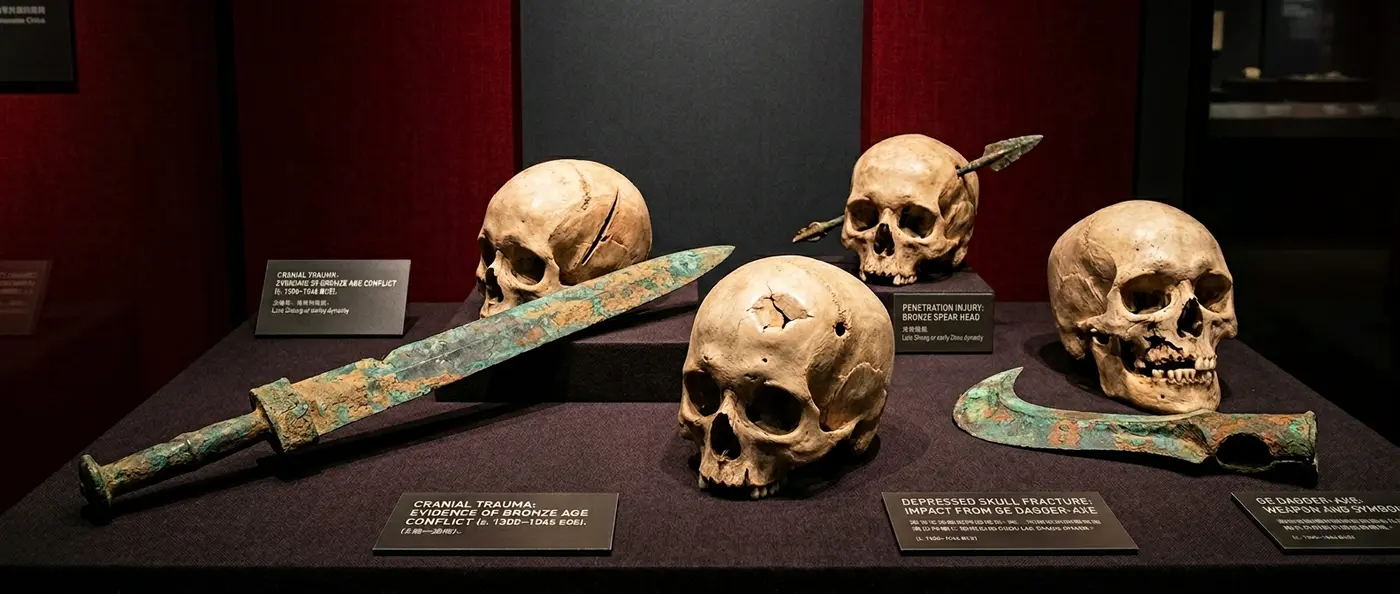
Eighteen separate stab wounds to the skull. That's what killed one victim at the Mogou cemetery in China's Gansu province 3,700 years ago. But here's the thing — one blow would have done the job. The other seventeen? Pure overkill. When archaeologists examined 348 skulls from this Bronze Age burial ground, they found 11% showed trauma so extreme it redefined their understanding of ancient violence.
📖 Read more: Marble Lion Philippi: 2026 Excavation Reveals Secrets
🗡️ The Discovery That Shocked Archaeologists
The Mogou cemetery operated between 1750 and 1100 BCE as part of the Qijia culture's Bronze Age civilization. With over 1,600 graves holding more than 5,000 individuals, Mogou reveals both the daily existence and brutal deaths of ancient northwestern China. These people lived primarily as farmers, trading metal goods and ceramics with neighboring groups across the region.
Elizabeth Berger, a bioarchaeologist at UC Riverside, presented the findings at the Society for American Archaeology's annual meeting in Denver. What stood out wasn't just the presence of violence, but its savage intensity.
Of the 348 adult and adolescent skulls examined, 11.1% bore evidence of unhealed trauma — stab wounds, blunt force injuries, and projectile damage. The most striking detail? Fifty-five percent of adults with trauma had suffered three or more cranial wounds.
💀 The Victims and Their Wounds
Men were more likely to have multiple cranial wounds compared to women. Several males bore defensive injuries — violent fractures to their arm bones showing they tried to ward off attacks. Researchers found trauma scattered across different parts of skulls, both front and back, suggesting multiple attackers or prolonged assaults.
One of the most disturbing cases involved a man with a massive cut slicing across his face from a sharp weapon. Another showed cut marks on his lower leg alongside those 18 distinct stab wounds to his skull. The violence wasn't confined to heads — entire bodies became targets.
🔍 The "Overkill" Phenomenon
Criminologists use "overkill" to describe homicides where killers inflict significantly more damage than needed to cause death. At Mogou, this phenomenon appears in multiple victims.
Berger explained there was an emotional, psychological, or performative aspect to the violence. This wasn't just killing — it was an attempt to destroy victims' social identities and inflict psychological damage on survivors.
⚔️ Why Such Extreme Violence?
Researchers believe the extreme brutality may have stemmed from ancient blood feuds. In such cases, simply killing your enemy wasn't enough — you had to humiliate them, destroy their identity, and send a powerful message to everyone else.
🏺 The Qijia Culture and Historical Context
The Qijia culture flourished in northwestern China during the Bronze Age, roughly from 2200 to 1600 BCE. Located at a strategic crossroads between different cultural groups, it served as a trading hub but also a potential flashpoint for conflicts.
Qijia people were primarily farmers and herders who had developed advanced metallurgy techniques. They produced bronze tools, weapons, and ornaments while maintaining trade relationships with neighboring civilizations. Their position as middlemen in commerce may have made them targets for raids or embroiled them in conflicts over trade route control.
Geographic Position
Mogou sits in Gansu province, at a crossroads between central China and the Central Asian steppes.
Lifestyle
Inhabitants engaged in agriculture, animal husbandry, and produced ceramics and metal goods for trade.
Technology
They had developed advanced bronze-working techniques, producing tools, weapons, and decorative objects.
🗿 Mogou's Unique Violence
No other archaeological site in the region shows similar violence levels, making Mogou an anomaly. Berger emphasized this represents something unique, setting Mogou apart from all other known Bronze Age sites in China.
Jenna Dittmar, a biological anthropologist at Edward Via College of Osteopathic Medicine who participated in the research, highlighted the importance of studying such cases. Violence, she explained, is a cultural element of society. When performed before an audience, it serves significant functions in shaping group identity and negotiating social relationships.
📊 Comparison with Other Ancient Violence Cases
To better understand Mogou's uniqueness, we can compare it with other known cases of extreme Bronze Age violence. Recently, archaeologists in Britain discovered evidence of equally shocking carnage at Charterhouse Warren in Somerset, dating back 4,000 years.
🌍 Mogou (China) vs Charterhouse Warren (Britain)
At Charterhouse Warren, researchers found evidence of decapitation, tongue removal, flaying, and even cannibalism. At least six individuals showed cut marks on their second cervical vertebra, indicating decapitation. Small hand and foot bones bore fractures consistent with human chewing.
🔬 Ongoing Research and New Technologies
Research at Mogou continues using modern technologies. Scientists study animal bones, parasites, and ancient DNA to better understand life during a critical transition to drier, colder climate. This climate change may have played a role in increasing conflicts over limited resources.
High-resolution trauma analysis allows researchers to precisely reconstruct how wounds occurred. They can distinguish between injuries from different weapons and determine the sequence of attacks.
💭 What the Past Teaches Us
Mogou's findings remind us that human violence isn't just a modern phenomenon. As Rick Schulting from Oxford University noted regarding similar discoveries, these represent "a stark reminder that people in prehistory could match more recent atrocities."
Studying such cases helps archaeologists understand not just events but the social dynamics that caused them. Violence at Mogou wasn't random — it was targeted, organized, and served specific purposes, whether revenge, punishment for taboo violations, or attempts to eliminate rivals.
«Violence is a cultural element of society. It's important to go back and re-examine previous skeletal collections, particularly to look for evidence of trauma.»
The eighteen stab wounds to that Bronze Age skull still demand an explanation. Why such fury? Why such excess? The answers may lie buried in Mogou's remaining graves, waiting for archaeologists to uncover the full story behind this ancient bloodbath.