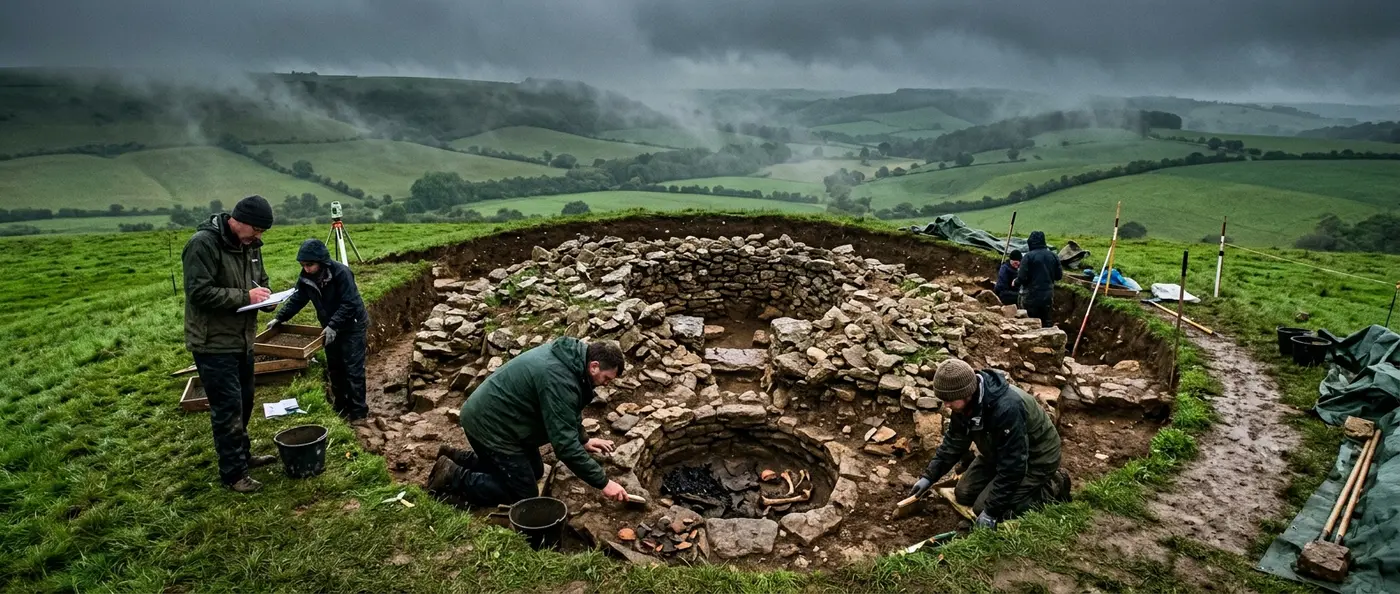
A granite tomb sealed for 4,000 years. Wooden artifacts that should have rotted millennia ago. A bear fur cloak wrapped around cremated remains. Archaeologists in England's Dartmoor just cracked open a Bronze Age burial chamber that overturns assumptions about prehistoric ritual practices across Europe.
🏺 The Dartmoor Discovery That Stunned Archaeologists
August 2024. Cut Hill, one of Dartmoor's highest peaks at 603 meters. A team of archaeologists uncovered a stone burial chamber dating to around 1800 BCE, roughly one meter square and sealed beneath three massive granite slabs. The tomb's age was impressive enough, but the peat bog had preserved something far more valuable inside.
Peat creates an acidic, oxygen-free environment that stops decay cold. While most 4,000-year-old wood crumbles to dust, this tomb contained perfectly preserved wooden fragments. The team lifted the entire chamber intact and transported it to a lab for micro-excavation — a painstaking process that promises to reveal intimate details about Early Bronze Age life in Britain.
Dartmoor has yielded Bronze Age treasures before. In 2011, archaeologists discovered another tomb at Whitehorse Hill, dating between 1730 and 1600 BCE. Inside: cremated remains of a young adult wrapped in a brown bear fur, textiles, and a necklace with over 200 beads made from clay, slate, tin, and amber. That amber came from the Baltic — proof that Bronze Age communities weren't isolated villages but nodes in vast trade networks spanning continents.
🗿 Europe's Megalithic Burial Monuments
Dartmoor's tombs aren't outliers. They're part of a continent-wide tradition of monumental burial that reached staggering proportions. In the Czech Republic, archaeologists recently uncovered what might be Europe's largest prehistoric burial mound near Hradec Králové. This monument stretches 190 meters — nearly twice the length of an American football field — and dates to the 4th millennium BCE.
The mound belongs to the Funnel-Beaker culture, named for their distinctive funnel-shaped ceramic vessels placed as grave goods. These people lived in the region between 3800 and 3350 BCE, building monuments that required coordinated labor from hundreds of individuals. Petr Krištuf from the University of Hradec Králové called it "the longest prehistoric burial mound not only in our region, but possibly in all of Europe."
⚱️ Rituals and Grave Goods
Bronze Age burials reveal sophisticated ritual practices. The Baltic amber beads found at Whitehorse Hill traveled over 1,000 miles to reach Dartmoor — evidence of trade routes that connected the North Sea to the Mediterranean. These weren't isolated communities scraping by in the wilderness. They were part of a Bronze Age world system with standardized weights, shared technologies, and luxury goods that crossed cultural boundaries.
Laura Basell from the University of Leicester, reflecting on the Cut Hill landscape, observed: "Cut Hill offers stunning views but is often shrouded in mist and has something ethereal about it. While researching, I wondered if Bronze Age people saw this place as a liminal zone between earth, water, and sky — and perhaps life and death."
Trade Networks
Baltic amber and exotic materials prove extensive trade routes connected distant European regions by 1800 BCE, creating a Bronze Age global economy.
Ritual Practices
Careful placement of bodies and selection of grave goods reveal complex religious beliefs about the afterlife and spiritual transformation.
Social Hierarchy
Monumental tombs with rich grave goods indicate elite classes and organized societies with clear social stratification.
🔬 New Technologies Reveal Ancient Secrets
Modern archaeology deploys forensic-level analysis that would have seemed like magic to earlier generations of researchers. The Cut Hill tomb's micro-excavation happens under laboratory conditions, allowing recovery and analysis of microscopic remains that field excavation would destroy.
Lee Bray from the Dartmoor National Park Authority explained: "This is very detailed work that will take time to complete, but we're all very excited. It's an amazing discovery with the potential to be as exciting as the Whitehorse Hill finds."
Radiocarbon dating has revolutionized our understanding of these monuments' chronology. For the Cut Hill tomb, dating charred wood from inside the chamber provided precise dates around 1800 BCE, confirming its placement in the Early Bronze Age. DNA analysis and isotopic studies can now reveal where people came from, what they ate, and whether individuals buried in the same mound were related.
💡 Why Does Peat Preserve Organic Materials?
Peat creates an acidic, anaerobic environment that prevents bacteria from causing decomposition. This allows preservation of wood, textiles, leather, and other organic materials for thousands of years — allowing archaeologists to study ancient daily life in detail impossible with typical excavations.
🏛️ From Neolithic to Bronze Age
Recent finds clarify the shift from Neolithic to Bronze Age societies. In Cornwall, charred hazelnut shells discovered at Tregunnel Hill near Newquay yielded dates between 3985 and 3793 BCE, overturning assumptions about when agriculture reached the region.
This discovery matters because southwestern Britain was traditionally considered peripheral to the Neolithic revolution's spread. The new evidence shows agriculture and permanent settlement adoption occurred at least a century earlier than previously believed. These weren't late adopters — they were early participants in Europe's agricultural transformation.
🌍 The Bigger Picture of Ancient Burial Practices
Bronze Age burial mounds show how seriously these societies took honoring their dead. From Central Europe's megalithic monuments to Dartmoor's stone chambers, these structures testify to complex societies with organized labor, religious beliefs, and artistic expression.
Ralph Fyfe from the University of Plymouth, analyzing the landscape around the Cut Hill tomb, noted intensive periods of human activity in the area during prehistoric times. "These weren't people who suddenly started building burial monuments and reorganizing the landscape around them. They lived in a place they were deeply familiar with and knew intimately."
⚖️ European Burial Mound Comparison
🔮 The Future of Research
As archaeologists continue analyzing finds from Dartmoor and other sites, new technologies like ancient DNA analysis and isotopic studies promise to reveal even more details about Bronze Age life. These methods can tell us where people originated, what they ate, and whether individuals buried in the same mound were family members.
Krištuf from the Czech university expressed hope that analyzing burials in the large mound will reveal whether the individuals buried there were related. "Similar burial mounds in Central Europe usually consist of one, at most two, burials. From this perspective, it will be interesting to see how the discovered burials relate to each other."
These discoveries remind us that Bronze Age people weren't simply "primitive" ancestors. They created monuments requiring significant organization and resources, maintained extensive trade networks, and held complex beliefs about life and death. Each new discovery adds another piece to the puzzle of understanding our past.