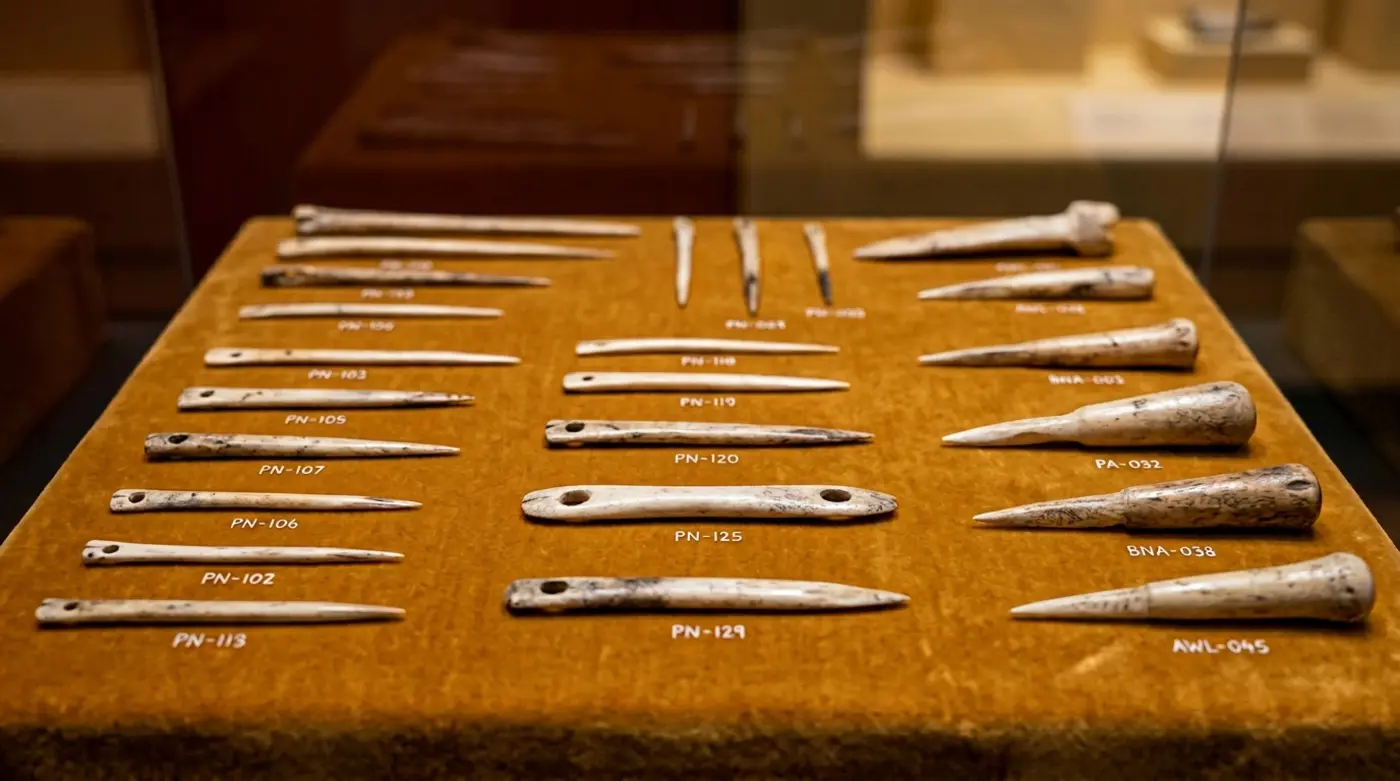
Picture a Paleolithic human crouched at a cave entrance, holding a thin piece of bone. With patience and skill, they shape one end into a sharp point, then carefully drill a tiny hole near the base. This simple tool — a bone needle — would revolutionize how our ancestors protected themselves from the cold and change how humans survived harsh climates.
🪡 The First Sewing Tools in Prehistory
The first sewing tools appeared tens of thousands of years ago. Archaeological finds from Northern Europe show that Late Stone Age humans made clothing from animal hides sewn together with leather strips. The process was simple but effective: they punched holes in the hide and threaded strips through using a tool that resembled today's knitting needle.
Southern Europe tells a different story. There, archaeologists have uncovered delicate bone needles dating to the same period. These needles suggest that people in the region had already begun sewing textile clothing — evidence of more advanced weaving technology.
🦴 The Technology of Bone Needles
Creating Paleolithic eyed needles demanded extraordinary precision. Making them required exceptional skill and patience. Craftsmen carefully selected thin bones from birds or small mammals, then ground them with stones until they achieved the desired shape.
The most challenging part was creating the eye. Using small flint pieces as drills, craftsmen carefully opened a hole near the needle's base. The process demanded precision — bone could easily crack. A finished needle represented hours of painstaking work.
Awls, on the other hand, were simpler to make. These tools, resembling small stilettos, punched holes in leather or other materials before thread passed through. Awls were crafted from bone, horn, or even hardwood, and their sharp tips made piercing tough materials easier.
⚔️ From Survival to Art
Sewing tools evolved alongside human society itself. Initially, needles and awls served exclusively to make clothing that protected against cold. Over time, these tools began creating more complex constructions.
In ancient Middle Eastern civilizations, weaving and embroidery evolved into high art forms. Despite advances in textile and fabric techniques, the equipment used for sewing clothes remained relatively simple. A significant breakthrough occurred during the Middle Ages, when iron needles reached Europe, gradually replacing traditional bone needles.
Cold Weather Protection
The first sewn garments from animal hides allowed humans to survive in colder climates and migrate to new regions.
Artistic Expression
Over time, sewing evolved from survival necessity to artistic expression through decorative patterns and embroidery.
Social Identity
Clothing began indicating social status, tribal identity, and cultural belonging through specific sewing techniques.
🏺 The Neolithic Transition
Recent discoveries in Cornwall, Britain shed new light on the transition from Paleolithic to Neolithic times. At Tregunnel Hill, near Newquay, archaeologists uncovered charred hazelnut shells dating between 3985 and 3793 BCE. These finds, alongside pottery fragments and flint tools, suggest that agriculture and permanent settlement began in the region at least a century earlier than previously believed.
The Neolithic period marks a fundamental shift in human history — the transition from nomadic hunter-gatherer lifestyles to permanent farming communities. Along with plant and animal domestication came new technologies, including pottery. The Tregunnel Hill finds include a Carinated Bowl, a type of Neolithic pottery closely linked to early farming communities in Britain.
💡 Did You Know?
The hazelnut shells found at Tregunnel Hill survived because they were charred, likely during ritual practices. These humble food remains proved to be exceptional time capsules, preserving within their carbonized remains the moment when a new way of life took root in one of Britain's most ancient landscapes.
🌍 The Global Spread of Sewing Techniques
The art of sewing wasn't confined to one geographic region. Different cultures developed their own unique techniques and tools, adapted to local materials and needs. In Australia and Tasmania, indigenous peoples used half-hitch knot techniques to create baskets and nets. In Tierra del Fuego, South America, similar techniques were applied to making clothing and shelters.
In Africa, the sewn spiral coiling technique dominated many regions. This method, using a bundle of thin fibers as a base and sewn with needle or awl, appeared in archaeological layers dating from ancient Egypt. The technique spread throughout the Mediterranean and reached Western Europe, while variations appeared in North America, India, and sporadically in the Asian Pacific region.
📜 From Tools to Industry
For thousands of years, basic sewing tools remained virtually unchanged. Until the second half of the 19th century, almost all clothing and shoes were produced by individual tailors and shoemakers working either alone or with one or two apprentices. Every tailor's apprentice aimed to learn how to make a complete garment as quickly as possible.
The invention of the sewing machine in the 19th century revolutionized the clothing industry. After several attempts, a practical machine was patented in 1830 by Barthélemy Thimonnier of Paris, who produced 80 machines for making military uniforms. Unfortunately, Thimonnier's machines were destroyed by a mob of tailors who feared unemployment.
🔄 Evolution of Sewing Tools
🔬 Modern Archaeological Discoveries
Modern archaeological techniques continue revealing new information about ancient sewing tools. In Egypt, an Egyptian-German archaeological mission recently discovered 13,000 inscribed pottery fragments, known as ostraca, at the ancient site of Athribis in Sohag. While most of these texts relate to astrology and administration, some contain information about daily life, including arts and crafts.
The ostraca cover a vast time period, with the oldest being Demotic tax receipts from the 3rd century BCE and the most recent being Arabic labels from the 9th to 11th centuries CE. The 43,000 fragments make this Egypt's largest single-site collection of ancient texts.
Among the finds are texts from an ancient school, containing writing exercises and arithmetic problems. Some texts show how Egyptians taught practical skills like weaving and sewing.