📖 Read more: Ancient Epirus: Molossians and Pyrrhus the Great
🛡️ The Collision Course with Empire
480 BC. Xerxes I, King of the Persian Empire, launched the largest military expedition the ancient world had ever seen. This wasn't just another conquest. This was the continuation of the Persian Wars that his father Darius had started — a campaign to crush Greek independence once and for all.
The Greek city-states, despite their endless squabbles, recognized the existential threat. In Sparta, King Leonidas stepped forward to lead a small force that would buy time by delaying the Persian advance. His choice of Thermopylae wasn't random — the narrow pass between mountain and sea would neutralize Persia's overwhelming numerical advantage.
Leonidas's decision to take only 300 elite warriors from Sparta had multiple layers. First, Spartan religious law forbade mobilizing the full army during the Carneia, a major religious festival. Second, Leonidas knew this mission was essentially suicide. He handpicked 300 men who all had sons — ensuring their family lines would continue after their deaths.
⚔️ Did You Know?
Every one of the 300 Spartans chosen by Leonidas was a father with living sons. This ensured their families would have heirs after their inevitable deaths in battle.
🏛️ The Real Numbers - Not Just 300
The popular image of "the 300" tells only part of the story. Thousands of other Greeks fought alongside the Spartans. Ancient sources record 700 Thespians, 400 Thebans, plus warriors from Arcadia, Corinth, Phlius, and Mycenae. The total Greek force numbered between 5,000 and 7,000 men.
Persian numbers vary wildly in ancient accounts. Herodotus claims millions, but modern historians consider 100,000 to 300,000 more realistic. Even with conservative estimates, Persian numerical superiority was crushing. They brought warriors from across their empire — Medes, Immortals, Scythian archers, and dozens of other peoples.
The Greeks faced impossible odds. But they had advantages the Persians didn't expect. Superior armor. Disciplined formations. And most crucially, terrain that turned Persian numbers into a liability rather than an asset.
🗡️ The Narrow Pass Strategy
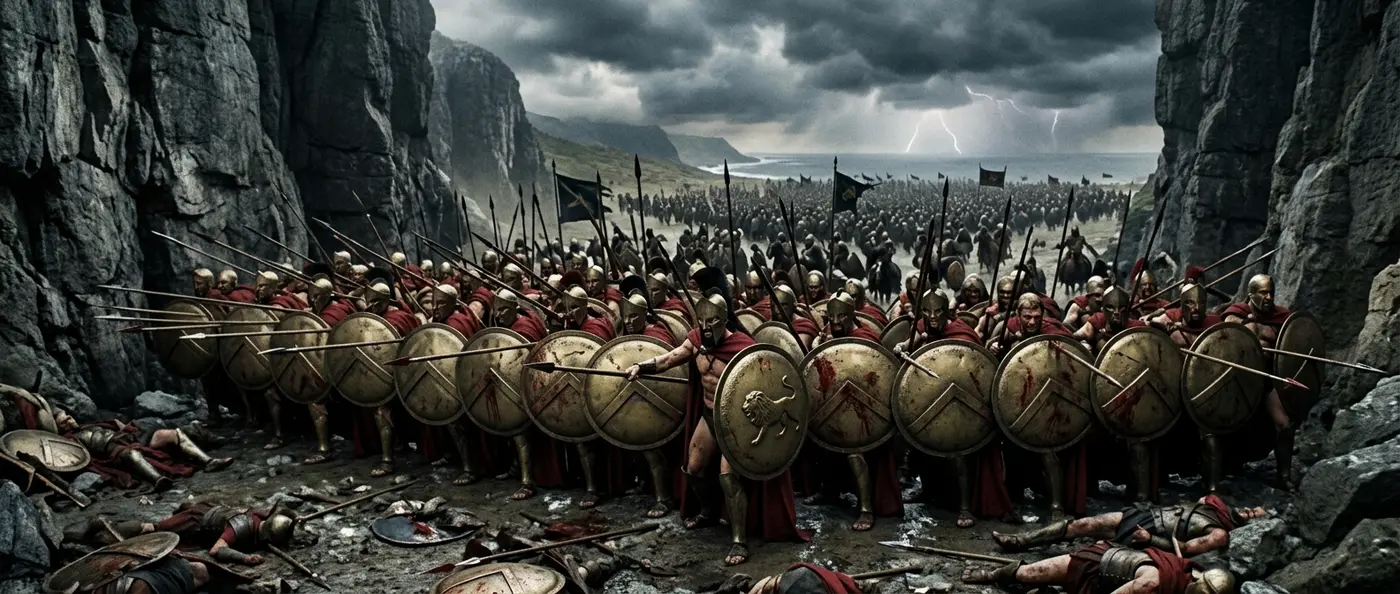
Thermopylae was much narrower then — just 50 feet wide at some points. This allowed the Greeks to form an impenetrable phalanx where heavily armored hoplites with large shields and long spears could effectively counter Persian wave attacks. Geography became their greatest weapon.
Spartan tactics were simple but devastating. They used line rotation, allowing tired warriors to rest while fresh troops took their place. The Persians, accustomed to fighting on open plains, struggled to adapt to the constraints of the narrow pass. Their cavalry was useless. Their archers couldn't find clear shots.
Day one opened with the Medes — elite Persian infantry — smashing against Greek lines. Despite their courage, they broke against the wall of Greek shields. Xerxes, watching his casualties mount, sent in the Immortals — his personal guard of 10,000 elite warriors.
Even the Immortals couldn't break through. The Spartans used feigned retreats, drawing Persians into traps where fresh Greek forces waited. By day's end, the Persians had suffered massive casualties without gaining a single yard.
Day two followed the same pattern. Persian attacks continued relentlessly, but the result was identical. The Greeks, rotating their forces, held their positions steadily. Xerxes began to despair. His massive army was being held by a force 30 times smaller.
The Spartan Phalanx
Spartans fought in tight formation with overlapping shields, creating an impenetrable wall. Their 8-foot spears kept enemies at distance while bronze armor deflected arrows and sword strikes.
Line Rotation
Every few hours, front lines withdrew and fresh warriors took their place. This allowed Greeks to maintain peak fighting effectiveness while Persians exhausted themselves in continuous attacks.
Terrain as Ally
The narrow pass and steep cliff on the right prevented Persians from using cavalry or flanking maneuvers. Their numerical advantage became meaningless in the confined space.
🐍 The Betrayal of Ephialtes
The end came from where they least expected it. A local Greek named Ephialtes from Malis approached Xerxes and revealed a secret mountain path that led behind Greek lines. His name became synonymous with betrayal in Greek culture — the word "ephialtes" still means "nightmare" in modern Greek.
On the night of the second day, Hydarnes led the Immortals through the Anopaea path. The 1,000 Phocians guarding the pass were caught off guard and retreated to the mountain peaks. By dawn of the third day, Leonidas learned they were surrounded.
📖 Read more: Ancient Thebes: Athens' Forgotten Rival That Ruled Greece
Knowing the end was near, Leonidas dismissed most of his army. Only the 300 Spartans, 700 Thespians who refused to abandon their allies, and 400 Thebans remained. The final battle would be an act of conscious self-sacrifice — a message to all Greece about the price of freedom.
⚔️ Forces in the Final Battle
🦁 The Last Stand and Legend
On the third day, knowing death was certain, the Greeks fought with unmatched ferocity. They moved out from the narrow pass to more open ground to inflict maximum casualties. When their spears broke, they fought with swords. When swords were lost, they continued with bare hands and teeth.
Leonidas fell early in the battle, and savage fighting erupted around his body. The Spartans managed to recover it four times from the Persians. Finally, surrounded on all sides with the Immortals attacking from behind, the last defenders retreated to a small hill.
There, forming a circle, they fought to the end. When none could stand, the Persians finished them with arrows. No Spartan surrendered. All died at their posts. The sacrifice was complete.
The defeat at Thermopylae was a strategic victory. Three days of delay gave Greeks time to organize. Athens was evacuated, the fleet prepared, and soon Greeks triumphed at Salamis and Plataea, saving Greek civilization from Persian domination.
But beyond strategic importance, Thermopylae became symbol. Symbol of courage against impossible odds, of duty over survival, of the value of freedom. Simonides' epitaph erected at the battle site captures the spirit of sacrifice: "Go tell the Spartans, stranger passing by, that here obedient to their laws we lie."
Today, 2,500 years later, the story of the 300 continues to inspire. From ancient literature to modern cinema, the Battle of Thermopylae lives on in collective memory. While details may have been mythologized over time, the central message remains unchanged: some values are worth defending to the end.
🏛️ The Leonidas Monument
At Thermopylae today stands a statue of Leonidas with the inscription "MOLON LABE" — his legendary response when Xerxes demanded he surrender his weapons. Thousands of visitors from around the world come annually to pay tribute.
🔍 Myths and Reality
The Thermopylae story has been inflated by myths and legends. Let's examine some truths often overlooked. First, Spartans didn't fight naked or in light armor as depicted in movies. They wore heavy armor including helmet, breastplate, greaves, and their famous shield.
Second, Xerxes wasn't the deformed giant of films, but an educated leader of one of history's greatest empires. The Persians weren't barbarians, but had a highly developed civilization with significant achievements in art, architecture, and administration. They practiced religious tolerance and allowed conquered peoples considerable autonomy.
Third, the battle wasn't simply a clash between freedom and tyranny. Sparta had its own harsh system with helots (slaves), while the Persian Empire allowed significant autonomy to subject peoples. Reality, as always, is more complex than myth.
🌍 The Global Impact of Legend
Thermopylae's influence extends far beyond ancient Greece. Military academies worldwide study Leonidas's tactics. The phrase "molon labe" serves as a rallying cry for resistance movements. Even today, when we speak of heroic resistance against superior forces, Thermopylae is the first example that comes to mind.
But perhaps Thermopylae's greatest legacy is the reminder that numbers aren't always decisive. That courage, discipline, and belief in a cause can change history's course. In a world often dominated by the power of numbers and scale, the story of the 300 reminds us of the power of the human spirit.
The narrow pass where 300 Spartans made their stand teaches us that sometimes the most important battles aren't the ones you win, but the ones you choose to fight. Their sacrifice bought time for Greek civilization to survive and flourish, ultimately shaping the Western world we know today.