⚔️ The Road to Salamis
The story begins ten years earlier. In 490 BC, the Athenians had defeated the Persians at Marathon — a humiliation that King Darius I never lived to avenge, dying in 486 BC. His son Xerxes I (r. 486-465 BC) decided to finish what his father couldn't: the complete subjugation of Greece.
In August 480 BC, Xerxes crossed the Hellespont with an army of hundreds of thousands. At Thermopylae, 300 Spartans under King Leonidas delayed him for three days before falling in battle. At Artemisium, the Greek fleet faced the much larger Persian navy without a clear victor. Forced to retreat, the Greeks regrouped at Salamis.
Central Greece lay open to the invader. The Persians sacked city-states, and Athens itself was torched — the Acropolis burned. But 30 Greek cities were preparing for counterattack. And Salamis would prove that Greece had not been conquered.
🚢 The Two Fleets
The Persian fleet was colossal. Herodotus reports 1,207 triremes initially — a number considered exaggerated. After losses to storms (particularly at Magnesia) and the battle of Artemisium, an estimated 500-800 ships faced the Greeks at Salamis. Phoenicians, Egyptians, Cypriots, Cilicians, Ionians — peoples from across the empire manned the crews. Technically, the Phoenicians were superior sailors. But this multiethnic mix created problems: different languages, different motivations, difficult communication.
The Greek fleet numbered about 370 triremes. Athens contributed 200 — more than half. Corinth followed with 40, Aegina with 30, Megara with 20, and Sparta with just 16. Though smaller numerically, the Greek fleet had one massive advantage: they all spoke the same language, fought for the same freedom, and protected their families — who were literally behind them, on the shores of Salamis.
🏺 The Trireme: Ancient Naval Engineering Marvel
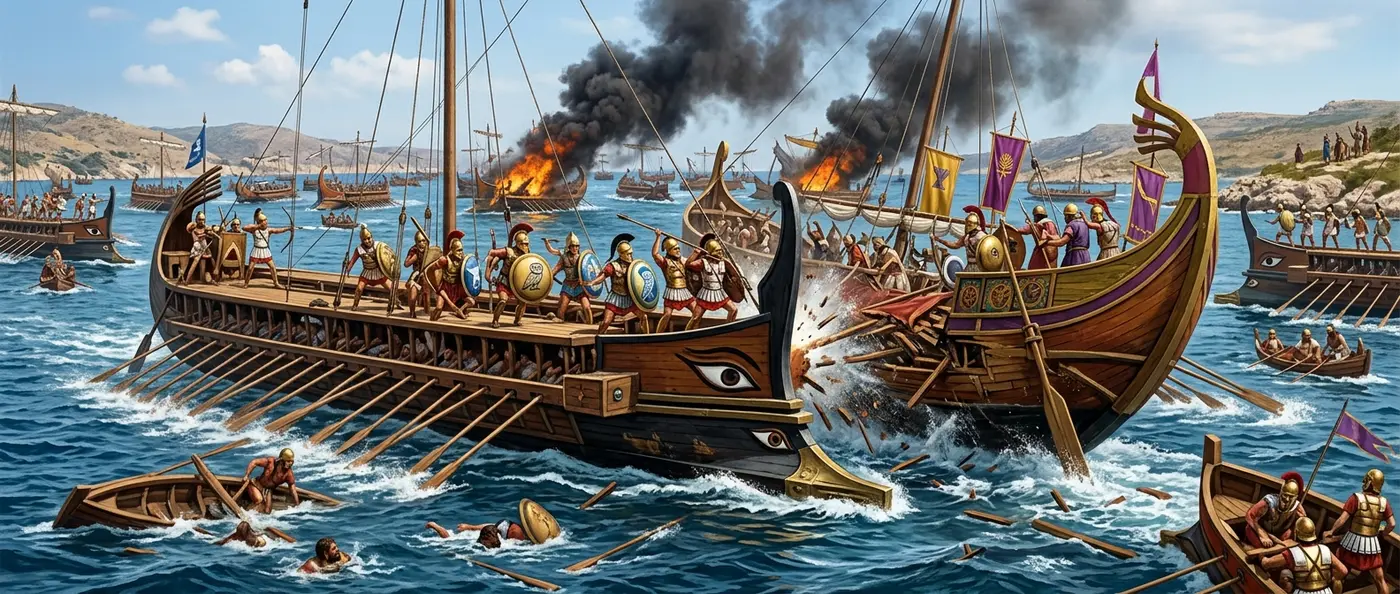
Both sides used triremes — wooden warships of 40-50 tons, up to 40 meters long. Each trireme was powered in battle by 170 oarsmen, arranged in three tiers on each side. Light, aerodynamic vessels — capable of rapid acceleration, braking, zigzagging, and 360-degree turns within just two ship-lengths.
The main strategy was ramming: a bronze ram at the prow designed to pierce enemy ships in the sides or stern — the most vulnerable points. Alternatively, a well-timed pass close to the enemy could break enough oars to immobilize the ship. Crews trained to pull oars inside within seconds — a skill requiring months of practice.
Each Greek trireme carried at least 10 hoplites and 4 archers. The Persians carried more: 14 marines and 30 Medes armed with bows, spears, and swords. This was an advantage in boarding actions — but a disadvantage in narrow waters, where speed mattered more.
💡 The trireme's weakness
Triremes could only operate effectively in relatively calm waters, with waves under 1 meter — otherwise water entered through the oar ports. Each night they were hauled ashore, as their light wood absorbed water and became heavy. There was no space for supplies or sleep aboard — crews were forced to disembark every evening.
🧠 Themistocles' Stratagem
The official commander was the Spartan Eurybiades — a strange choice, given that Athens contributed the most ships. In practice, tactics were decided by a council of 17 generals. The dominant voice belonged to Themistocles — the brilliant Athenian admiral with 20 years of experience, who had just successfully faced the superior Persian fleet at Artemisium.
Themistocles pushed to stay at Salamis rather than retreat to the Isthmus of Corinth. The reason? In the narrow waters, Persian numerical superiority would be neutralized. Their ships couldn't deploy. According to Herodotus and Aeschylus, Themistocles secretly sent messages to Xerxes, implying that the Greek alliance was dissolving and the fleet was preparing to escape. It was a trap.
Xerxes took the bait. He sent the Egyptian fleet to block the straits between Salamis and Megara, while the main fleet moved at night into the narrows. The Persians hoped for surprise — but at such distances, the noise of hundreds of oarsmen was impossible to hide.
🔥 The Hour of Collision
At dawn, Xerxes sat on Mount Aigaleo with his golden throne and scribes recording the battle. Instead of a fleet in flight, he saw the Greeks arrayed in two lines along a 3-kilometer curve — about 130 ships in the front line against 150 Persian, three ships deep.
The Persian fleet advanced. As it aligned with the narrower Greek front, ships became crowded. The Greeks held their positions, drawing enemies into increasingly tight space. And then: ramming. Ships struck ships, oars snapped, wood splintered. In the confined space, after collision, they couldn't disengage — and soldiers on the decks fought as in land battle.
With more Persian ships pressing from behind and Corinthians attacking from the flanks, the situation became chaotic — especially for the Persians. Their ships collided with each other. Their sailors, most of whom couldn't swim, drowned without help. The Greeks, with more maneuvering room, could "pick" targets among the packed enemy vessels.
Battle Tactics
The Greeks used the periplous (encirclement) and diekplous (breakthrough) tactics. Goal: to strike the sides and stern — the most vulnerable points of any trireme.
Artemisia
Artemisia, tyrant of Halicarnassus, led 30 Dorian ships in the Persian fleet. Herodotus reports she sank a friendly ship to escape Greek pursuit — Xerxes commented "My men have become women and my women, men."
Defection
Two Ionian ships defected to the Greeks just before battle. Themistocles had sent messages to the Ionian subjects of Persia, hoping for more defections — but none came.
🏆 The Afternoon of Victory
By afternoon, Greek victory was undeniable. The Persians lost about 300 ships — the Greeks only 40. Surviving Persian vessels retreated to Asia Minor. In the final stage, Greek hoplites were ferried from Salamis to the opposite shore, annihilating Persian land forces.
Xerxes, watching the rout from his throne, decided to leave. He returned to his palace at Susa, leaving the capable general Mardonius to continue. The Persians still held much of Greece and their land army remained intact. But naval defeat forced them to postpone land operations for a full year — a crucial delay.
The Greeks used this time to unite. In August 479 BC, at the Battle of Plataea, the largest hoplite army ever assembled — Spartans, Athenians, Corinthians, Megarians — crushed Mardonius. Xerxes' ambitions in Greece ended permanently.
The sea around Salamis was filled with wreckage and drowned Persians for days after the battle. Herodotus reports that Greeks collected thousands of shields, spears, and helmets from the water. Part of the spoils was dedicated to the gods — particularly Poseidon and Athena. At Delphi, the victorious cities dedicated bronze statues and tripods in thanksgiving.
⚖️ Greek vs Persian Fleet
📚 The Legacy of Salamis
The Battle of Salamis is considered the first major naval battle recorded in history. Had the Persians won, Greek civilization — democracy, philosophy, theater, science — might never have developed as we know it. Pericles' golden age, Aeschylus' dramas (who fought at Salamis himself), Socrates' philosophy — all came after.
Aeschylus himself, eight years later, staged "The Persians" (472 BC) — the oldest surviving Greek drama. It presented the battle through the eyes of the Persian court, with Xerxes' mother Atossa learning news of the disaster. No other ancient theatrical work is based on such recent events — Aeschylus was writing about something he had lived through.
Themistocles, the architect of victory, didn't end well. Athens ostracized him around 471 BC, and he ended up — ironically — in Persia, as a refugee under the protection of Xerxes' successor, Artaxerxes I. He died in Magnesia of Asia Minor around 460 BC, honored by his former enemies.
As Apollo's oracle at Delphi had prophesied: "only a wooden wall will save you." The wooden walls were the triremes. In the narrow waters between Salamis and Attica, a handful of Greek ships resisted an empire stretching from the Danube to the Indus River. Salamis wasn't just a battle — it was the moment Western civilization decided it would exist.