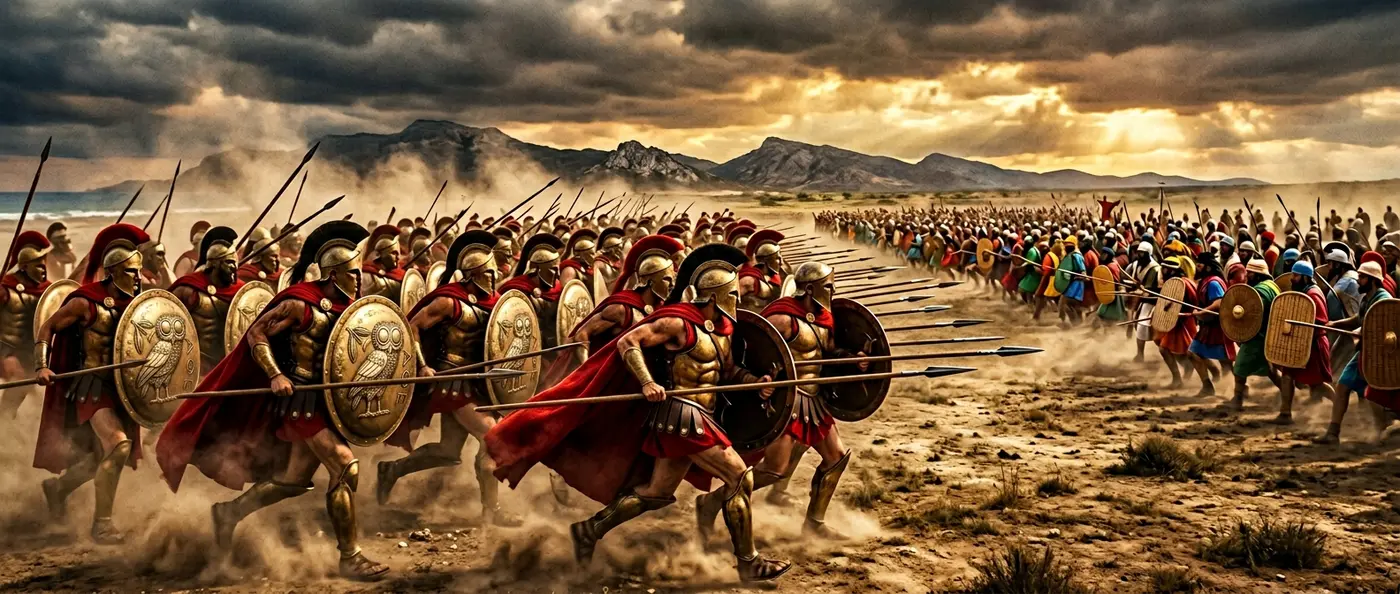
Dawn broke on September 12, 490 BCE, revealing 10,000 Athenian hoplites staring across the Marathon plain at a massive Persian army that had landed on the beach overnight. Facing them: roughly 25,000 Persian warriors ready to crush this small Greek force and march straight to Athens. What happened next wasn't just a military clash — it was the moment that determined the trajectory of Western civilization.
🏛️ The Powder Keg Explodes
Marathon was the climax of decades of mounting tension between the expanding Persian Empire and the Greek city-states. The Ionian Revolt of 499 BCE had lit the fuse — Greek cities in Asia Minor rebelled against Persian rule with backing from Athens and Eretria. That support infuriated King Darius I.
The Persian king swore revenge. After crushing the revolt in 494 BCE, he turned west. His first expedition under Mardonius in 492 BCE failed spectacularly when storms wrecked the fleet near Mount Athos. But Darius wasn't done.
In 490 BCE, a fresh expeditionary force under generals Datis and Artaphernes crossed the Aegean. First target: Eretria on Euboea, which they obliterated completely. Then the Persian fleet sailed for Attica, landing their forces on Marathon's coastal plain — just 26 miles from Athens.
⚔️ David Meets Goliath
The contrast between these armies was stark. The Persian force represented the era's ultimate military machine — lightly armored archers, cavalry, and infantry drawn from across their vast empire. Their tactics relied on arrow barrages to disorganize enemies before the final assault.
The Athenians brought their famous hoplites — heavily armored infantry with shields, spears, and bronze breastplates. The hoplite phalanx — men standing shoulder-to-shoulder in dense ranks — was a tactical innovation that had dominated Greek-on-Greek warfare.
Athens had begged Sparta for help, but the Spartans claimed they couldn't march until their religious festival of Carneia ended. Only tiny Plataea sent 1,000 hoplites to reinforce the Athenians. So roughly 11,000 Greeks faced a force at least twice their size.
🗺️ Miltiades' Masterstroke
Command fell to Miltiades, a veteran general who knew the Persians intimately from his time ruling the Chersonese under Persian overlordship. Miltiades understood that delay favored the Persians — either their cavalry would arrive from the rear, or they'd manage to send forces by sea directly to Athens.
For four days the armies faced each other without fighting. On the fifth morning, Miltiades made his audacious decision to attack. His tactics were revolutionary: instead of advancing at normal pace, he ordered his men to charge the final 200 meters before impact.
Even more innovative was his phalanx formation. Miltiades deliberately weakened his center while strengthening both flanks. When the Persians attacked, the Greek center retreated as planned, but the powerful wings enveloped the attackers from both sides.
The Charge Attack
Athenians sprinted the final 200 meters, minimizing exposure to Persian arrows while maximizing impact force.
The Tactical Formation
The deliberately weak center acted as bait, allowing reinforced flanks to encircle the Persians.
Perfect Timing
The early morning attack caught Persians before they could fully organize and deploy their cavalry.
💀 Collision and Collapse
When the armies clashed, the result was brutal and decisive. The Persians, accustomed to fighting at range with bows, found themselves facing the crushing power of the Greek phalanx. The hoplites' long spears and heavy shields proved superior to Persian light equipment in hand-to-hand combat.
As the Greek center retreated according to plan, the Persians thought they were winning and pushed deeper. This was exactly what Miltiades expected. The two strong Greek flanks, having shattered their opponents, wheeled inward and struck the Persians from both sides.
The Persian line collapsed. What began as organized retreat quickly became panicked flight toward the ships. The Greeks pursued the fleeing enemy to the beach, where fighting continued around the Persian vessels. There fell the war-archon Callimachus and Cynegirus, brother of the tragic poet Aeschylus, who according to tradition died trying to hold back a Persian ship with his bare hands.
🏃 Pheidippides' Run
After the victory, the messenger Pheidippides ran the 26 miles to Athens to announce the triumph. Legend says he arrived, shouted "Nenikekamen!" (We have won!), and collapsed dead from exhaustion. This heroic run inspired the modern marathon race.
📊 The Butcher's Bill
The numbers tell the story. According to Herodotus, the Persians lost 6,400 men while the Athenians lost just 192. These 192 heroes were buried on the battlefield beneath a mound that still stands today as a monument to their sacrifice. The Plataeans, who lost 11 men, buried their dead in a separate mound.
Victory didn't end the danger. The Persians boarded their ships and sailed for Phalerum, hoping to reach Athens before the army returned. But Miltiades reacted with lightning speed. He ordered his exhausted men to march immediately toward the city. When the Persian fleet reached Phalerum and saw the Athenian army waiting on the shore, the Persians abandoned all hope and sailed back to Asia.
⚔️ Casualty Comparison
🌟 The Shockwave Through History
Marathon's victory rippled far beyond its military significance. For the first time, a small Greek force had defeated the seemingly invincible Persian army. This gave Greeks the confidence that they could resist Persian expansion.
For Athens, Marathon launched its golden age. The city that had saved Greece gained enormous prestige. This confidence fueled the development of democracy, philosophy, theater, and arts that characterized the 5th century BCE. Without Marathon, the Parthenon might never have been built, and Socrates, Plato, and Aristotle might never have had the chance to teach.
The battle also became symbolic. It proved that free citizens fighting for their homeland could defeat the subjects of an empire. This idea shaped Western thought for centuries.
🏛️ Marathon's Enduring Legacy
Marathon became more than a military victory — it defined a civilization. The Athenians honored their dead with monuments and annual ceremonies. Aeschylus, who fought in the battle, was so proud of his participation that his epitaph mentioned not his theatrical works but only that he fought at Marathon.
The battle inspired countless works of art and literature. From the Athenian agora to modern museums, Marathon represents the triumph of free citizens over empire.
Today, marathon races held worldwide keep the battle's memory alive. Every runner covering 26.2 miles symbolically repeats Pheidippides' feat, connecting the present with that historic moment 2,500 years ago.
The Battle of Marathon remains instructive. It reminds us that history can turn on a single day, that strategy and courage can overcome numerical superiority, and that defending freedom can inspire superhuman achievements. On Marathon's plains, 10,000 Greeks saved more than Athens — they saved the idea that free cities could stand against empires.