📐 The Mistake That Exposed a Mathematical Revolution
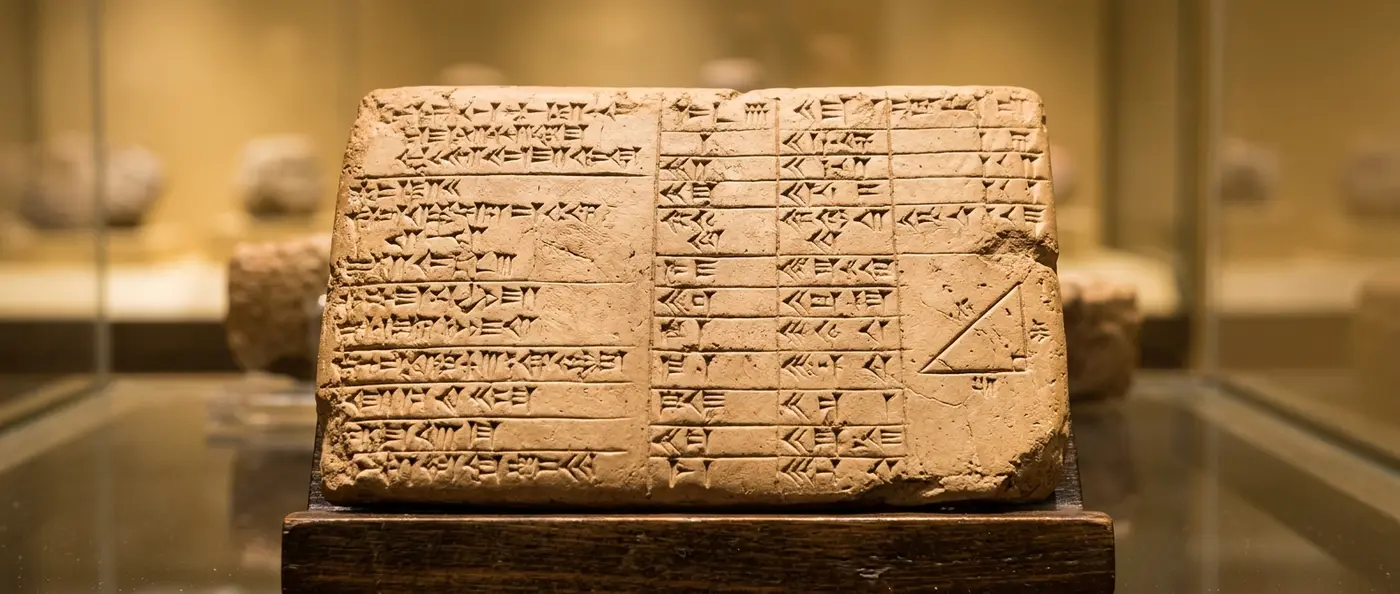
Oxford's Ashmolean Museum houses a round clay tablet just 8.2 centimeters across. Etched in cuneiform script, an unknown Babylonian student attempted to calculate the area of a right triangle. He wrote 3.75 for the height and 1.875 for the base. The correct answer should have been 3.5156, but the student miscalculated and got 3.1468.
This mistake, preserved for nearly 4,000 years, reveals something groundbreaking. Babylonians didn't just know triangle geometry — they understood and applied what we now call the Pythagorean theorem, the relationship between the sides of a right triangle, more than a millennium before the Greek philosopher Pythagoras became famous for it.
Archaeologists discovered the tablet in 1931 at the Kish site, alongside two dozen similar student "homework" pieces. Dating between 1900 and 1600 BCE, during the Old Babylonian period, these tablets emerged when Mesopotamia's great empires were expanding and complex mathematics became essential for administration and engineering.
🏛️ From Sumer to Babylon: The Birth of Mathematics
Babylonian mathematics traces back much earlier, around 3000 BCE in Sumer. As the first city-states grew, complex calculations became necessary. Administrators needed to calculate taxes, record trade transactions, measure land areas, and create agricultural calendars.
Sumerians developed the first known writing system — cuneiform — and alongside it, a sophisticated mathematical framework. When Babylonians dominated Mesopotamia, they inherited and evolved this mathematical tradition, creating one of the ancient world's most advanced mathematical systems.
Kish and Babylon became centers of mathematical education. In specialized schools called "edubba" (tablet houses), young scribes learned not just writing but calculation. Clay tablets found in these areas show that education included algebra, geometry, and astronomy.
🔢 The Sexagesimal System: A Legacy That Lives On
The Babylonians' greatest achievement was the sexagesimal number system — based on 60 instead of our base-10 system. This might sound strange, but we use it daily without realizing it.
Every time we check a clock and see 60 seconds in a minute or 60 minutes in an hour, we're using the Babylonian system. Same when measuring angles — a circle has 360 degrees (6 × 60). This choice wasn't random. The number 60 divides evenly by many numbers (1, 2, 3, 4, 5, 6, 10, 12, 15, 20, 30, 60), making calculations easier in an age without calculators.
Babylonian mathematicians created tables for multiplication, division, squares, and cubes. Some tables were so accurate they could be used today. They also developed methods for solving quadratic and cubic equations — achievements Europe wouldn't match for millennia.
Time & Angles
60 seconds, 60 minutes, 360 degrees — all stem from the Babylonian sexagesimal system we still use today.
Mathematical Tables
They created detailed multiplication, square, and cube tables with remarkable accuracy for their era.
Advanced Algebra
Solved quadratic and cubic equations — an achievement Europe wouldn't reach for millennia.
📜 Plimpton 322: Pythagorean Before Pythagoras
The most famous proof that Babylonians knew the Pythagorean theorem is the Plimpton 322 tablet, dating around 1800 BCE. This tablet contains a table with 15 rows of numbers representing Pythagorean triples — sets of three integers satisfying the relationship a² + b² = c².
For example, the triple (3, 4, 5) is Pythagorean because 3² + 4² = 9 + 16 = 25 = 5². Plimpton 322 contains much larger, more complex triples like (119, 120, 169) and (3367, 3456, 4825). What stands out is that these triples aren't random — they appear systematically chosen, indicating deep understanding of the underlying mathematical theory.
Researchers believe the tablet served educational purposes or as a tool for solving practical architectural and engineering problems. Its existence proves Babylonians not only knew the theorem but used it systematically in their calculations.
💡 Why "Pythagorean"?
The theorem bears the Greek philosopher Pythagoras's name (570-495 BCE) because his school was first to formally prove it using geometric methods. Babylonians knew and used it but left no written proofs — only practical applications.
⚡ From Theory to Practice: Everyday Applications
Babylonian mathematics wasn't just theoretical exercise. It had immediate applications in imperial daily life. Engineers used geometric calculations to build irrigation canals, construct temples and palaces, and lay out roads. Merchants needed them to calculate interest, profits, and losses.
A common problem was calculating areas of irregularly shaped fields. They divided the field into triangles and quadrilaterals, calculated each area, and added them together. This required precise knowledge of triangle geometry, including how to calculate their sides.
Astronomer-priests used complex calculations to predict eclipses, track planetary movements, and create accurate calendars. Their prediction accuracy was so great they could calculate the year's length with an error of just minutes.
📚 The Educational Revolution: From Memory to Writing
The small tablet with the student's mistake from Kish represents something far greater than a simple miscalculation. It marks a fundamental shift in how humans transmitted knowledge. For the first time in history, education didn't rely solely on oral tradition and memorization.
This transition, beginning around 3500 BCE in Kish, was as revolutionary as the shift from paper to digital media in the 20th century. Students could now practice, make mistakes, correct them, and learn at their own pace. Teachers could create standardized lessons and exercises.
Many discovered tablets have the teacher's problem on one side and the student's solution attempt on the other. We see corrections, erasures, rewrites — all elements of a living educational process that mirrors today's learning.
📊 Babylonian vs Greek Mathematics
🌟 Babylonian Legacy in Modern Mathematics
Babylonian mathematical influence extends far beyond the sexagesimal system. Their equation-solving methods influenced medieval Arab mathematicians, who transmitted this knowledge to Europe. The word "algebra" comes from Arabic, but many techniques it describes trace back to ancient Babylon.
Remarkably, in 2024, two Louisiana high school students, Ne'Kiya Jackson and Calcea Johnson, achieved something thought impossible: they proved the Pythagorean theorem using trigonometry without circular reasoning. They subsequently discovered nine more proofs, showing that even today, 4,000 years after the Babylonians, the theorem continues inspiring new discoveries.
The practical needs along the Tigris and Euphrates rivers — measuring fields, constructing buildings, calculating taxes — became the foundation of modern mathematics. Every time an architect designs a building, an engineer calculates forces, or a programmer creates computer graphics, they use principles first discovered by the Babylonians.
🔮 The Lesson from an Ancient Mistake
The small clay tablet with the unknown student's error teaches us something deeper than mathematics. It shows that human curiosity and the desire to learn are timeless. The student who made this mistake 4,000 years ago isn't different from today's students struggling with geometry.
It also reminds us that great discoveries rarely happen in isolation. Babylonians built on Sumerian knowledge, Greeks on Babylonian knowledge, Arabs on Greek knowledge, and so forth. Knowledge is a chain connecting all civilizations and all ages.
Next time you use the Pythagorean theorem or check your watch, remember the unknown mathematicians of Babylon. Without them, our world would be vastly different. And perhaps, as Jackson and Johnson proved, even the oldest mathematical theorems hide new secrets waiting to be discovered.