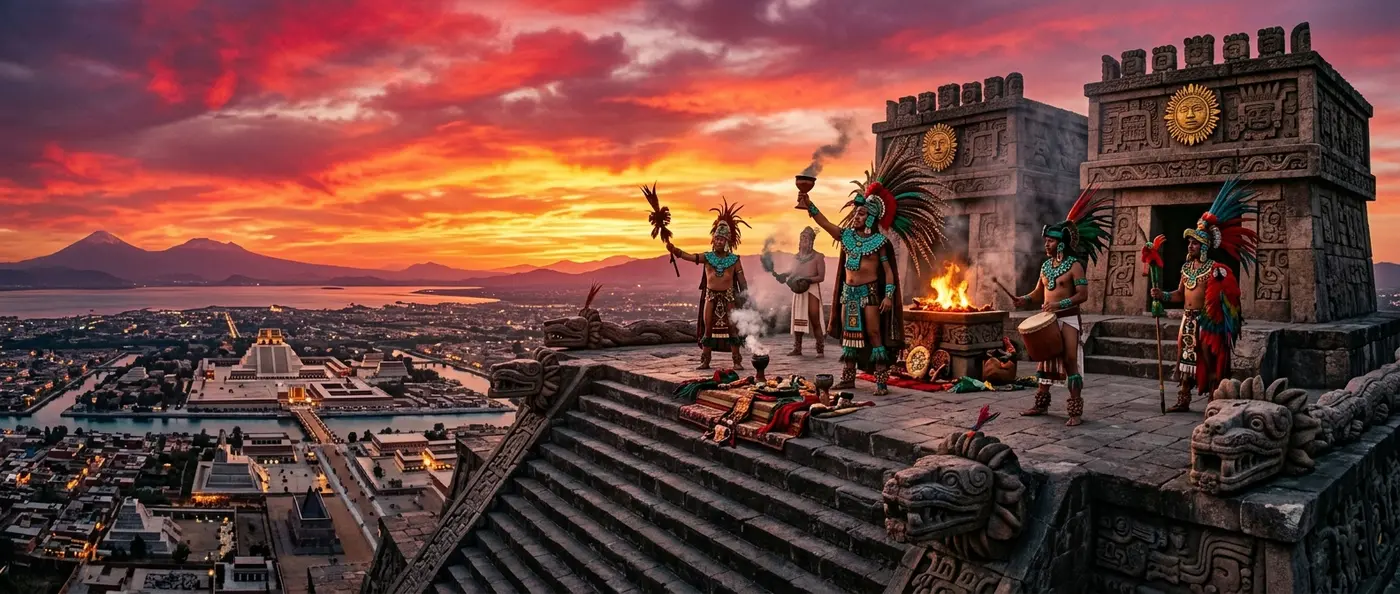
Four priests held the victim down on the stone altar. The high priest raised his obsidian blade. Then came the sound—a piercing shriek from a skull-shaped whistle that made the blood freeze. Five hundred years ago in Mexico, thousands climbed pyramid steps to feed their lives to the gods. The Aztecs believed without human blood, the sun wouldn't rise tomorrow and the world would collapse into darkness.
🔱 The Cosmology of Blood
Aztec religion rested on a complex cosmology that demanded constant feeding of the gods with human blood. They believed the world had been destroyed four times before and now existed in the fifth age—the Sun of Fire.
Huitzilopochtli, the god of war and sun, was the central deity requiring daily nourishment with human hearts. The Aztecs called themselves "people of the sun" and considered it their sacred duty to provide the god with tlaxcaltiliztli—the daily food of blood and hearts.
Warriors who died in battle or as sacrifices became quauhteca ("the eagle people") and accompanied the sun on its journey across the sky. After four years, they returned to earth as hummingbirds, Huitzilopochtli's sacred bird.
💀 The Whistles of Death
Recent archaeological discoveries reveal new aspects of sacrifice rituals. Research published in Communications Psychology in November 2024 shows Aztecs used special skull-shaped ceramic whistles during human sacrifices.
Sascha Frühholz, a neuroscientist at the University of Zurich, and his team studied these "death whistles" measuring just 3-5 centimeters long. When blown forcefully, they produced a piercing, terrifying sound resembling a scream. Brain scans of 70 modern listeners showed the sound activated brain regions linked to emotional responses and fear.
Archaeologists found these whistles clutched in the hands of sacrifice victims buried at Tlatelolco, near the capital Tenochtitlán. They likely represented Mictlantecuhtli, lord of the underworld, and prepared victims for their journey to Mictlan, the realm of the dead.
⚔️ The Ritual of Sacrifice
Aztec human sacrifices followed specific ritual protocols that varied depending on the god being honored. The most common method was extracting the heart while the victim was still alive.
The victim was led to the pyramid's summit where four priests held them down on a stone slab. The high priest, dressed in the god's sacred garments, used a ritual obsidian knife to open the chest and remove the heart. The still-beating heart was offered to the sun and then burned in the quauhxicalli ("eagle vessel").
🏺 The Sacred Calendar
The 15th month of the ritual year, Panquetzaliztli ("Festival of Precious Feather Banners"), was dedicated to Huitzilopochtli. During this month, warriors and priestesses danced nightly in the plaza before the god's temple, while war captives bathed in a sacred spring before being sacrificed.
🏛️ The Great Temples of Sacrifice
The Templo Mayor in Tenochtitlán was the center of sacrifice rituals. The massive pyramid with twin temples at its summit—one dedicated to Huitzilopochtli and one to Tlaloc, the rain god—dominated the capital's center.
In 1487, during the dedication of the renovated pyramid by Emperor Ahuitzotl, thousands of captives were sacrificed in a ceremony lasting four days. Spanish conquistadors who arrived later described with horror the temple walls covered in dried blood.
Coatepec
The mythical mountain where Huitzilopochtli was born, symbolically represented by the Templo Mayor. Here the god killed his 400 siblings and his sister Coyolxauhqui.
Hummingbird
Huitzilopochtli's sacred bird. Dead warriors were believed to reincarnate as hummingbirds after four years in the sky.
Xiuh Cóatl
The "turquoise serpent," Huitzilopochtli's mythical weapon with which he defeated his enemies at birth.
🌅 The Four Lost Suns
Aztec mythology described four previous ages that had been destroyed. The first, the Sun of Water, was destroyed by flood. The second, the Sun of Earth, by earthquake. The third, the Sun of Wind, was destroyed by a giant hurricane, with only Quetzalcóatl surviving.
This cyclical understanding of destruction and rebirth permeated all Aztec thought. The world was unstable, constantly threatened by chaos. Only continuous blood offerings to the gods could maintain order and prevent final destruction.
Even the creation of the sun and moon required sacrifice. At Teotihuacán, the gods gathered in darkness and lit a massive fire. Two of them, Nanahuatzin and Tecciztécatl, threw themselves into the flames, becoming the sun and moon respectively. But the sun refused to move until all the other gods offered their blood.
👑 The Priestly Order
The Aztec priesthood controlled every aspect of ritual death. Each temple and god had its own priestly hierarchy. In Tenochtitlán, the high priests of Tlaloc and Huitzilopochtli led the entire priestly organization.
Priests trained in the calmecac, special schools where sons of nobles and certain commoners learned rituals, astrology, and temple land management. The high priest of Huitzilopochtli, known as Quetzalcóatl Totec Tlamacazqui ("Feathered Serpent, Priest of Our Lord"), was one of the empire's most powerful figures.
🗿 The Journey to the Underworld
The Aztecs believed in different afterlife destinations depending on how one died. Those who drowned, were struck by lightning, or died from water-related diseases went to Tlaloc's paradise. Warriors and women who died in childbirth ascended to the heavens as companions of the sun.
Everyone else descended to Mictlan, the realm of the dead beneath the northern deserts. There they traveled for four years until reaching the ninth hell, where they disappeared forever. Offerings were made to the dead 80 days after burial and then annually for four years.
💀 Afterlife Destinations
🌄 The Legacy of Blood
Aztec human sacrifices remain one of the most controversial elements of their civilization. For them, these rituals were essential for maintaining cosmic order. Without constant feeding of the gods with blood, the sun would stop rising and the world would plunge into eternal darkness.
This pessimistic worldview coexisted with the stunning dynamism of Aztec culture. In less than two centuries, the Aztecs created one of the largest empires in pre-Columbian America, with sophisticated architecture, art, and social organization.
Today, archaeologists continue discovering new evidence about Aztec sacrifice practices. Each new find, from death whistles to mass graves, adds another piece to the puzzle of this complex civilization that lived and died believing their blood kept the world alive.