🌏 The World's Oldest Living Cultural Continuum
Australia's Aboriginal people represent something unique in human history. While other ancient civilizations flourished and vanished, Australia's first inhabitants maintained their traditions uninterrupted for at least 65 millennia. Recent excavations at Western Australia's Juukan Gorge revealed evidence of habitation dating back 47,000 years, while Cloggs Cave in southern Australia concealed 12,000-year-old ritual objects.
These discoveries do more than date ancient occupation. At Cloggs Cave, researchers found two small fire hearths with lightly charred wooden sticks protruding from them. Chemical analysis revealed traces of animal or human fat on the sticks — evidence that perfectly matches rituals recorded by anthropologists in the late 19th century among the Gunaikurnai, an indigenous group from the southern coast.
This stunning connection between archaeological findings and living traditions shows how cultural knowledge successfully transmitted across more than 500 generations, from the end of the last ice age to today.
🗿 Juukan Gorge: A Window into Deep Time
Western Australia's Juukan Gorge in the Pilbara region housed an archaeological treasure of global significance. The Juukan 2 rock shelter, excavated in 2014, revealed thousands of significant artifacts dating back 47,000 years. Among the finds was a 3,000-year-old ancient braid of human hair whose DNA analysis showed it related to today's traditional land owners.
Perhaps the most striking discovery was a bone tool made from a kangaroo shin bone, roughly 30,000 years old, with ochre on its tip. The presence of ochre suggests possible ritual use, offering a rare glimpse into the spiritual practices of ice age humans.
Tragically, in May 2020, Juukan 2 was destroyed during an iron ore mine expansion. Although Rio Tinto had legal permission, the destruction sparked global outrage and highlighted inadequate cultural heritage protections in Australia.
🔥 Ancient Rituals That Survive
At Cloggs Cave, archaeologists matched physical evidence with indigenous oral history. The two ritual sticks, made from Casuarina wood (Australian pine), had been carefully processed to become exceptionally smooth. Radiocarbon dating showed one was between 11,930 and 12,440 years old, while the other was between 10,870 and 11,210 years old — the oldest wooden objects ever found in Australia.
The cave was never used as a general campsite. Instead, it served exclusively for special ritual purposes for roughly 25,000 years, from 25,000 years ago until at least 1,600 years ago. This long-term, specialized use underscores the site's profound spiritual significance.
Gunaikurnai elders recognized similarities between the ancient findings and their own traditional practices, leading to a groundbreaking collaboration between scientists and indigenous communities. The collaboration confirmed that ritual practices survived unchanged for millennia.
Oral Tradition
Aboriginal stories contain precise descriptions of geological events that occurred thousands of years ago, including sea level rises and volcanic eruptions.
Rock Art
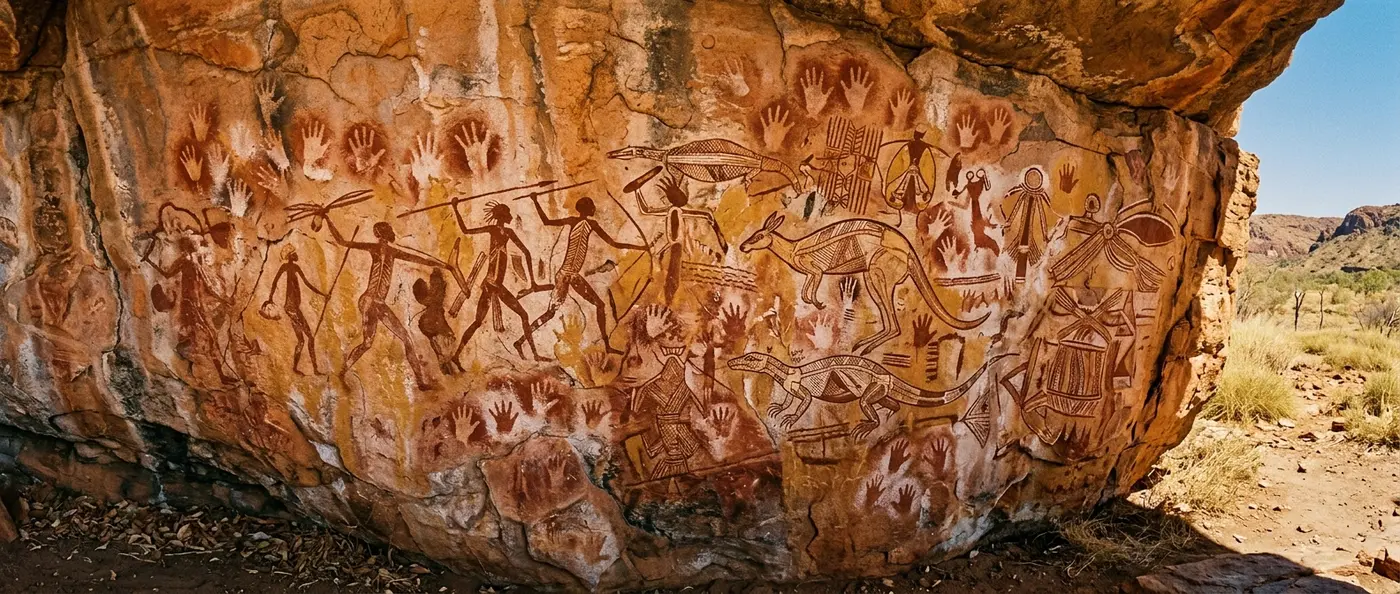
Australia hosts some of the world's oldest rock art, with depictions dating back at least 28,000 years.
Genetic Continuity
DNA from ancient finds, like the hair braid at Juukan, confirms genetic connections to today's Aboriginal people.
🌾 Innovations in Sustainable Management
Aboriginal people weren't simply hunter-gatherers, as colonizers long believed. At Budj Bim Cultural Landscape, added to UNESCO's World Heritage list in 2019, sits one of the world's oldest aquaculture systems. The eel management system, dating back 6,600 years, demonstrates advanced engineering knowledge and sustainable agriculture.
According to Braydon Saunders, visitor guardian at Budj Bim, the system wasn't just traps but genuine farming. The Gunditjmara manipulated water movement to control where eels and fish lived, moving them according to weather conditions. The system allowed eels to continue their natural life cycle, swimming to tropical waters around New Guinea to spawn.
Around the traps, archaeologists discovered charred, hollow trees used for smoking surplus eels, along with foundations of hundreds of stone huts. Radiocarbon dating showed aquatic plant species were introduced to the environment about 8,000 years ago, proving deliberate landscape management.
💡 Myth Debunked
The colonial belief that all Aboriginal people were nomadic hunter-gatherers has been definitively disproven. Archaeological evidence shows permanent settlements, advanced agriculture, and complex resource management systems dating back thousands of years.
🏛️ Cultural Heritage Under Threat
The destruction of Juukan Gorge highlighted an urgent issue: inadequate protection of indigenous sacred sites in Australia. Despite Rio Tinto's legal permission, the action was against the wishes of traditional owners and sparked international condemnation. The incident led to a review of heritage protection legislation in Western Australia.
After the destruction, archaeologists began re-excavating the site. Over the past two years, they removed roughly 150 cubic meters of debris that was once the cave's roof and back wall. Beneath the rubble, they found traces of organic material and remnants of the cave floor, including more braided hair, shell beads believed transported from the coast, and fragments from a Tasmanian devil's jaw — an animal that vanished from mainland Australia over 3,000 years ago.
🔬 Science and Tradition in Dialogue
Modern archaeological research in Australia increasingly adopts a collaborative approach combining scientific techniques with traditional indigenous knowledge. As Bruno David, an archaeologist at Monash University, noted, "science can only tell you so much. Incorporating traditional cultural knowledge provides the opportunity to tell a broader story about the Old People and the cultural landscape they lived in."
The combined approach reveals new details. At Tower Hill, a dormant volcanic crater believed to have erupted about 34,000 years ago, radiocarbon dating suggests the Gunditjmara lived in the area at the time of the eruption. Guides at Worn Gundidj at Tower Hill refer to the landscape as a "living supermarket," showing how plants continue to be used for food, fiber, and medicine.
In Melbourne, the Yarra River — known as Birrarung in local languages — remains a significant cultural space for the Woiwurrung and Boonwurrung. According to Christopher Jakobi, indigenous programs coordinator at Royal Botanic Gardens Melbourne, the area was once a place where thousands of people gathered for ceremonies, trade, and interstate affairs.
⚖️ Ancient Civilizations Compared
🎨 Living Heritage Today
Aboriginal cultural heritage survives colonization and urban development. At Melbourne's Koorie Heritage Trust, Rob Hyatt observes that visitors are often surprised to discover Melbourne has rich indigenous history and that the culture is still alive in the area.
Contemporary artists and chefs like Nornie Bero from Mer Island in the Torres Strait continue sharing their heritage. At her Big Esso restaurant, she serves dishes representing her heritage, using traditional ingredients like yam, saltbush, wattle seeds, and local fish.
However, colonization left deep scars. As Gunaikurnai elder Russell Mullett noted, much knowledge was lost during the mission station era, where "the cutting off of cultural knowledge was happening." Without 19th-century ethnographers who recorded certain practices, this knowledge might not have been transmitted.
Today, recognizing and protecting Aboriginal cultural heritage is a critical issue. The addition of Budj Bim to UNESCO's World Heritage list and increasing collaboration between scientists and indigenous communities shows positive direction. Simultaneously, incidents like Juukan Gorge's destruction remind us there's still a long way to go.
Australia's Aboriginal people teach us something fundamental about human capacity for preserving and transmitting knowledge. In a rapidly changing world, their 65,000-year history stands as proof of tradition's power, adaptation, and deep connection to the land. As we continue discovering and understanding this ancient heritage, it becomes clear we have much to learn from the world's oldest continuous civilization.