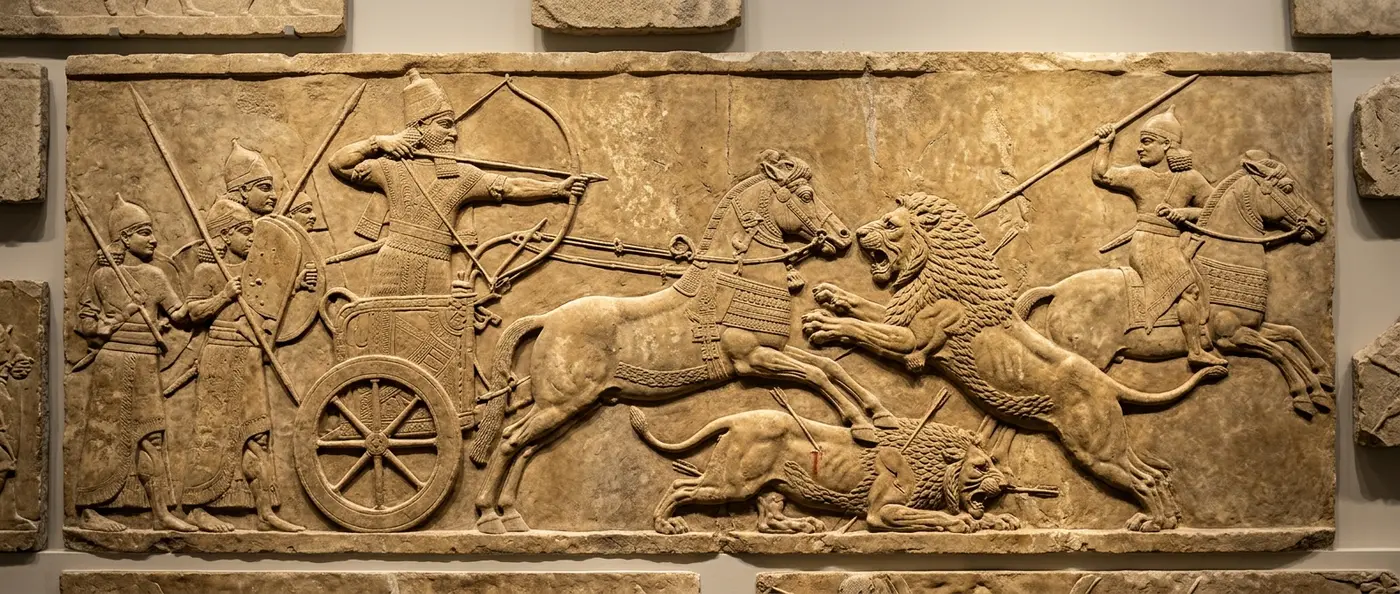
Thousands of visitors walk past them daily in the British Museum's halls. Massive stone slabs tower overhead, carved with scenes of shocking brutality. Lions tear apart prisoners. Soldiers behead enemies. Kings obliterate entire cities. These aren't random acts of violence—they're carefully choreographed propaganda pieces that once lined the palaces of ancient Assyria, documenting with surgical precision the cold reality of imperial dominance.
🏛️ The Assyrian Empire and the Art of Power
The Assyrian Empire dominated Mesopotamia from the 14th to 7th centuries BCE, becoming one of the ancient world's most powerful and expansionist forces. With capitals at Nineveh, Kalhu (modern Nimrud), and Dur-Sharrukin (modern Khorsabad), the Assyrians built a massive state stretching from Iran to Egypt.
Every relief functioned as a visual manifesto of imperial might, warning visitors and ambassadors about the fate awaiting those who dared resist. Each scene was meticulously designed to inspire awe and fear.
The artists who created these works were specialized craftsmen operating under direct palace supervision. They used limestone and alabaster—materials that allowed detailed rendering of complex scenes. Their technique was so advanced we can still distinguish individual muscle fibers on warriors' bodies and fabric folds in their garments.
⚔️ War Scenes and Conquest
The most striking Assyrian reliefs depict military campaigns. We see city sieges with detailed illustrations of siege engines, battering rams, and mobile towers. The artists didn't shy away from war's brutality: prisoners led in chains, enemies impaled on stakes, heads stacked in pyramids.
During the siege of Lachish in 701 BCE, Sennacherib recorded every phase of the destruction. In a relief series spanning dozens of meters, we witness the entire siege progression: from the Assyrian army's arrival through the city's final destruction and its inhabitants' deportation. Every detail is rendered with surgical precision.
The cold, almost bureaucratic documentation of violence makes them even more terrifying. There's no passion or rage in these depictions. Destruction is presented as an organized, methodical process. Even the most horrific scenes are rendered with the same attention to detail characterizing hunting scenes or ceremonial processions.
🦁 The Royal Lion Hunt
Beyond war scenes, Assyrian reliefs immortalized royal lion hunts. These depictions carried deep symbolic meaning. Lions represented the forces of chaos threatening state order, and the king, by killing them, confirmed his role as civilization's protector.
Ashurbanipal's reliefs (668-627 BCE) from Nineveh represent this art's pinnacle. We see the king hunting from his chariot, fighting lions hand-to-hand, killing them with spear or bow. The animals are rendered with stunning realism. We can see muscles tensing, manes flowing, even anguish in dying lions' eyes.
One of the most moving scenes shows a lioness struck by arrows, dragging her paralyzed hind legs while still trying to attack. The moment's tragedy is rendered with such power it transcends the work's original propagandistic purpose.
Construction Technique
Craftsmen used bronze and iron tools to carve the soft limestone. Work was done on-site, after placing slabs on walls.
Coloring
Originally the reliefs were polychrome. Traces of red, blue, and black paint have been found on certain pieces, indicating a much more vivid appearance.
Scale
Some reliefs reached 10 feet high and extended dozens of meters along walls, creating a continuous visual narrative.
📜 The Language of Propaganda
Assyrian reliefs weren't just art for art's sake. They constituted a sophisticated visual communication system transmitting specific messages. Every element had meaning: figure sizes indicated hierarchy (the king always largest), their position in the composition their power, gestures and poses their relationship to the monarch.
Inscriptions accompanying the reliefs reinforced the visual message. Written in cuneiform script, they described the king's victories in detail—the number of enemy dead, the spoils acquired. The language was standardized but impressive, filled with epithets magnifying the monarch's glory while diminishing his enemies.
This system influenced all subsequent civilizations. Persians, Greeks, and Romans adopted similar visual narrative techniques to project their own power. Even today, we can see echoes of this tradition in monuments and museums celebrating military victories.
🔍 Did You Know?
Assyrian reliefs were so massive and heavy that when British archaeologist Austen Henry Layard discovered them in the 19th century, he had to construct special vehicles and use hundreds of workers to transport them to London. Some weighed over 30 tons!
🏺 Daily Life in the Reliefs
Despite their emphasis on violence and conquest, Assyrian reliefs give us valuable information about daily life. We see scenes from royal banquets, religious ceremonies, palace and temple construction. Details of clothing, jewelry, furniture, and architectural elements help us reconstruct the period's material culture.
Particularly interesting are depictions of foreign peoples bringing tribute. We see Egyptians, Phoenicians, Hebrews, Medes, and others parading before the Assyrian king with their characteristic clothing and gifts. These scenes are valuable sources for studying the period's dress and cultural exchanges.
The reliefs also depict Assyrian technological progress. We see advanced siege engines, irrigation systems, bridges, and ships. Their detailed rendering allows historians to understand how these constructions functioned and how they contributed to the empire's expansion and maintenance.
🗿 The Reliefs' Legacy
The Assyrian Empire's fall in 612 BCE marked the end of this artistic tradition. Palaces were destroyed, many reliefs buried under ruins. For over two millennia they remained hidden, until 19th-century excavations brought them back to light.
Today, Assyrian reliefs are scattered in museums worldwide. The largest collections are housed in the British Museum, the Louvre, New York's Metropolitan Museum, and Berlin's Pergamon Museum. Unfortunately, many that remained in Iraq were destroyed or looted during recent conflicts.
New technologies reveal hidden aspects of the reliefs. Modern techniques like 3D scanning and digital analysis reveal details invisible to the naked eye. Researchers discover new elements about construction techniques, colors used, even the identity of artists who created them.
⚖️ Comparison with Other Ancient Arts
💭 Modern Interpretations and Dilemmas
Studying Assyrian reliefs raises a dilemma: how do we approach art that glorifies oppression? How should we approach works created to celebrate oppression and terror? Can we appreciate their artistic value without legitimizing their message?
Modern museum curators face the dilemma of how to present these works. On one hand, they're ancient art masterpieces deserving preservation and study. On the other, they depict scenes of extreme violence in ways that could be considered offensive or traumatic for certain viewers.
There's also the issue of provenance and repatriation. Many reliefs in Western museums were removed from Iraq during the colonial period. The modern Iraqi state has requested their return, arguing they constitute an inseparable part of its cultural heritage.
Despite these dilemmas, the significance of Assyrian reliefs remains undisputed. They reveal a civilization that dominated Mesopotamia for centuries. Through them, we can understand not only the period's art and technology, but also the values, beliefs, and perceptions of a people who, despite their harshness, created works of timeless beauty.
In the triumph scenes covering the British Museum's walls, every detail—from impaled bodies to pyramids of heads—reminds us that behind every masterpiece lies human suffering.