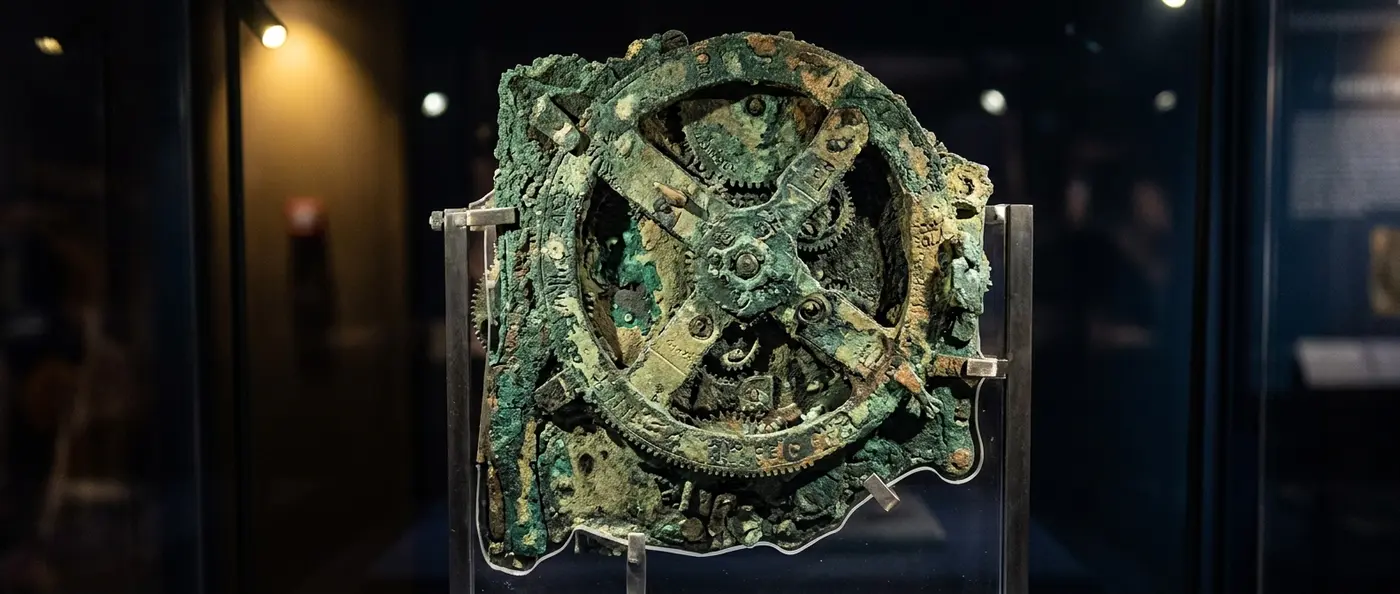
A corroded lump of bronze, nearly tossed back into the sea as worthless junk, turned out to be humanity's first analog computer. The Antikythera Mechanism, built between 205 and 60 BC according to current estimates, could predict the positions of the Sun, Moon, and five planets, solar and lunar eclipses, lunar phases, and even the four-year cycle of the Panhellenic and Olympic Games. With 69 bronze gears so tiny their teeth measured about one millimeter each, this shoebox-sized device overturned assumptions about ancient Greek engineering.
🏛️ The Discovery: Sponge Divers and Shipwreck
In 1900, Captain Dimitrios Kondos from Symi and his crew of sponge divers discovered an ancient shipwreck at 45 meters depth near the island of Antikythera. A diver surfaced clutching the bronze arm of an ancient statue — and the Greek Navy was immediately called by the Greek government to assist in recovering the antiquities. The ship, dated around 70-60 BC, was loaded with amphorae from Rhodes and Kos, marble statues carved from Parian marble, glass from Syria and Egypt, and coins from Pergamon and Ephesus. Among these treasures lay a misshapen lump of metal and wood, about the size of a shoebox, that nobody understood.
According to an early anecdote — possibly inaccurate but telling — the lump was so unremarkable in appearance that it nearly got thrown back into the sea as rusted garbage. Instead it was transported with the other finds to the National Archaeological Museum in Athens, where it was catalogued as "a plaque with inscription, whose letters could not be copied." There it sat in storage, forgotten among statues and amphorae, until May 18, 1902, when archaeologist Valerios Stais noticed interlocking bronze gears through the thick layer of corrosion: interlocking bronze gears and Greek letters carved into the metal. Within days, news spread that a "significant discovery" had been made at the museum — but despite the initial excitement, nobody yet knew what exactly the mysterious device was or what purpose lay behind the microscopic gears. It was recognized as some type of calculating machine only in 1905, but real understanding began only in the late 20th century, when modern imaging technology allowed access to its interior.
⚙️ How It Worked: The First Analog Computer
The Mechanism was built from thin bronze sheets and originally measured about 34 centimeters tall — housed inside a wooden box with a crank handle permanently attached to the side. Turning this crank activated an extraordinarily complex chain of interlocking gears that calculated astronomical phenomena with breathtaking precision. Each full rotation of the central gear corresponded exactly to one solar year. On the front plate, a large dial with pointers represented the positions of the Sun and Moon in the zodiac, while a half-silvered small sphere showed lunar phases — full moon, new moon, quarters.
The back held even more intricate mechanisms. The large upper dial consisted of a five-turn spiral groove with a movable pointer, showing the 235 synodic months of the Metonic cycle — a period of almost exactly 19 years, already known from Babylonian sources, vital for calendar regulation. An additional four-year dial showed when the Panhellenic Games would take place, including the ancient Olympics. The lower dial, with a four-turn spiral groove, predicted solar and lunar eclipses based on the 18.2-year Saros cycle — an astronomical cycle that the Babylonians had recorded many centuries earlier.
The Antikythera Mechanism is considered the first analog computer because it processed continuously changing data through mechanical gears — exactly the definition of analog computation. The user input a date by turning the crank, and the mechanism output results: planetary positions, eclipses, moon phases. The gear teeth, about one millimeter each, represent unthinkable precision for the ancient world. No similar system appeared again until the mechanical clocks of medieval cathedrals, over a thousand years later.